Page loaded successfully. Showing biography for Louai Kayyali.
Louai Kayyali BIOGRAPHY
1934 Aleppo, Syria - 1978. Known for: Working class figure and genre painting.
Born in Aleppo, Louay Kayyali (1934-1978) began painting at the age of eleven. Although the bulk of his artistic career spanned only a short period of time (from 1961-1976), he was a highly important... Read full biography
Born in Aleppo, Louay Kayyali (1934-1978) began painting at the age of eleven. Although the bulk of his artistic career spanned only a short period of time (from 1961-1976), he was a highly important modernist, with contributions to the advancement of Syrian art that were vast. After returning from... Read full biography
Born in Aleppo, Louay Kayyali (1934-1978) began painting at the age of eleven. Although the bulk of his artistic career spanned only a short period of time (from 1961-1976), he was a highly important modernist, with contributions to the advancement of Syrian art that were vast. After returning from studying at the Academy of Fine Arts in Rome, he worked as an art instructor at secondary schools in the Syrian capital and later as a professor of interior design in the Faculty of Fine Arts at the... Read full biography
Born in Aleppo, Louay Kayyali (1934-1978) began painting at the age of eleven. Although the bulk of his artistic career spanned only a short period of time (from 1961-1976), he was a highly important modernist, with contributions to the advancement of Syrian art that were vast. After returning from studying at the Academy of Fine Arts in Rome, he worked as an art instructor at secondary schools in the Syrian capital and later as a professor of interior design in the Faculty of Fine Arts at the University of Damascus. With his place in the local art scene already established—he had represented Syria in the 1960 Venice biennale alongside Fateh Moudarres—he utilized his art to depict popular subjects in compositions that possessed... Read full biography
Born in Aleppo, Louay Kayyali (1934-1978) began painting at the age of eleven. Although the bulk of his artistic career spanned only a short period of time (from 1961-1976), he was a highly important modernist, with contributions to the advancement of Syrian art that were vast. After returning from studying at the Academy of Fine Arts in Rome, he worked as an art instructor at secondary schools in the Syrian capital and later as a professor of interior design in the Faculty of Fine Arts at the University of Damascus. With his place in the local art scene already established—he had represented Syria in the 1960 Venice biennale alongside Fateh Moudarres—he utilized his art to depict popular subjects in compositions that possessed sociopolitical themes, commenting on class struggle and the development of Arab society in the early stages of the post-colonial era. His Ayyam Auctions... Read full biography
Artist Biography
Biography page for Louai Kayyali ((1934 - 1978)), known for Working class figure and genre painting. Showing 2 biographical entries and 0 sample artworks.
Louai Kayyali - Artist Info
About Louai Kayyali
Name variants
Louay Kayali, Louay Kayyali
Biography from the Archives of askART
 Born in Aleppo, Louay Kayyali (1934-1978) began painting at the age of eleven. Although the bulk of his artistic career spanned only a short period of time (from 1961-1976), he was a highly important modernist, with contributions to the advancement of Syrian art that were vast.
After returning from studying at the Academy of Fine Arts in Rome, he worked as an art instructor at secondary schools in the Syrian capital and later as a professor of interior design in the Faculty of Fine Arts at the University of Damascus. With his place in the local art scene already established—he had represented Syria in the 1960 Venice biennale alongside Fateh Moudarres—he utilized his art to depict popular subjects in compositions that possessed sociopolitical themes, commenting on class struggle and the development of Arab society in the early stages of the post-colonial era.
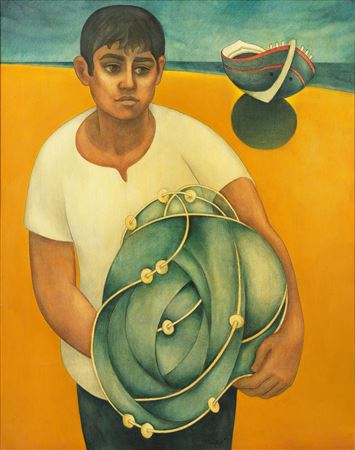
His often-brooding portraits were frequently executed from a vantage point that situated the artist (and the viewer) slightly below the subject or at eye level, so that the figure was at all times either equal to or above the position of an outside gaze, an element that elevated the status of the ordinary people that he portrayed. This subtle yet powerful (and groundbreaking) method of portraiture was accentuated with images of his protagonists in their everyday settings, selling lottery tickets, fixing the nets of fishing boats or carrying their shoe shining equipment—a combination that spoke to a wide spectrum of the Syrian public.
His delicate still-lives and landscapes, with their understated weighty inferences, are equally compelling and monumental in feel. Although the artist sold most of his work while he was alive (those that were not otherwise destroyed during bouts of depression), Kayyali was virtually unknown outside of Syria for decades.Biography from the Archives of askART
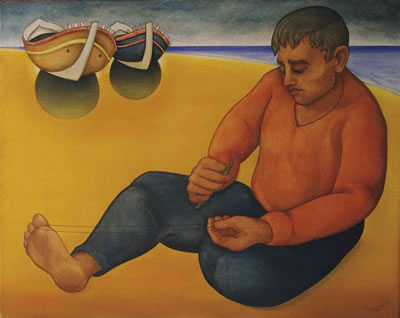 Louay Kayyali is best-known for his depictions of dispossessed working-class figures, where the focus is a single figure, typically boys forced to work in menial jobs such as shoe-shiners and newspaper or lottery ticket vendors, rather than attending school. An example is one of his painting of a boy with sad eyes who sells the traditional Syrian ice cream called booza. Booza is a pounded ice cream mixed with sahlab, rose water, and mastic, and booza sellers have become a recognizable part of the Syrian urban cultural scene. The message of the painting is the boy's need to survive through selling in the streets.
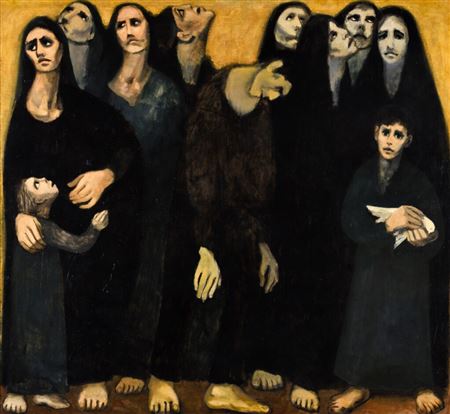
Melancholy and resignation best characterize much of Kayyali's work after the 1967 war and the sentiments of political failure in the Arab World in general. Active during a time of immense upheaval, Kayyali was one of the region's most prominent socio-political artists, his paintings externalizing the pressing humanitarian and political issues that surrounded him.
His powerful depictions of ordinary people are characterized by strong fluid lines that define the figures and the absence of extraneous detail. Although reminiscent of Russian social realist painting, through his humane treatment of his subjects he conferred them with more individuality and pathos. A recurrent theme in his work was the desolation and misery of social outsiders, his trauma finding expression in a series of deeply sentimental paintings.