Page loaded successfully. Showing biography for Louise Bourgeois.
Louise Bourgeois BIOGRAPHY
1911 Paris, France - 2010 New York City. Known for: Grouped wood shape sculpture, installation.
A prolific artist, Louise Bourgeois created an immense body of work including prints, drawings, paintings and sculpture, the latter being the medium that brought her international attention. In fact,... Read full biography
A prolific artist, Louise Bourgeois created an immense body of work including prints, drawings, paintings and sculpture, the latter being the medium that brought her international attention. In fact, she was one of the first installation artists. She is also classified as an Abstract Expressionist... Read full biography
A prolific artist, Louise Bourgeois created an immense body of work including prints, drawings, paintings and sculpture, the latter being the medium that brought her international attention. In fact, she was one of the first installation artists. She is also classified as an Abstract Expressionist because of her early activity in New York City. Recognition came somewhat late in her life because she spent many years committed to domestic life of raising children and maintaining a home for them... Read full biography
A prolific artist, Louise Bourgeois created an immense body of work including prints, drawings, paintings and sculpture, the latter being the medium that brought her international attention. In fact, she was one of the first installation artists. She is also classified as an Abstract Expressionist because of her early activity in New York City. Recognition came somewhat late in her life because she spent many years committed to domestic life of raising children and maintaining a home for them and her husband. She was born in France three years before the beginning of World War I, and her early childhood was unsettled because she and her mother traveled about to follow her father in the military. After the war, her parents worked in a... Read full biography
A prolific artist, Louise Bourgeois created an immense body of work including prints, drawings, paintings and sculpture, the latter being the medium that brought her international attention. In fact, she was one of the first installation artists. She is also classified as an Abstract Expressionist because of her early activity in New York City. Recognition came somewhat late in her life because she spent many years committed to domestic life of raising children and maintaining a home for them and her husband. She was born in France three years before the beginning of World War I, and her early childhood was unsettled because she and her mother traveled about to follow her father in the military. After the war, her parents worked in a tapestry factory, and much of the family conversation concerned hard work and technique and style. She attended... Read full biography
Artist Biography
Biography page for Louise Bourgeois ((1911 - 2010)), known for Grouped wood shape sculpture, installation. Showing 3 biographical entries and 0 sample artworks.
Louise Bourgeois - Artist Info
About Louise Bourgeois
Biography from the Archives of askART
 A prolific artist, Louise Bourgeois created an immense body of work including prints, drawings, paintings and sculpture, the latter being the medium that brought her international attention. In fact, she was one of the first installation artists. She is also classified as an Abstract Expressionist because of her early activity in New York City.
Recognition came somewhat late in her life because she spent many years committed to domestic life of raising children and maintaining a home for them and her husband.
She was born in France three years before the beginning of World War I, and her early childhood was unsettled because she and her mother traveled about to follow her father in the military. After the war, her parents worked in a tapestry factory, and much of the family conversation concerned hard work and technique and style. She attended school at the Lycee Fenelon in Paris and majored in philosophy and then attended the Sorbonne. Her mother died when Louise was eight years old, and she was so grief stricken that she found refuge in the subject of geometry, which was logical, predictable, and systematic and provided a world of order for her.
She studied art with post-cubist Ozenfant and Leger and lived the life of the Bohemian on the Left Bank of Paris while commuting from her home. At the Grande Chaumiere, the workshop of generations of art students, she had the honorary job as overseer of the models, all prostitutes whom she admired as fearless and amazingly modest and clean.
In 1937, she became a guide at the Louvre, and in 1938, she married Robert Goldwater, American art historian to whom she was married until his death in 1973. They raised three sons in New York City, and she loved nurturing children.
Her first exhibition, an innovative assemblage of black forms symbolic of human beings and the unity of the family, was in 1949, and other wood groups followed suggesting all sorts of topics on the human condition including abused women, sex, love and anxiety. Her techniques include carving, welding, casting and assemblage.
In 1977, she earned an honorary doctorate from Yale University, and in May, 1999, she was chosen one of the century's top twenty-five most influential artists in the west by ARTNews magazine for the great impact her work has had on other artists in the exploration of "human forms, relationships, and language."
For the May 2000 inauguration of the Tate Gallery of Modern Art in London, Bourgeois was commissioned to do a large-scale work to occupy the 500 foot long Turbine Hall.
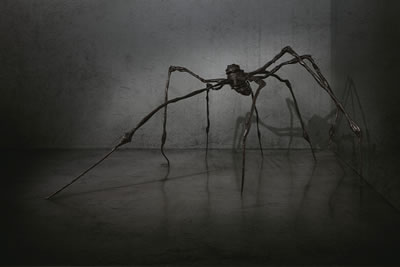
Among her most famous works are a series of giant spiders presented as symbols of the mother, entitled Maman, with one standing more than 30 feet (nine meters) high outside the National Gallery of Canada.
Of her sculpture, she wrote: "my work grows from the duel between the isolated individual and the shared awareness of the group." (Herskovic, 46)
Sources include:
Charlotte Rubinstein, American Women Artists
Marika Herskovic, Editor, American Abstract Expressionists of the 1950s, An Illustrated Survey
Added note:
After suffering a heart attack on Saturday, May 29, 2010, Louise Bourgeois passed away on Monday, May 31, 2010 at Beth Israel Hospital in New York City. She was 98 years old.Biography from Levis Fine Art
While Louise Bourgeois' childhood was tumultuous, moving country to country while her father served in the military, her artistic studies tremendously benefited from this experience. She was primarily raised in Paris and as a result of good fortune she studied post-cubist art with Amedee Ozenfant and Ferdinand Leger in the early 1930's. In spite of her artistic career not taking hold until after her move to New York City, marriage and the raising of her children, she is considered one of the first female modernists. Although she has created a prolific body of work including paintings, drawings, and prints, it was sculpture which gave her the most promising recognition. Her work expresses the juxtaposition between simplicity and complexity. Bourgeois works through her medium developing and exploring the human form: its relationship and its language.
From the New York School Abstract Expressionists: Artists Choice by Artists catalogue (2000), Bourgeois said the following: "I think a work is 'finished' when I have nothing to eliminate. I make constructions which are usually vertical; when I start them, they are full of colors and complicated in form. Every one of the complications goes and the color becomes uniform and finally they become completely white and simple. Yet I am disgusted by simplicity. So I look for a larger form and another work- which goes through the same process of elimination." It is precisely this simplistic form which envelopes Bourgeois' work while also expressing and wrestling with more complicated issues.
Bourgeois' works are in numerous museums around the world including the Albright-Knox Gallery, San Francisco Museum of Modern Art, Dallas Museum of Art, Hisrchorn Museum and Sculpture Garden and the Whitney Museum of American Art.
© 2008 Levis Fine Art, Inc.Biography from Wright
Louise Bourgeois was a renowned 20th Century feminist and installation artist. Born in Paris in 1911, she studied math at the University of Paris and fine art at several French academies. Shortly after opening her business as an art dealer she met, and later married, American art historian Robert Goldwater in 1938. After moving to New York, she enrolled at the Art Students League and began her career in painting and printmaking. Drawing from traumatic themes in childhood, the content of Bourgeois’ work explores the human body, anger, beauty, and desire. Utilizing these themes to reconstruct memories, she developed a personal visual language including spiders, sewn appendages, biomorphic forms, and cages to represent internal conflicts. Her first solo exhibition of paintings were presented in New York in 1945, and she moved into sculptural work through the latter half of the decade. In the 1950s and 1960s she traveled to France and Italy, experimenting in new materials such as latex and marble while undergoing intensive psychoanalysis.
In 1982, Bourgeois’ body of work was celebrated with a retrospective at the Museum of Modern Art New York with other later major museum retrospectives held at the Guggenheim Museum Bilbao and Tate Modern, London. In 1982, Bourgeois’ body of work was celebrated with a retrospective at the Museum of Modern Art New York with other later major museum retrospectives held at the Guggenheim Museum Bilbao and Tate Modern, London. Among her accolades, she was named Officer of the Order of Arts and Letter by the French minister of culture in 1983, received the Grand Prix National de Sculpture from the French government in 1991, was presented the National Medal of Arts by United States President Bill Clinton in 1997, recognized with a fellowship from the National Endowment for the Arts in 1973, and elected as a fellow of the American Academy of Arts and Sciences in 1981.
Louise Bourgeois continued to create work while teaching at several universities until her death in 2010 at the age of 98.