Page loaded successfully. Showing biography for Mabel Alvarez.
Mabel Alvarez BIOGRAPHY
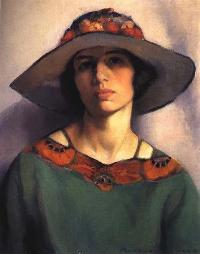
1891 Wailua, Hawaii - 1985 Los Angeles, California. Known for: Mod portrait, still life, and figure painting.
Mabel Alvarez (1891-1985). Born on the island of Oahu, Hawaii, Mabel Alvarez arrived in California with her family in 1906. In 1909 they moved from Berkeley to Los Angeles where Alvarez’ artistic... Read full biography
Mabel Alvarez (1891-1985). Born on the island of Oahu, Hawaii, Mabel Alvarez arrived in California with her family in 1906. In 1909 they moved from Berkeley to Los Angeles where Alvarez’ artistic talents were recognized by her high school art teacher. Alvarez’ early artistic career is best defined... Read full biography
Mabel Alvarez (1891-1985). Born on the island of Oahu, Hawaii, Mabel Alvarez arrived in California with her family in 1906. In 1909 they moved from Berkeley to Los Angeles where Alvarez’ artistic talents were recognized by her high school art teacher. Alvarez’ early artistic career is best defined by those she sought as mentors and teachers. Her lifelong quest for spiritual fulfillment and professional challenge encouraged an open exploration of ideas. Ultimately these qualities joined together... Read full biography
Mabel Alvarez (1891-1985). Born on the island of Oahu, Hawaii, Mabel Alvarez arrived in California with her family in 1906. In 1909 they moved from Berkeley to Los Angeles where Alvarez’ artistic talents were recognized by her high school art teacher. Alvarez’ early artistic career is best defined by those she sought as mentors and teachers. Her lifelong quest for spiritual fulfillment and professional challenge encouraged an open exploration of ideas. Ultimately these qualities joined together in art works which demonstrate considerable talent as well as innovative thinking. In the teens and twenties Alvarez became acquainted with early American modernists working in Los Angeles. Her first teacher, William Cahill, encouraged study through... Read full biography
Mabel Alvarez (1891-1985). Born on the island of Oahu, Hawaii, Mabel Alvarez arrived in California with her family in 1906. In 1909 they moved from Berkeley to Los Angeles where Alvarez’ artistic talents were recognized by her high school art teacher. Alvarez’ early artistic career is best defined by those she sought as mentors and teachers. Her lifelong quest for spiritual fulfillment and professional challenge encouraged an open exploration of ideas. Ultimately these qualities joined together in art works which demonstrate considerable talent as well as innovative thinking. In the teens and twenties Alvarez became acquainted with early American modernists working in Los Angeles. Her first teacher, William Cahill, encouraged study through live models and introduced Alvarez to Impressionist styles which she adopted with great success. When Cahill moved away, Alvarez worked u... Read full biography
Artist Biography
Biography page for Mabel Alvarez ((1891 - 1985)), known for Mod portrait, still life, and figure painting. Showing 5 biographical entries and 0 sample artworks.
Mabel Alvarez - Artist Info
About Mabel Alvarez
Biography from the Archives of askART
 Mabel Alvarez (1891-1985)
Born on the island of Oahu, Hawaii, Mabel Alvarez arrived in California with her family in 1906. In 1909 they moved from Berkeley to Los Angeles where Alvarez’ artistic talents were recognized by her high school art teacher. Alvarez’ early artistic career is best defined by those she sought as mentors and teachers. Her lifelong quest for spiritual fulfillment and professional challenge encouraged an open exploration of ideas. Ultimately these qualities joined together in art works which demonstrate considerable talent as well as innovative thinking.
In the teens and twenties Alvarez became acquainted with early American modernists working in Los Angeles. Her first teacher, William Cahill, encouraged study through live models and introduced Alvarez to Impressionist styles which she adopted with great success. When Cahill moved away, Alvarez worked under Stanton MacDonald-Wright who shared with her what he had gleaned from European avantgarde movements. MacDonald-Wright served as Alvarez’ mentor and teacher during the twenties, encouraging her to abandon Impressionistic colors for a stronger, more modern palette. During this time Alvarez befriended other artists who focused on figures and still lifes instead of the popular landscape. Among those she associated with was painter Henrietta Shore.
Alvarez’ quest for a spiritual practice or philosophy was in part motivated by her hope that through her art she could manifest the beauty and dignity she found in the world. She understood that her art would benefit from a deeper understanding of the human condition, commenting that it was useless to paint when it does not come straight from the center. Better to say nothing at all.
Alvarez’ openness allowed her to consider alternative concepts willingly. Around 1918 she was introduced to Eastern mysticism and began to meditate on a regular basis. In 1924 she traveled and absorbed a great deal of Eastern art including Persian, Indian and Tibetan. In the 1920s Theosophy lectures and societies made their way to southern California. While a student of Cahill’s, Alvarez discovered the writings of Will Levington Comfort whose ideas were rooted in Theosophy, a kind of eastern religious thought that explored distinctions between the world of form and the formless world, encouraging believers to make visible their inner sensations and feelings.
Alvarez’ spiritual explorations led to a series of symbolic paintings done between 1925 and 1933 in which she begins to record her dreams. Unlike the surrealists whose dream canvases tell of spontaneous and random connections, Alvarez depicts an ideal world where forms float in fantasy-like landscapes. In the paintings Alvarez referred to as “Dreamscapes” women in a meditative position are the central subjects. In Silent Places a figure is situated in a brightly colored mountainscape. This mysterious wonderland may be lonely but is anything but threatening. The halo-like glow surrounding the woman reflects Alvarez’ desire for a spiritual home.
Dream of Youth done in 1925 is perhaps Alvarez’ most significant painting of this period in that it summarizes both Eastern and Western influences while illustrating her desire to experience life’s transitions and transformations. This painting can be read from a western as well as an eastern vantage point. The vignettes around the central figure can be seen as spects of maturation from the revelry of music to friendship and partnership. The same vignettes can be interpreted as various stages of enlightenment. Angelic figures are nearly transparent in this arcadian landscape which is filled with symbolic forms—doves and lotus flowers hold equal weight. The central figure is the artist herself who serves as the trunk or support for the tree of life. The pastel palette of Dream of Youth is illustrative of Alvarez’ meditative search for harmony. This image of peace and stillness is in part made so by Alvarez’ choice of green as the main color.
Alvarez’ diary indicates that she was captivated by the idea of color’s possibilities and sought to create harmonies that reinforced her ideas of a unified, poetic world. Like many artists of this time Alvarez was familiar with Wassily Kandinsky’s spiritual interest in the power of color. Green was the color of choice for many of Alvarez’ paintings. In color symbolism, green is the most restful color representing love, hope and youth. For Alvarez’ friend MacDonald-Wright green was the color of calm and quiet.
In 1933 art critic Arthur Miller gave Alvarez what at the time constituted a sincere compliment, raising her from dilettante to professional, when he stated in a Los Angeles Times article: She isn’t a woman painter, she’s an artist. In addition to her symbolist work, Alvarez did many portrait commissions for prominent Los Angelenos and occasional still lifes. Later in her life she spent time in the Caribbean. The c. 1954 Untitled image shows a further simplification of Alvarez’ modernist style. Faceless, non-individualized women frequently appear in symbolist paintings as representations of all humanity. Her love and understanding of color’s power is also clearly evident in this canvas.
During her lifetime Alvarez exhibited at the San Francisco Art Academy, the Art Institute of Chicago, New York’s Museum of Modern Art, the Crocker Art Gallery in Sacramento, the Frye Museum in Seattle and was the focus of solo exhibitions at the Los Angeles County Museum of Art in 1929, 1940 and again in 1980. In 2000 Dream of Youth was included in the Los Angeles County Museum of Art’s Made in California: Art, Image, and Identity, 1900-2000 exhibition.
Source: JLW Collection Website
Submitted by: Linda MalloyBiography from the Archives of askART
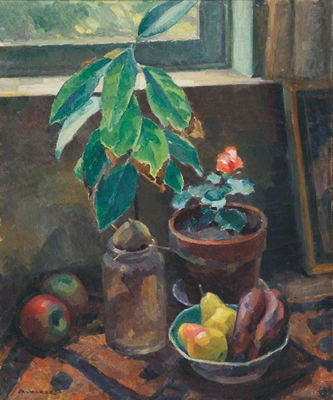 Combining both modernism and realism, Mabel Alvarez became a well-known 20th century West Coast female artist of portraits, still lifes, and landscapes.
She was born in Waialua, near the north shore of Oahu in Hawaii, and moved to California with her family who had made vast amounts of money from buying and selling land in Honolulu. She was the youngest of five children of Clementine Setza Alvarez and Dr. Luis Fernandez Alvarez, a government physician.
Her father, a native of Spain and son of the business manager to the Spanish king's son, was providing medical care to Chinese and Japanese workers imported to Hawaii. He was later the personal physician to Queen Liluokalani and her husband. Mabel's mother was a great beauty from a prominent family of musicians in St. Paul, Minnesota, and her brother, Walter Alvarez, was one of the founders of the Mayo Clinic in Rochester, Minnesota, a prominent Mayo physician who lectured widely. A nephew, Dr. Luis Alvarez, was part of the Manhattan Project at Los Alamos, New Mexico, and won the Nobel Prize for Physics in 1968.
From early childhood, she had art talent and her father insured that she had a lifetime of financial security to pursue her fine art. In 1915, she enrolled in the leading art school in Los Angeles, directed by William Cahill. A mural she produced for the Pan-California Exposition in San Diego earned her a gold medal, and a charcoal portrait she did of a woman was used for many years on the cover of the art school's promotional brochure. Her self portrait was used in 1995 on the cover of the popular book, Independent Spirits, about women artists and published by the Autry Museum.
An early promoter of hers was Arthur Millier, powerful art critic of the Los Angeles Times in the 1920s and 30s. From 1918, she did a number of symbolic or dream-like paintings influenced by Will Levington Comfort, a Los Angeles philosopher who espoused meditation experiences. She also loved to do cheerful paintings that appealed to children, and the Samuel Goldwyn and Irving Berlin families commissioned her to do portraits and murals for their children.
In 1931 in Los Angeles, she met Morgan Russell, co-founder of the Synchromy art movement. A student of both Matisse and Cezanne, he became Mabel's teacher for the remaining 20 years of his life, and his joyous sense of color and rhythmic form and structure fit beautifully with her natural tendencies.
After her father's death in 1937, she returned to Hawaii for a year and painted portraits, figure studies, and still lifes.
A trip to the Caribbean islands in the 1950s led to brightening of her palette and using many oranges, reds, and bright pinks in tropical genre scenes. Later travels to Mexico reinforced these tendencies. As she got older, she turned more and more to religious and symbolic subjects. S he spent the last several years of her life in a Los Angeles nursing home and died at age 94 on March 13, 1985.
She exhibited nationwide including the Art Institute of Chicago and the Los Angeles County Museum and in 1999 became one of a group of important American artists showcased in Paris by the U.S. State Department. In August, 1999, a special exhibition of her work, titled "A Radiant Thread," was held at the Adamson-Duvannes Galleries in Los Angeles.
Source:
American Art Review
David Forbes, Encounters With ParadiseBiography from The Redfern Gallery
Painter, lithographer. Born in Oahu, HI on Nov. 28, 1891, Mabel Alvarez moved with her family to California in 1906. Settling in Los Angeles, she studied with James E. McBurney, William Cahill, Stanton MacDonald-Wright, and Morgan Russell.
An advocate of modern art, she did work tha includes figures, still lifes and portraits.
Member: Group of Eight; Los Angeles Art Association; California Art Club; San Diego Fine Arts Society; American Federation of the Arts; Los Angeles Museum Association
Exhibited: San Francisco Art Association, 1918; Art Institute of Chicago, 1923; Museum of Modern Art, 1933; California State Fair, 1950; San Joaquin Pioneer Museum, 1950; Crocker Art Gallery, Sacramento, 1951; Los Angeles County Museum of Art, 1929 (solo), 1941 (solo), 1954, 1955, 1980 (solo)Awards: silver medal, Panama California Expo, San Diego, 1916; California Art Club, 1918, 1919, 1933; Federal Women's Club, 1923; Laguna Beach Art Association, 1928; Ebell Club of Los Angeles, 1933-35; Oakland Art Gallery, 1938; Honolulu Printmakers, 1939; Madonna Festival, Los Angeles, 1954; Laguna Beach Museum, 1984
Works Held: Haggin Museum, Stockton; Law Building, USC
Credit:
Edan Hughes, "Artists in California, 1786-1940"Biography from William A. Karges Fine Art
Born on the Hawaiian island of Oahu in 1891, Mabel Alvarez was the youngest of 5 children. Her father, Dr. Luis Fernandez Alvarez was a Spanish born physician to Hawaiian royalty, and a business advisor to the Spanish King's son. With a large fortune made from buying and selling land in Hawaii, Dr. Alvarez moved his family to California, where his children were afforded excellent education.
Mabel Alvarez, who had always shown artistic talent, attended William Cahill's prestigious art academy in Los Angeles. Alvarez enjoyed many immediate successes, including a Gold Medal for a Mural she produced for the Pan-California Exhibition in San Diego.
In the 20's and 30's her works were heavily influenced by the Synchromy Movement's Stanton MacDonald-Wright and Morgan Russell, who would be her teacher for over 20 years. Alvarez's work was a constant evolution. Her late works are introspective, focusing on religious and symbolic themes. She spent the last several years of her life in a nursing home in Los Angeles, where she died in March, 1985.Biography from Orange County Museum of Art
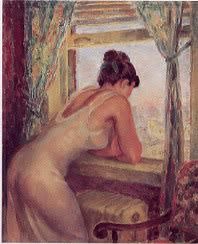 Mabel Alvarez (1891-1985) was a significant painter of beautiful, evocative portraits and introspective spiritual subjects. She was an important leader in the Los Angeles art scene in the 1920s and 30s. Her studies with major artists, including Modernists Stanton Macdonald-Wright and Morgan Russell, fueled her lifelong fascination for new styles and diverse media.
Her exceptional artistic skills were in the service of a restless intellect, tempered by both spirituality and practicality. As she moved from Impressionism to Modernism, from portraits to still lifes, from drawing to painting, sculpture, ceramics, and lithography, Mabel Alvarez created a body of work that was impressive to her fellow artists and the critics of her day. Thanks to recent scholarship and exhibitions such as this one, the first major retrospective of her work, a new generation will have the opportunity to encounter and appreciate this fascinating artist. The Mabel Alvarez retrospective opens on May 1 at the Orange County Museum of Art (OCMA) and will be on view until July 18, 1999.
She was born in 1891 on the island of Oahu, Hawaii, into a large, prominent family of physicians, scientists, and performing artists. Her father, of Spanish-Cuban descent, was a successful doctor and researcher. Her mother was from a Minnesota family that included a famous opera singer and concert pianist. One of her brothers was nominated for a Nobel Prize for his contributions to the field of medicine. Mabel was the youngest of five children.
In 1906 the family, already quite wealthy from shrewd investments in Hawaiian real estate, returned to the mainland, first to Berkeley, then settling permanently in Los Angeles in 1909. Alvarez's artistic talent was recognized immediately by her high school art teacher, Edwin McBurney, who placed her in advanced design and drawing classes. McBurney allowed her to assist him with his commission to create murals for the 1915 Panama-California Exposition in San Diego. Alvarez's watercolor sketches for this work show the influence of both Art Nouveau and Symbolism.
The Impressionist style was beginning to take root in California, owing in some measure to the arrival from Boston of William Vincent Cahill and the establishment of his School of Illustrating and Painting in 1914. Alvarez enrolled in his classes and he encouraged her to be more playful with her paint, to quit her job as a fashion illustrator, and to make portraits from live models. Her Portrait of Mrs. H. McGee Bernhart shows Cahill's influence and Alvarez's mastery of the delicate color and shimmering light effects of Impressionism.
When Cahill moved from Los Angeles to Laguna Beach, Alvarez sought and found a new mentor in the revolutionary Modernist Stanton Macdonald-Wright, Her studies with him through much of the decade of the 1920s produced strongly colored, solid works, such as her award-winning Self-Portrait. She also became a close friend of Morgan Russell, who, together with Macdonald-Wright, founded the Synchronism movement, one of the earliest attempts to create paintings of purely abstract shapes and colors.
Alvarez's insatiable curiosity and quest for self-improvement (both artistic and personal) drove her to explore metaphysical meditation techniques, to travel to Europe and the East Coast, and to study the arts of Asia. Her enigmatic painting Dream of Youth shows these influences. She pursued her diverse interests with energy and dedication, meticulously logging her experiences in diaries that she kept throughout her long life.
Those records, now in the archives of the Smithsonian Institution, bespeak her deep involvement with other artists, artistic movements, and her own technical studies. Her local and national prominence is evidenced by the number of important exhibitions that featured her work: California Art Club shows, a three-person exhibition at the Los Angeles Museum of Art (later LACMA), and a nationwide selection of works by living artists at The Museum of Modern Art in New York, among many others.
In 1935 Alvarez began to study creative writing in order to capture her aging father's reminiscences of their time in Hawaii. Soon after his death in 1937, she made a year-long visit to the islands where she did still lifes and figures studies of the Hawaiian people. She returned to Los Angeles before the attack on Pearl Harbor and painting took a back seat to her war-time volunteer efforts. She taught art to help the rehabilitation of wounded veterans.
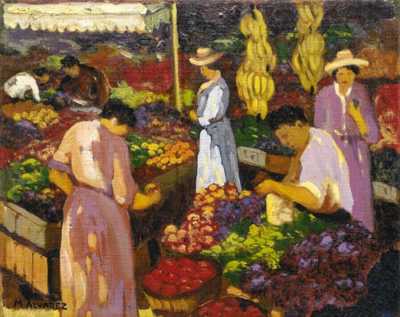
What painting she did accomplish during the 1940s shows her heightened concern with color harmony and simple, but poetic, subject matter. This fascination with color relationships remained the dominant theme of her work throughout the rest of her life. Paintings of her travels in Mexico and the Caribbean from the 1950s utilize bright, layered pastels and ethereal brushwork to create images of fruit markets, festivals, and churches. This new style excited her so much that she painted over earlier works using her new approach.
The passionate spirit of Mabel Alvarez departed this world on March 13, 1985, at the age of ninety-three, but her legacy of images-- universal archetypes exquisitely expressed in harmonious color- remains, and continue to inspire.
Source: Orange County Museum of Art, Newport Beach, California
Submitted by: Linda Malloy