Page loaded successfully. Showing biography for Marcel Janco.
Marcel Janco BIOGRAPHY
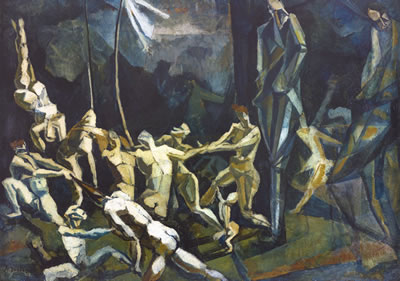
1895 Bucharest, Romania - 1984 Tel Aviv, Israel. Known for: Dada painting, collage, illustration, murals, linocut, costume design.
Marcel Janco was a Romanian and Israeli visual artist, architect and art theorist. He was the co-inventor of Dadaism and a leading exponent of Constructivism in Eastern Europe. In the 1910s, he... Read full biography
Marcel Janco was a Romanian and Israeli visual artist, architect and art theorist. He was the co-inventor of Dadaism and a leading exponent of Constructivism in Eastern Europe. In the 1910s, he co-edited, with Ion Vinea and Tristan Tzara, the Romanian art magazine Simbolul. Janco was a practitioner... Read full biography
Marcel Janco was a Romanian and Israeli visual artist, architect and art theorist. He was the co-inventor of Dadaism and a leading exponent of Constructivism in Eastern Europe. In the 1910s, he co-edited, with Ion Vinea and Tristan Tzara, the Romanian art magazine Simbolul. Janco was a practitioner of Art Nouveau, Futurism and Expressionism before contributing his painting and stage design to Tzara's literary Dadaism. He parted with Dada in 1919, when he and painter Hans Arp founded a... Read full biography
Marcel Janco was a Romanian and Israeli visual artist, architect and art theorist. He was the co-inventor of Dadaism and a leading exponent of Constructivism in Eastern Europe. In the 1910s, he co-edited, with Ion Vinea and Tristan Tzara, the Romanian art magazine Simbolul. Janco was a practitioner of Art Nouveau, Futurism and Expressionism before contributing his painting and stage design to Tzara's literary Dadaism. He parted with Dada in 1919, when he and painter Hans Arp founded a Constructivist circle, Das Neue Leben. Reunited with Vinea, he founded Contimporanul, the influential tribune of the Romanian avant-garde, advocating a mix of Constructivism, Futurism and Cubism. At Contimporanul, Janco expounded a "revolutionary" vision of... Read full biography
Marcel Janco was a Romanian and Israeli visual artist, architect and art theorist. He was the co-inventor of Dadaism and a leading exponent of Constructivism in Eastern Europe. In the 1910s, he co-edited, with Ion Vinea and Tristan Tzara, the Romanian art magazine Simbolul. Janco was a practitioner of Art Nouveau, Futurism and Expressionism before contributing his painting and stage design to Tzara's literary Dadaism. He parted with Dada in 1919, when he and painter Hans Arp founded a Constructivist circle, Das Neue Leben. Reunited with Vinea, he founded Contimporanul, the influential tribune of the Romanian avant-garde, advocating a mix of Constructivism, Futurism and Cubism. At Contimporanul, Janco expounded a "revolutionary" vision of urban planning. He designed some of the most innovative landmarks of downtown Bucharest. He worked in many art forms, including il... Read full biography
Artist Biography
Biography page for Marcel Janco ((1895 - 1984)), known for Dada painting, collage, illustration, murals, linocut, costume design. Showing 4 biographical entries and 0 sample artworks.
Marcel Janco - Artist Info
About Marcel Janco
Name variants
Marcel Iancu, Marcel Janko
Biography from the Archives of askART
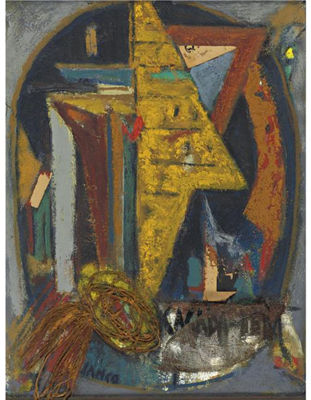 Marcel Janco was a Romanian and Israeli visual artist, architect and art theorist. He was the co-inventor of Dadaism and a leading exponent of Constructivism in Eastern Europe. In the 1910s, he co-edited, with Ion Vinea and Tristan Tzara, the Romanian art magazine Simbolul.
Janco was a practitioner of Art Nouveau, Futurism and Expressionism before contributing his painting and stage design to Tzara's literary Dadaism. He parted with Dada in 1919, when he and painter Hans Arp founded a Constructivist circle, Das Neue Leben.
Reunited with Vinea, he founded Contimporanul, the influential tribune of the Romanian avant-garde, advocating a mix of Constructivism, Futurism and Cubism. At Contimporanul, Janco expounded a "revolutionary" vision of urban planning. He designed some of the most innovative landmarks of downtown Bucharest. He worked in many art forms, including illustration, sculpture and oil painting.
Janco was one of the leading Romanian Jewish intellectuals of his generation. Targeted by antisemitic persecution before and during World War II, he emigrated to British Palestine in 1941. He won the Dizengoff Prize and Israel Prize, and was a founder of Ein Hod, a utopian art colony, controversially built over a deserted Palestinian Arab settlement.
Marcel Janco was the brother Georges and Jules Janco, who were his artistic partners during and after the Dada episode. His brother-in-law and fellow Constructivist promoter was the writer Jacques G. Costin, known as a survivor of 1940s antisemitism.
Marcel Janco died on April 21, 1984 at age 88.
In the realm of visual arts, curators Anca Bocanet and Dana Herbay organized a centennial Marcel Janco exhibit at the Bucharest Museum of Art with additional contributions from writer Magda Cârneci. In 2000, his work was featured in the "Jewish Art of Romania" retrospective, hosted by Cotroceni Palace.
Outside Romania, Janco's work has been reviewed in specialized monographs by Harry Seiwert (1993) and Michael Ilk (2001). His work as painter and sculptor has been dedicated special exhibits in Berlin, Essen (Museum Folkwang) and Budapest, while his architecture was presented abroad with exhibitions at the Technical University Munich and the Bauhaus Center.
Among the events showcasing Janco's art, some focused exclusively on his rediscovered Holocaust paintings and drawings. These shows include On the Edge (Yad Vashem, 1990)[6] and Destine la rascruce ("Destinies at Crossroads", MNAR, 2011).
Wikipedia,
http://en.wikipedia.org/wiki/Marcel_Janco
* For references for these terms and others, see AskART Glossary http://www.askart.com/AskART/lists/Art_Definition.aspxBiography from Tiroche Auction House
Marcel Janco born in Bucharest, Romania in 1895, his life history can be divided into two main chapters: 46 years in Europe and 43 years in Israel. His artistic talent became apparent early on. He learned the foundations of classical art from his teacher Josef Isser who would continue to influence his work throughout his life. Janco started "Simbolul" and "Chemarea", literary journals in which his drawings were first published.
At the age of 20, Janco went to Zurich to study architecture at the Federal Institute of Technology and joined a group of young artists performing at the Cabaret Voltaire as part of the avant-garde Dada movement. Janco played an active role in the entire group’s activities, curated exhibitions, issued manifestos, and published a journal. Janco himself designed the masks they wore in their performances and participated in the shows. During this period, Janco also belonged to "New Life", a group that organized artistic and intellectual activities.
In 1922, after a brief stay in Paris, Janco returned to Romania and his paintings were now mostly of local landscapes, peasants, interiors and classical subjects which he depicted in a modernist style. His work displayed cubist elements along with dark coloration, particularly browns and grays, and he was involved with several other groups of Romanian artists who were similarly striving to promote the principles of modernism. Despite his professional success in the country of his birth, in 1940, at the start of World War II, Janco decided to move with his family to Israel.
Once here, both his style of painting and his architectural work underwent a striking change, with the Mediterranean light finding its way into his palette. He carried with him a sketchbook in which he recorded what he saw, and then reproduced the scenes in vivid colors on his return to the studio. His paintings from this period depict the landscapes and people of the country, as well as its heroic struggle for independence. In 1948 Janco was one of the founding fathers of the movement "Ofakim Hadashim" (New Horizons) alongside artists such as Yehezkel Streichman and Joseph Zaritsky.
In 1953 Janco wanted to find a way to restore the Arab village Ein Hod and convinced artists and sculptors to move there. He himself joined the first group of settlers in Ein Hod. Janco was part of the art school "Studia" and later he taught in a variety of institutions, as well as in courses conducted in Ein Hod. In the last twenty years of Janco's life he actively promoted the village of Ein Hod, as well as writing articles about a range of subjects that drew his interest and in 1967 he received the Israel Prize for his work. His last works display an absolute return to abstract and geometric shapes.Biography from Montefiore Auction House
Marcel Janco, painter, born 1895, Bucharest, Romania. Immigrated 1941.
1915 Went to Switzerland and joined Hugo Bell, Jean Arp.
1916 -19 An originator of the Dada movement and participated in all its activities. Painted the famous masks in the style of African masks which were exhibited in "Cabaret Voltair". Painted abstract reliefs, combining expressionism and cubism.
1921 After a short time in Paris, returned to Bucharest, worked in architecture and was active in artists groups.
1948 A founder of New Horizons Group.
1953 A founder of the artists villege Ein Hod.
Education
1915 Studied Architecture, l'Ecole Polytechnique, Zurich, Switzerland
Teaching
1953 Seminar Ha'Kibbutzim, Oranim
Awards and Prizes
1945, 1946 The Dizengoff Prize for Painting and Sculpture, Municipality of Tel Aviv Jaffa, Tel Aviv
1950, 1951 The Dizengoff Prize for Painting and Sculpture, Municipality of Tel Aviv Jaffa, Tel Aviv
1958 The Histadrut Prize
1967 Israel Prize for Painting
1982 worthy of the City of Tel-Aviv, Municipality of Tel Aviv-Yaffo, Tel AvivBiography from Ans Azura
Marcel Janco was a Romanian and Israeli visual artist, architect and art theorist. He was the co-inventor of Dadaism and a leading figure of Constructivism in Eastern Europe. An influential figure within all these fields, Janco was also involved in several key publications during his career - including Romanian neo-avantgarde magazines Contimporanul and Simbolul, as founder, editor, writer and graphic designer.
Janco's experiments in abstract art stemmed from a theorization of abstract-expressionistic decorations as part of a basic architectural design. In 1926, he was present at the Hasefer Art Show in Bucharest, and created what is often described as the first Constructivist structure in Bucharest. He had several personal exhibitions, in Tel Aviv, Milan and Paris and attended the 1966 Venice Art Biennale. He won the Israel Prize of 1967, in recognition of his work as a painter.