Page loaded successfully. Showing biography for Margo Hoff.
Margo Hoff BIOGRAPHY
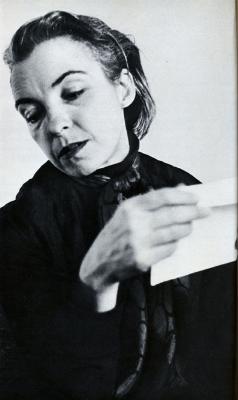
1912 Tulsa, Oklahoma - 2008 Manhattan, New York City. Known for: Abstract painting, woodcuts, lithography, crayon drawing, collage, textiles, stained glass.
Following are obituaries of Margo Hoff, from her website. Margo Hoff (born 1910) died during the early morning hours of Sunday, August 17, 2008. She passed, in her sleep, in Manhattan. She was 98... Read full biography
Following are obituaries of Margo Hoff, from her website. Margo Hoff (born 1910) died during the early morning hours of Sunday, August 17, 2008. She passed, in her sleep, in Manhattan. She was 98 years of age. In keeping with her wishes, she was cremated, and her ashes placed in Graceland Cemetery,... Read full biography
Following are obituaries of Margo Hoff, from her website. Margo Hoff (born 1910) died during the early morning hours of Sunday, August 17, 2008. She passed, in her sleep, in Manhattan. She was 98 years of age. In keeping with her wishes, she was cremated, and her ashes placed in Graceland Cemetery, in Chicago, Illinois. She also specified that there be no funeral service. Although those of us who knew her mourn her, more moving than her loss is the inspiring life she led. She was fearless,... Read full biography
Following are obituaries of Margo Hoff, from her website. Margo Hoff (born 1910) died during the early morning hours of Sunday, August 17, 2008. She passed, in her sleep, in Manhattan. She was 98 years of age. In keeping with her wishes, she was cremated, and her ashes placed in Graceland Cemetery, in Chicago, Illinois. She also specified that there be no funeral service. Although those of us who knew her mourn her, more moving than her loss is the inspiring life she led. She was fearless, pursued her dreams, created great art and achieved great success. Hers was a long and amazing journey. A memorial was held on the afternoon of January 17, 2009, in the Spartan 14th Street loft that served as her painting studio—and, in later years, her... Read full biography
Following are obituaries of Margo Hoff, from her website. Margo Hoff (born 1910) died during the early morning hours of Sunday, August 17, 2008. She passed, in her sleep, in Manhattan. She was 98 years of age. In keeping with her wishes, she was cremated, and her ashes placed in Graceland Cemetery, in Chicago, Illinois. She also specified that there be no funeral service. Although those of us who knew her mourn her, more moving than her loss is the inspiring life she led. She was fearless, pursued her dreams, created great art and achieved great success. Hers was a long and amazing journey. A memorial was held on the afternoon of January 17, 2009, in the Spartan 14th Street loft that served as her painting studio—and, in later years, her home—for many, many years. Her remembrance was well attended. Margo's daughter Mia Buehr was there, as was her son-in-law, Ken Vaughn. Als... Read full biography
Artist Biography
Biography page for Margo Hoff ((1912 - 2008)), known for Abstract painting, woodcuts, lithography, crayon drawing, collage, textiles, stained glass. Showing 2 biographical entries and 0 sample artworks.
Margo Hoff - Artist Info
About Margo Hoff
Biography from the Archives of askART
 Following are obituaries of Margo Hoff, from her website.
Margo Hoff (born 1910) died during the early morning hours of Sunday, August 17, 2008. She passed, in her sleep, in Manhattan. She was 98 years of age. In keeping with her wishes, she was cremated, and her ashes placed in Graceland Cemetery, in Chicago, Illinois. She also specified that there be no funeral service. Although those of us who knew her mourn her, more moving than her loss is the inspiring life she led. She was fearless, pursued her dreams, created great art and achieved great success. Hers was a long and amazing journey.
A memorial was held on the afternoon of January 17, 2009, in the Spartan 14th Street loft that served as her painting studio—and, in later years, her home—for many, many years. Her remembrance was well attended. Margo's daughter Mia Buehr was there, as was her son-in-law, Ken Vaughn. Also present were some of the many people whose lives she'd affected over the years, including colleagues, students, friends. Some of those present Margo had known for decades; some had known her more casually; some had never had the joy of meeting her in person, but nearly felt as though they had—through what they'd heard and read about her—and most of all, through her singular and astounding body of work.
Of course it would be impossible to capture here in words the energy and the heartfelt emotions of the memorial itself, but what follows are transcriptions of what various people came forward to say about Margo.
Margo's gallerist in Chicago, John Corbett (of Corbett vs. Dempsey gallery), had very much wanted to attend in person, but this proved impossible. He did provide the following overview of Margo-as-artist, which was read by Charles Hovland. John has graciously given permission for us to post his text on MargoHoff.com.
"Margo Hoff—A Life in Art" by John Corbett
(Copyright January, 2009; used by permission)
Margo Hoff was too expansive and bold a creative force to be adequately encapsulated. She was, from early in her life, a thoroughly international artist, both in reputation and in personal philosophy. Over the course of an astonishing seven decades of artistic production, Hoff was extremely well-traveled, exhibited extensively in many different kinds of contexts, and was celebrated in places far from her three most settled residences, Tulsa, Chicago, and Manhattan. And although her initial acclaim was earned as a painter, Hoff was in the most genuine sense a polyglot artist, working in a range of two-dimensional media including woodcut, lithography, casein, oil, watercolor, crayon, gouache, every variety of collage, textiles, and stained glass.
To attempt a sweeping description of such a varied and multifarious person is certain to leave important things out, but the following biography touches on some of the key elements of Hoff’s life as an artist and the brilliant body of work she produced.
Perhaps the best way to understand Hoff’s artwork is to tie it directly to the unfolding of her personal life. After a youth spent as a member of a large family in Tulsa, Oklahoma, where she was initially exposed to art, studied drawing, and began to imagine herself as an artist, Hoff settled in Chicago. It was in the Windy City that she came to artistic maturity and formulated an aesthetic identity. Indeed, for many of her collectors and friends, she remains a great Chicago artist, despite the fact that she eventually spent nearly half a century in New York. But her style as a figurative painter – and to some extent even her signature approach to abstraction – were formulated in the vibrant and highly stimulating environs of Chicago’s mid-century art scene, starting with her studies at the School of the Art Institute.?
Hoff’s Chicago work was almost entirely figurative. Her approach to figuration was deeply influenced by the Mexican painters of the 1930s, whose work she encountered early and in person during trips to Mexico. Indeed, she and her husband George Buehr traveled south of the border numerous times, often together with artist colleagues Frank Vavruska, Eleanor Coen, and Max Kahn. In the early 1940s, when trips to Europe became increasingly difficult, many Chicago artists spent time gathering inspiration in South and Central America, and especially Mexico. The Mexican nationalists Rivera and Kahlo were important, but perhaps more key were the Mexican muralists, including Sigueros and Orozco.
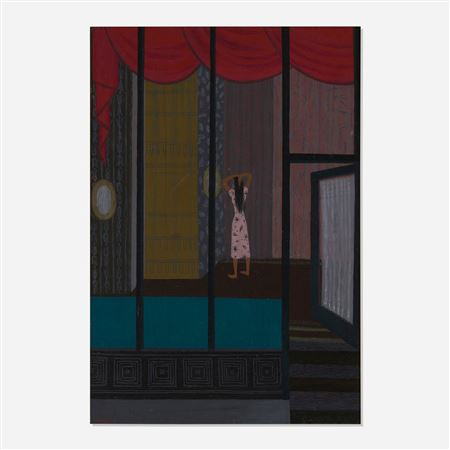
Unlike some of her contemporaries in Chicago, Hoff was not drawn to surrealism, preferring more prosaic subjects to the hysterical, off-beat and highly dramatic ones of Gertrude Abercrombie, Julia Thecla, Aaron Bohrod, Karl Priebe, and Ivan Albright. And where many of her generation – including Buehr – were influenced by the brushy expressionism promoted by Francis Chapin, Hoff preferred a clean, linear style. Where her earliest work was rich in volumes and modeling, she eventually began to incorporate more complex patterns and would develop a unique way of mixing flat, unmodulated areas, exchanging a naturalism more a more stylized kind of figuration. This may well have been impacted by her work as a printmaker, which was quite extensive in the ‘40s and ‘50s, especially in the tricky medium of woodblock, of which she was an absolute master. Some of her most emblematic images are her woodblock prints, often made in tiny editions, from this period.
At the transition point of this change from naturalism to stylization, in 1946, Hoff’s career experienced its first major boost when the Art Institute purchased her oil painting Murder Mystery, a glorious achievement in which the interplay of patterns on a blue rug and red blanket recall the influence of Matisse. This painting was hanging in the halls of the great museum for decades, and they still exhibit it from time to time; it remains in their permanent collection, along with several of Hoff’s works. (She was awarded four awards in the annual Chicago & Vicinity Exhibition alone, in ’45, ’46, ’50, and ’53, the latter being a first prize and “Logan award” for her painting Stagefright, which also came with a handsome $1000 cash award.)
Hoff was extremely successful from this point on in her working life, cultivating a series of great relationships with galleries, exhibiting constantly in museums and galleries worldwide. The first, and most enduring, of her gallery relationships was with the young Chicago dealer Sally Fairweather and her Fairweather-Hardin Gallery, but over the years she would be represented by other important venues including Hadler Rodriguez and Betty Parsons.?
With a move to New York in 1960, Hoff’s work changed significantly. More brightly colored and less earth-toned, the new work was also increasingly abstract, following a turn that had begun in Chicago with works like her triumphant City Block, a painting that strikes a remarkable balance between abstraction and representation in the form of an overhead view of a cityscape. She took the flatness of her patterned backgrounds and brought them forward, eliminating the figure and reveling in the interaction of hue, value and tone.
The excitement of her new environment, and the increased opportunities offered by the higher-profile gallery world of New York, was a great stimulant to Hoff, and she was extremely prolific throughout the 1970s and 1980s. Evolving a highly personal version of post-cubist abstraction, in which the play of hyperactive color and geometric form creates energy and motion without relying on definite perspective, Hoff’s New York oeuvre is full of masterpieces, some giant and some miniscule. Her interest in the budding world of fiber arts drew her to use more disparate materials, including rubber and fabric, in her bright, magical collages. Just as her early works riffed on Matisse’s use of pattern, these pieces related to the French artist’s cut-outs.
Her late works are radiant, joyous, sometimes decorative – although without any of the vapid connotations of that word – and completely enthralled with the power of the eye and the urgency of art. She was equally drawn to abstractions of nature and the man-made environment, creating equally memorable impressions of a winter path and excavation machines. Although she was completely aware of the intricacies of the art world and current trends, Hoff was never interested in hopping the latest bandwagon and neither was she drawn to conceptual art or minimalism. She was always an image-maker, and she made work that vibrated, echoed, and expressed deep resonances. In this sense, she was a fearless and uninhibited artist, true only to her own vision.
In a review of one of Hoff’s last Chicago exhibitions, in 1987, Ann Lee Morgan accurately wrote that her paintings and collages “implicitly rebuke a contentious art world that has no time to relish the life-affirming sensations of looking, seeing, and feeling.” Hoff’s work always took time for these activities, and it is best experienced with plenty of time for contemplation and enjoyment. We are fortunate to have Margo Hoff’s astonishing body of work as a testament to her continuous, emphatic affirmation of life.Biography from the Archives of askART
 Artist Statement from the website of Margo Hoff, 1910-2008:
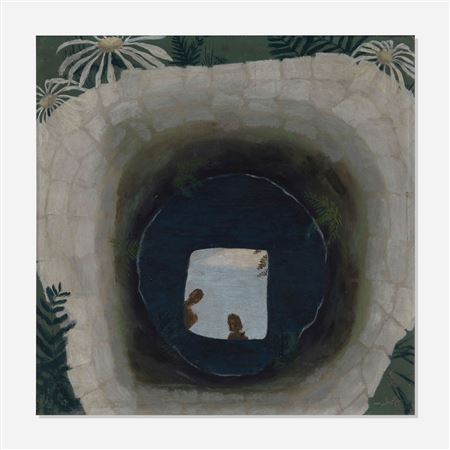
I am a painter living in New York City. I am an autobiographical artist in that I have always used the events, places, images, remembrances of my life as central themes of my work. I am looking for an essence, or inner life of an idea.?When asked what my influences have been my answer is "Almost anything except the work of other artists." I've been influenced by rocks, weeds, views from airplanes, rivers, subways, forests, machines, kinds of light, red things and imagination.?
One of my constant companions is my sketchbook. Since it is a small black book, people have thought me a poet, a scholar, a religious person carrying a prayer book. Once at Customs in Moscow my sketchbook was taken from me (later returned) because my notes were a “code.” The sketches are actually a kind of shorthand writing. The world moves so quickly that images are blurred or lost. I try to record responses and moments. Later, I work with the note-sketches, developing them to the final form.?
I was born into a large family, six brothers and one sister, and into a small house. This made it natural to spend much time out of doors. In Oklahoma the summers were long and hot and filled with small adventures. In my childhood explorations of nature (plants, rocks, caves, landscapes) I made discoveries that I use even now in my painting.?At six years, I modeled small animals and people from clay that the well drillers dug. I learned about color from rocks, leaves, and berries. A game we had was "coloring rocks." We pounded small rocks to dust, mashed berries or leaves, made colors, painted surfaces of large rocks and let them dry in the sun. At eleven I had typhoid fever. For a summer I was bedridden. I did many drawings and cutouts, and my imagination came alive.?
Thirteen was an important year. I began high school. I saw an oil painting for the first time. It was called Moonrise on Blue River. I began drawing from a live model, from casts, from imagination. I did a mural on four sides of the art room.?The following year I won a silver medal in "Free-Hand Drawing" at the Scholastic Meet at the University of Oklahoma. Many years later I won another silver medal, at the Art Institute of Chicago.
Teaching Grants/Artist-in-Residence
1950-53 Hull House, Chicago, IL (painting studio and ceramics)?
1954-61 Visiting Artist, Ball State College, Muncie, IN?
1955-56 Visiting Artist, American University of Beirut, Lebanon (Duke Foundation Grant)?
1960 Oxbow School of Painting, Saugatuck, MI (seminar in painting)?
1967-68 Visiting Professor, University of Southern Il, Carbondale, (Illinois Council for Arts)?
1970-71 Artist-in-Residence, Saint Mary's College, Notre Dame, IN?
1971 Visiting Artist, Maria Garetti School, Fort Portal, Uganda (Derance Foundation Grant)?
1974 Artist-in-Residence, Saint Mary's College, Notre Dame, IN
?1974 Collegio Santa Maria, Sao Paolo, Brazil (Derance Foundation Grant)?
1975 Artist-in-Residence, Evansville Museum, Evansville, IN (Indiana Council on the Arts)?
1976 State University of New York at Purchase, Purchase, NY?
1978 Visiting Artist, Drew University, Madison, NJ?
1979 Artist-in-Residence, Saint Mary's College, Notre Dame, IN?
1979 Visiting Artist, Drew University, Madison, NJ?
1980 Visiting Professor, School of Art, University of Denver, Denver, CO?
1980 Artist-in-Residence, Rhode Island School of Design, Providence, RI?
1980 Visiting Artist, Drew University, Madison, NJ?
1982 Artist-in-Residence, Rhode Island School of Design, Providence, RI?
1984 Lecturer and Evaluator, Cooper Union, New York, NY?
1984 Visiting Artist, Drew University, Madison, NJ?
1985 Guest Artist, Northeast Normal University, Changchun, Jilin, People's Republic, China