Page loaded successfully. Showing biography for Maria Lassnig.
Maria Lassnig BIOGRAPHY
1919 Kappel am Krappfeld, Austria - 2014 Vienna, Austria. Known for: Abstract self portriature, figurative art.
Following is The New York Times obituary of the artist. Maria Lassnig, Painter of Self From the Inside Out, Dies at 94. By RANDY KENNEDY. MAY 9, 2014. Maria Lassnig, an Austrian painter whose fierce... Read full biography
Following is The New York Times obituary of the artist. Maria Lassnig, Painter of Self From the Inside Out, Dies at 94. By RANDY KENNEDY. MAY 9, 2014. Maria Lassnig, an Austrian painter whose fierce devotion to self-portraiture — in lacerating, darkly funny, often grotesque ways — led her through... Read full biography
Following is The New York Times obituary of the artist. Maria Lassnig, Painter of Self From the Inside Out, Dies at 94. By RANDY KENNEDY. MAY 9, 2014. Maria Lassnig, an Austrian painter whose fierce devotion to self-portraiture — in lacerating, darkly funny, often grotesque ways — led her through decades of obscurity to a celebrated late-flowering career, died on Tuesday in Vienna. She was 94. Her death was announced by Hauser & Wirth, the gallery that represented her for many years along with... Read full biography
Following is The New York Times obituary of the artist. Maria Lassnig, Painter of Self From the Inside Out, Dies at 94. By RANDY KENNEDY. MAY 9, 2014. Maria Lassnig, an Austrian painter whose fierce devotion to self-portraiture — in lacerating, darkly funny, often grotesque ways — led her through decades of obscurity to a celebrated late-flowering career, died on Tuesday in Vienna. She was 94. Her death was announced by Hauser & Wirth, the gallery that represented her for many years along with the Friedrich Petzel Gallery. She is the subject of a survey, through May 25, at MoMA PS1 in Queens, spanning more than 50 years of her painting. Ms. Lassnig was unusual among late-20th century figurative artists in working not from photography or... Read full biography
Following is The New York Times obituary of the artist. Maria Lassnig, Painter of Self From the Inside Out, Dies at 94. By RANDY KENNEDY. MAY 9, 2014. Maria Lassnig, an Austrian painter whose fierce devotion to self-portraiture — in lacerating, darkly funny, often grotesque ways — led her through decades of obscurity to a celebrated late-flowering career, died on Tuesday in Vienna. She was 94. Her death was announced by Hauser & Wirth, the gallery that represented her for many years along with the Friedrich Petzel Gallery. She is the subject of a survey, through May 25, at MoMA PS1 in Queens, spanning more than 50 years of her painting. Ms. Lassnig was unusual among late-20th century figurative artists in working not from photography or observation but from what she called "body awareness," a Surrealist-influenced method of paint... Read full biography
Artist Biography
Biography page for Maria Lassnig ((1919 - 2014)), known for Abstract self portriature, figurative art. Showing 2 biographical entries and 0 sample artworks.
Maria Lassnig - Artist Info
About Maria Lassnig
Name variants
Maria Lassing
Biography from the Archives of askART
 Following is The New York Times obituary of the artist.
Maria Lassnig, Painter of Self From the Inside Out, Dies at 94
By RANDY KENNEDY
MAY 9, 2014
Maria Lassnig, an Austrian painter whose fierce devotion to self-portraiture — in lacerating, darkly funny, often grotesque ways — led her through decades of obscurity to a celebrated late-flowering career, died on Tuesday in Vienna. She was 94.
Her death was announced by Hauser & Wirth, the gallery that represented her for many years along with the Friedrich Petzel Gallery. She is the subject of a survey, through May 25, at MoMA PS1 in Queens, spanning more than 50 years of her painting.
Ms. Lassnig was unusual among late-20th century figurative artists in working not from photography or observation but from what she called "body awareness," a Surrealist-influenced method of painting only her mental perception of herself and her feelings.
Her raw, fleshy portraits might depict her in fun-house distortion, or wrestling with a lover, or with her face encased in plastic. Du Oder Ich ("You or me") from 2005, presents her naked, hairless and earless, wielding two pistols, one pointed at her head and the other at the viewer, a vision that might suggest her ambivalent feelings about the art public, which for so long denied her the recognition she felt she deserved.
"Giving her work its due in the history of postwar painting would undoubtedly knock some preconceived notions pleasantly out of whack," Roberta Smith wrote in The New York Times in 2002. And, well into her 60s, she began to receive that recognition, especially in Europe.
In 1980, the same year she was one of Austria's representatives at the Venice Biennale, Ms. Lassnig became the first female professor of painting in a German-speaking country at the University of Applied Arts Vienna. In 1988 she was the first female artist to be awarded the Grand Austrian State Prize. Last year, she was presented with the Golden Lion for Lifetime Achievement at the Venice Biennale.
Iwan Wirth, a founder of Hauser & Wirth, said that even as her health declined in recent years, Ms. Lassnig continued to work with remarkable energy and independence, drawing and painting until the last months of her life.
A few years ago, he said, when she was the subject of a major exhibition in Vienna, Mr. Wirth called her studio to offer to send a car to pick her up for the opening, which was to be attended by Austria's president. "She told me, 'Everybody's trying to send me a car. I'm going to take the bus,' " he recalled. "And she did, and the bus was delayed and nobody could find her."
Maria Lassnig was born Sept. 8, 1919, in Kappel am Krappfeld, a small town in southern Austria. Her mother gave birth to her out of wedlock and later married a much older man, but their relationship was troubled and tempestuous and Ms. Lassnig was raised mostly by her grandmother.
She studied in the 1950s at the Academy of Fine Arts in Vienna and lived in Paris, where she met André Breton, Benjamin Péret and other founders of the Surrealist movement. Under the influence of Abstract Expressionism and Art Informel, she painted abstract canvases that she often titled as self-portraits. But by the 1960s, she turned toward figuration for good, painting what she once described as "all the indentations, the things one senses."
"I do remember when it occurred to me the first time, when I got the idea of painting the way I feel at a given moment," she recalled in another interview. "I was sitting in a chair and felt it pressing against me. I still have the drawings where I depicted the sensation of sitting. The hardest thing is to really concentrate on the feeling while drawing. Not drawing a rear end because you know what it looks like, but drawing the rear end feeling."
She moved to New York in the late '60s, as painting's status was plummeting in the wake of Minimalism and Conceptualism. Her work was generally ignored, but she soaked up ideas from New York artists like Dan Graham and Vito Acconci, Conceptualists whose work often focused on the body.
She began making films in the 1970s, some comically autobiographical and others that explored tortured conceptions of the female form. By the 1990s her influence could be seen widely, showing up in the work of many younger artists like Thomas Schütte, Nicole Eisenman and Dana Schutz.
Ms. Lassnig leaves no immediate survivors.
"When I was young, I was clever enough to know that if I got married or had children, I would be eaten," she once said. "I would be sick if I couldn't paint, and I would be schizophrenic because I would have wanted to" both paint and raise a family. "So I renounced it."
She was once asked if her intense self-absorption and self-awareness were healthy or perhaps held the possibility of turning her into a hypochondriac.
"Thankfully," she replied, "I possess a strong sense of reason."Biography from Christie's London, South Kensington
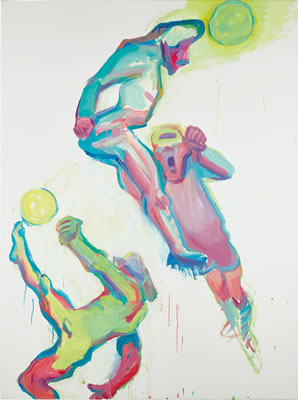
Maria Lassnig's paintings are intended to translate, both through the manner of their creation and through the images themselves, a notion of the artist's experience of her body. During her career, this has resulted in a variety of both abstracted and figurative works. In Der Tod und das Mädchen, that idea of 'body awareness' is accentuated by the almost fluid forms of the limbs and the jutting angles they have taken as the woman is propelled through her paces by the dynamic form of Death, himself rendered in colours reminiscent of flesh and bruising despite being a skeleton.
That notion of the artist's experience of her own body has lain at the centre of Lassnig's work for decades. Like Picasso, she is an artist who has become freer and freer in her artistic explorations as the years have passed, her vigour undiminished or perhaps even sharpened by her age.
She was born in 1919, meaning that Der Tod und das Mädchen was painted in her eightieth year, yet it dances with a vicious and engaging sense of motion. When her works were shown at the Serpentine Gallery, London two years ago, several critics pointed out that her works appeared to be a fresh new force, as her reputation in Great Britain was not as established as it was on the Continent. In fact, she has been a great influence both in her native Austria and beyond, and had indeed become the first female professor of painting in the entire German-speaking world when she was appointed to that position at the University for Applied Arts in Vienna in 1980.
She had already lived in New York and Paris, and been exposed to the Abstract Expressionism in the United States, a movement which informed her visceral presentations of bodily experience, both those that appear abstract and the more figurative yet nonetheless highly energised works as Der Tod und das Mädchen. It comes as no coincidence, then, that many of her works are in public collections both in the Belvedere in Vienna and in the Museum of Modern Art, New York.