Page loaded successfully. Showing biography for Max Herman Pechstein.
Max Herman Pechstein BIOGRAPHY
1881 Zwickau, Germany - 1955 Berlin, Germany. Known for: Expressionist still life, genre, figure and landscape painting, printmaking.
Although Pechstein's career was primarily in Germany, he participated in several exhibitions in the United States. His painting, Calla Lilies, received the prize of $500.00 from the Garden Club of... Read full biography
Although Pechstein's career was primarily in Germany, he participated in several exhibitions in the United States. His painting, Calla Lilies, received the prize of $500.00 from the Garden Club of Allegheny County at the 28th Carnegie International Exhibition at the Carnegie Institute in... Read full biography
Although Pechstein's career was primarily in Germany, he participated in several exhibitions in the United States. His painting, Calla Lilies, received the prize of $500.00 from the Garden Club of Allegheny County at the 28th Carnegie International Exhibition at the Carnegie Institute in Pittsburgh, October 13 to December 4th, 1927. He entered East Sea Strand, a modernist coastal scene, in the 19th International Exhibition of Watercolors at the Art Institute of Chicago, April 25th to May 26th,... Read full biography
Although Pechstein's career was primarily in Germany, he participated in several exhibitions in the United States. His painting, Calla Lilies, received the prize of $500.00 from the Garden Club of Allegheny County at the 28th Carnegie International Exhibition at the Carnegie Institute in Pittsburgh, October 13 to December 4th, 1927. He entered East Sea Strand, a modernist coastal scene, in the 19th International Exhibition of Watercolors at the Art Institute of Chicago, April 25th to May 26th, 1940. From November 28, 1947 to January 4, 1948, his oil on canvas painting, The Circus, dated 1922 was on exhibit at the Baltimore Museum of Art. Source:. The Bakkom Collection, St. Paul, Minnesota. Courtesy of Matthew Bakkom... Read full biography
Although Pechstein's career was primarily in Germany, he participated in several exhibitions in the United States. His painting, Calla Lilies, received the prize of $500.00 from the Garden Club of Allegheny County at the 28th Carnegie International Exhibition at the Carnegie Institute in Pittsburgh, October 13 to December 4th, 1927. He entered East Sea Strand, a modernist coastal scene, in the 19th International Exhibition of Watercolors at the Art Institute of Chicago, April 25th to May 26th, 1940. From November 28, 1947 to January 4, 1948, his oil on canvas painting, The Circus, dated 1922 was on exhibit at the Baltimore Museum of Art. Source:. The Bakkom Collection, St. Paul, Minnesota. Courtesy of Matthew Bakkom... Read full biography
Artist Biography
Biography page for Max Herman Pechstein ((1881 - 1955)), known for Expressionist still life, genre, figure and landscape painting, printmaking. Showing 6 biographical entries and 0 sample artworks.
Max Herman Pechstein - Artist Info
About Max Herman Pechstein
Name variants
Hermann Max Pechstein
Biography from the Archives of askART
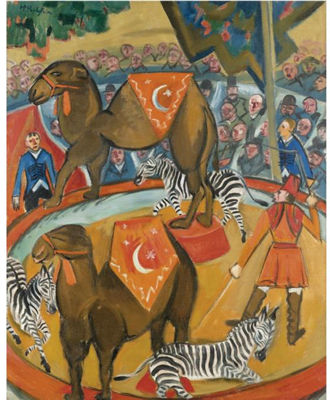 Although Pechstein's career was primarily in Germany, he participated in several exhibitions in the United States. His painting, Calla Lilies, received the prize of $500.00 from the Garden Club of Allegheny County at the 28th Carnegie International Exhibition at the Carnegie Institute in Pittsburgh, October 13 to December 4th, 1927. He entered East Sea Strand, a modernist coastal scene, in the 19th International Exhibition of Watercolors at the Art Institute of Chicago, April 25th to May 26th, 1940. From November 28, 1947 to January 4, 1948, his oil on canvas painting, The Circus, dated 1922 was on exhibit at the Baltimore Museum of Art.
Source:
The Bakkom Collection, St. Paul, Minnesota. Courtesy of Matthew BakkomBiography from Galerie St. Etienne
Hermann Max Pechstein was born in Eckerback, Germany, and studied at the School of Applied Arts and the Royal Academy of Fine Arts in Dresden. In 1905, he was awarded the Saxon State Prize for painting. The following year, he met Erich Heckel and joined the Die Brücke group in Dresden.
Pechstein traveled in 1908 to Paris, where he met the Fauve artists and exhibited with the Société Anonyme. In 1909, Pechstein joined the Berlin Sezession and exhibited with them the same year. However, after they rejected his works (and those of other avant-garde artists) in 1910, he resigned. He then helped found the Neue Sezession with George Tappert and became its first president. Pechstein exhibited with the Neue Sezession, the Blaue Reiter and published in Der Sturm between 1910 and 1912.
Pechstein traveled to the German occupied Palau Islands in the South Pacific in 1914, but was forced to leave when the Japanese invaded. On his return journey he was imprisoned by the Japanese at Nagasaki. After his release in 1915, Pechstein traveled through Asia and to the USA. Upon his return to Germany that same year, he was drafted and sent to the Western Front. He resumed his life in Berlin following his discharge in 1917.
After the war, Pechstein became one of the most active of the politicized Expressionist artists. During the early days of the Weimar Republic, he founded the Novembergruppe (along with Tappert, Klein and others), became a member of the Arbeitsrat für Kunst, and produced posters and illustrations for the Werbedienst (Publicity Office) of the provisional government. He exhibited in the first Novembergruppe exhibition in 1919 and contributed an essay, Was Wir Wollen (What We Want) to the manifesto An Alle Künstler. Pechstein joined the Liga für Menschenrechte und Sozialism (League for Human Rights and Socialism), supported the International Arbeiterhilfe and the Gesellschaft der Freunde des neuen Russia (Association of Friends of the New Russia), wrote for the socialist press and contributed illustrations to many radical journals.
During the 1920's he exhibited widely, and in 1932 he received the State Prize of the German Government. Pechstein was forbidden by the National Socialists to exhibit in Germany after 1933, and he was dismissed from his teaching position. In 1937 his works were confiscated by the Nazi's and labeled "degenerate," and six of his paintings were included in the "Degenerate Art" exhibition. During the final years of the Second World War, Pechstein was drafted into a labor detail and held in captivity in Russia . Upon his release in 1945 he returned to Berlin, where he received a teaching post at the Berlin College of Free Arts.Biography from Galerie Bassenge, Berlin
Along with landscapes and still lifes, portraits occupy a special place in Max Pechstein's late work. In 1946 Pechstein painted three portraits of Freda Wermel, all commissioned by her husband Dr. Michael T. Wermel, whom Pechstein met in Berlin in 1946. At the time, the American occupation soldier was an economics professor responsible for rebuilding unemployment insurance after the Nazi regime. After being defamed as a "degenerate artist" by the Nazis in 1937 as a first-class Expressionist, as a member of the Brücke and the New Secession, Pechstein worked at this time, from 1945, as a professor at the University of the Arts in West Berlin.
After a long period of silence and seclusion, he had only been rehabilitated shortly before he painted the "Portrait of Freda Wermel", and he seized the opportunity to once again influence art. Our portrait version is the second version of the portrait, alongside the "Freda Wermel in Spanish costume" (Soika 1946/7) and the "Freda Wermel in a blue blouse" (Soika 1946/9). According to Soika, our version remained in the artist's estate at the time. This probably explains the fact that it is unsigned. The two other versions remained in the possession of the sitters and their families until 2016/2017.Biography from Galerie Bassenge, Berlin
Pechstein spent every summer from 1927 to 1944 in the formerly remote fishing village of Rowe, now a popular Baltic Sea resort in the Polish province of Pomerania. He found numerous wonderful motifs in this untouched, unadulterated landscape and the working people. Our expressive charcoal drawing, which captures several sheaves of grain in powerful, dynamic strokes, was probably created during a late summer day in 1941. We would like to thank Julia Pechstein, Hamburg, for confirming the authenticity of the work on March 30, 2022 by email and for the kind information.Biography from Auctionata
Originally from Zwickau, Hermann Max Pechstein was one of the main representatives of German Expressionism and temporary member of the ‘Brücke’ (bridge). He mainly created figural motifs, some with exotic influence, still lives and landscapes. His landscapes are often influenced by the landscape of Pomerania where Pechstein had a lasting inspiring effect on the Artists' Colony Nidden in the years from 1909 to 1939. Due to an encounter with Ernst Ludwig Kirchner and Erich Heckel, he joined the association of artists ‘Brücke’ in 1906 as the only academic.
In 1908, Pechstein moved to Berlin. In the same year, he became a member of the ‘Berlin Secession’; in 1910, he was a co-founder and president of the ‘New Secession’. He was excluded from the 'Bridge' association in 1911, due to his simultaneous participation in the ‘Berlin Secession’.
After traveling to the South Pacific, Pechstein became a member and professor of the Prussian Academy of Arts in 1923. During the Third Reich, his works were classified as ‘degenerate’ and prohibited at exhibitions. After the Second World War, Pechstein became a professor at the Berlin University of the Arts. In 1952, he was awarded the Great Cross of Merit of the Federal Republic of Germany. Shortly before his death in 1955, Pechstein still took part at the documenta I in Kassel.
Today, Pechstein's works can be found in many museums, including the MOMA in New York, the Brücke Museum in Berlin, the State Museums of Berlin, the Albertina in Vienna and the Art Institute of Chicago. (cbo)Biography from J Levine Auction & Appraisal LLC (CLOSED)
Max Pechstein is known for expressionist still life, genre, figure and landscape painting. He played a crucial role in the breakthrough of Expressionism.
He was the first Expressionist artist to join the venerable ranks of the Prussian Art Academy in Belin. Pechstein's works were included in exhibitions next to artworks by other modern artists such as Kandinsky, Paul Klee, and Kirchner.