Page loaded successfully. Showing biography for Max Slevogt.
Max Slevogt BIOGRAPHY
1868 Landshut, Germany - 1932 Leinsweiler, Germany. Known for: Impressionist painting.
Among the depictions of landscapes in Max Slevogt's oeuvre, motifs from his adopted homeland in the Palatinate are by far the most prevalent. This also applies to the present painting, created in the... Read full biography
Among the depictions of landscapes in Max Slevogt's oeuvre, motifs from his adopted homeland in the Palatinate are by far the most prevalent. This also applies to the present painting, created in the immediate vicinity of the estate of Neukastel - which was originally owned by the family of his... Read full biography
Among the depictions of landscapes in Max Slevogt's oeuvre, motifs from his adopted homeland in the Palatinate are by far the most prevalent. This also applies to the present painting, created in the immediate vicinity of the estate of Neukastel - which was originally owned by the family of his wife and would later became the Slevogt estate after he purchased it. Following his marriage to Antonie Finkler, a friend of his youth, in 1898, Slevogt repeatedly explored the surrounding countryside,... Read full biography
Among the depictions of landscapes in Max Slevogt's oeuvre, motifs from his adopted homeland in the Palatinate are by far the most prevalent. This also applies to the present painting, created in the immediate vicinity of the estate of Neukastel - which was originally owned by the family of his wife and would later became the Slevogt estate after he purchased it. Following his marriage to Antonie Finkler, a friend of his youth, in 1898, Slevogt repeatedly explored the surrounding countryside, which was dominated by vineyards and forests, in order to pursue his newly discovered passion for plein-air painting. In our work, the viewer's gaze sweeps across the treetops of a dark-green pine forest towards three conical mountains of the... Read full biography
Among the depictions of landscapes in Max Slevogt's oeuvre, motifs from his adopted homeland in the Palatinate are by far the most prevalent. This also applies to the present painting, created in the immediate vicinity of the estate of Neukastel - which was originally owned by the family of his wife and would later became the Slevogt estate after he purchased it. Following his marriage to Antonie Finkler, a friend of his youth, in 1898, Slevogt repeatedly explored the surrounding countryside, which was dominated by vineyards and forests, in order to pursue his newly discovered passion for plein-air painting. In our work, the viewer's gaze sweeps across the treetops of a dark-green pine forest towards three conical mountains of the Palatinate Forest in the distance. At the right, viewers can recognize Burg Scharfenberg, a castle which is als... Read full biography
Artist Biography
Biography page for Max Slevogt ((1868 - 1932)), known for Impressionist painting. Showing 3 biographical entries and 0 sample artworks.
Max Slevogt - Artist Info
About Max Slevogt
Biography from Kunsthaus Lempertz
Among the depictions of landscapes in Max Slevogt's oeuvre, motifs from his adopted homeland in the Palatinate are by far the most prevalent. This also applies to the present painting, created in the immediate vicinity of the estate of Neukastel - which was originally owned by the family of his wife and would later became the Slevogt estate after he purchased it.
Following his marriage to Antonie Finkler, a friend of his youth, in 1898, Slevogt repeatedly explored the surrounding countryside, which was dominated by vineyards and forests, in order to pursue his newly discovered passion for plein-air painting.
In our work, the viewer's gaze sweeps across the treetops of a dark-green pine forest towards three conical mountains of the Palatinate Forest in the distance. At the right, viewers can recognize Burg Scharfenberg, a castle which is also known as "Münz" and whose silhouette is surrounded by the warm yellow glow of the setting sun. Three vertical reddish-brown tree trunks to the right of the painting's middle axis form a sort of repoussoir motif and simultaneously point from the shadowy zone in the foreground into the softly illuminated distance.
The "Sonnenuntergang" (Sunset) was created at a time when Slevogt had just completed his departure from Munich to Berlin in 1901 - something that meant much more than just a relocation for him. Slevogt had already been a member of the Berlin Secession since 1899 and, since that year, Bruno and Paul Cassirer had been regularly exhibiting his most recent works in their Berlin salon. "At the end of the nineties, those landscape pieces appear... which, in their whole individual value, make it possible to anticipate Slevogt's characteristic Impressionism." (cited in: Berthold Roland, Max Slevogt. Pfälzische Landschaften, Munich 1991, p. 18).Biography from Karl & Faber Kunstauktionen
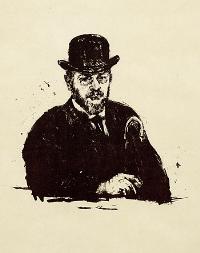
The images and photographs that are in Hans Imielas archive, suggest that it is in this portrait is a portrait of Slevogt's painter friend Robert Breyer (1866-1941). Slevogt captured here characteristic features in the physiognomy of his friend: the raised section of the eyebrows, wide-set eyes and thick hair to the left-borne crown speak for attribution to Robert Breyer.
The two young painters are probably met in 1888 at the Munich Academy for the first time in the class of Wilhelm Diez. They went in the following years together on extensive study trips and lived a long period of time even in the studio community. In these years, the connection was so close that the friends often signed with Sle yer (from Sle vogt and Bre-yer).
The very ambitious exhibition "Max Slevogt and Robert Breyer" Städtische Galerie Würzburg 1997-98, which was subsequently shown at the Kunsthalle Wilhelmshaven, made the importance of this artistic friendship very much. Friends have mutually portrayed and were held in many paintings and sketches. Slevogt's first known etching is dedicated to a full-length portrait of Robert Breyer Slevogt.
Dr. Paas writes: "Slevogt shows in this portrait a thrilling access to the physiognomy of what is depicted in the painting, working out the face, the rest of the figure leaves sketchy, its typical procedure. The bold and bravura painting suggests an origin time after 1890, at least lived in the period in which Slevogt in Munich."Biography from Sotheby's London, New Bond Street
Max Slevogt, together with Max Liebermann and Lovis Corinth formed the triumvirate of German Impressionists. Based in Berlin and Munich, Slevogt was a regular exhibitor at the Berlin Secession. In the 1920s Slevogt spent many summers in the Palatinate, where he enjoyed painting en plein air. Slevogt studied at the Munich Academy from 1885-1889 and at the Académie Julian in Paris in 1889.
However, it wasn't until Slevogt visited the 1900 Exposition Universelle in Paris where he saw the works of the French Impressionists that his painterly style changed dramatically. Until 1900 Slevogt's paintings were executed in a sombre, naturalistic style. Following his visit to the exhibition Slevogt increasingly turned to plein air landscape painting, developing a new, impressionist style of painting with vivid colours and thick, lively brush strokes. These became the hallmark of his mature style.