Page loaded successfully. Showing biography for Mervyn Laurence Peake.
Mervyn Laurence Peake BIOGRAPHY
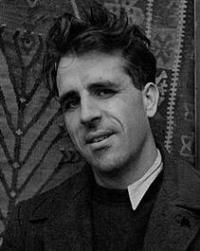
1911 Kuling, Jiangxi Qing China - 1968 Burcot, Oxfordshire, England. Known for: Illustration painting and drawing, still life, portrait and genre, war artist batlescenes.
Mervyn Laurence Peake (9 July 1911 – 17 November 1968) was an English writer, artist, poet, and illustrator. He is best known for what are usually referred to as the Gormenghast books. The three... Read full biography
Mervyn Laurence Peake (9 July 1911 – 17 November 1968) was an English writer, artist, poet, and illustrator. He is best known for what are usually referred to as the Gormenghast books. The three works were part of what Peake conceived as a lengthy cycle, the completion of which was prevented by his... Read full biography
Mervyn Laurence Peake (9 July 1911 – 17 November 1968) was an English writer, artist, poet, and illustrator. He is best known for what are usually referred to as the Gormenghast books. The three works were part of what Peake conceived as a lengthy cycle, the completion of which was prevented by his death. They are sometimes compared to the work of his older contemporary J. R. R. Tolkien, but Peake's surreal fiction was influenced by his early love for Charles Dickens and Robert Louis Stevenson... Read full biography
Mervyn Laurence Peake (9 July 1911 – 17 November 1968) was an English writer, artist, poet, and illustrator. He is best known for what are usually referred to as the Gormenghast books. The three works were part of what Peake conceived as a lengthy cycle, the completion of which was prevented by his death. They are sometimes compared to the work of his older contemporary J. R. R. Tolkien, but Peake's surreal fiction was influenced by his early love for Charles Dickens and Robert Louis Stevenson rather than Tolkien's studies of mythology and philology. Peake also wrote poetry and literary nonsense in verse form, short stories for adults and children (Letters from a Lost Uncle, 1948), stage and radio plays, and Mr Pye (1953), a relatively... Read full biography
Mervyn Laurence Peake (9 July 1911 – 17 November 1968) was an English writer, artist, poet, and illustrator. He is best known for what are usually referred to as the Gormenghast books. The three works were part of what Peake conceived as a lengthy cycle, the completion of which was prevented by his death. They are sometimes compared to the work of his older contemporary J. R. R. Tolkien, but Peake's surreal fiction was influenced by his early love for Charles Dickens and Robert Louis Stevenson rather than Tolkien's studies of mythology and philology. Peake also wrote poetry and literary nonsense in verse form, short stories for adults and children (Letters from a Lost Uncle, 1948), stage and radio plays, and Mr Pye (1953), a relatively tightly-structured novel in which God implicitly mocks the evangelical pretensions and cosy world-view of the eponymous hero.... Read full biography
Artist Biography
Biography page for Mervyn Laurence Peake ((1911 - 1968)), known for Illustration painting and drawing, still life, portrait and genre, war artist batlescenes. Showing 2 biographical entries and 0 sample artworks.
Mervyn Laurence Peake - Artist Info
About Mervyn Laurence Peake
Biography from the Archives of askART
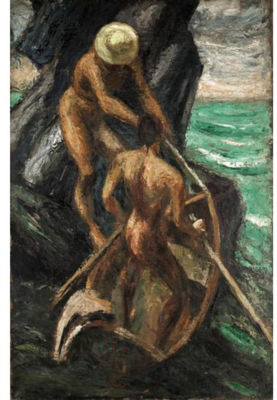 Mervyn Laurence Peake (9 July 1911 – 17 November 1968) was an English writer, artist, poet, and illustrator. He is best known for what are usually referred to as the Gormenghast books. The three works were part of what Peake conceived as a lengthy cycle, the completion of which was prevented by his death. They are sometimes compared to the work of his older contemporary J. R. R. Tolkien, but Peake's surreal fiction was influenced by his early love for Charles Dickens and Robert Louis Stevenson rather than Tolkien's studies of mythology and philology.
Peake also wrote poetry and literary nonsense in verse form, short stories for adults and children (Letters from a Lost Uncle, 1948), stage and radio plays, and Mr Pye (1953), a relatively tightly-structured novel in which God implicitly mocks the evangelical pretensions and cosy world-view of the eponymous hero.
Peake first made his reputation as a painter and illustrator during the 1930s and 1940s, when he lived in London, and he was commissioned to produce portraits of well-known people. For a short time at the end of World War II he was commissioned by various newspapers to depict war scenes. A collection of his drawings is still in the possession of his family. Although he gained little popular success in his lifetime, his work was highly respected by his peers, and his friends included Dylan Thomas and Graham Greene. His works are now included in the collections of the National Portrait Gallery, the Imperial War Museum and The National Archives.
In 2008, The Times named Peake among their list of "The 50 greatest British writers since 1945".
Mervyn Peake was born of British parents in Kuling (Lushan) in Jiangxi Province of central China in 1911, only three months before the revolution and the founding of the Republic of China. His father, Ernest Cromwell Peake was a medical missionary doctor with the London Missionary Society of the Congregationalist tradition, and his mother, Amanda Elizabeth Powell, had come to China as a missionary assistant.
The Peakes were given leave to visit England just before World War I in 1914 and returned to China in 1916. Mervyn Peake attended Tientsin Grammar School until the family left for England in December 1922 via the Trans-Siberian Railway. About this time he wrote a novella, The White Chief of the Umzimbooboo Kaffirs and much writing followed.
Peake completed his formal education at Croydon School of Art in the autumn of 1929 and then from December 1929 to 1933 at the Royal Academy Schools, where he first painted in oils.
His early career in the 1930s was as a painter in London, although he lived on the Channel Island of Sark for a time. He first moved to Sark in 1932 where his former teacher Eric Drake was setting up an artists' colony. In 1934 Peake exhibited with the Sark artists both in the Sark Gallery built by Drake and at the Cooling Galleries in London, and in 1935 he exhibited at the Royal Academy and at the Leger Galleries in London.
In 1936 he returned to London and was commissioned to design the sets and costumes for The Insect Play and his work was acclaimed in The Sunday Times. He also began teaching life drawing at Westminster School of Art where he met the painter Maeve Gilmore, whom he married in 1937. They had three children, Sebastian (1940–2012), Fabian (b. 1942), and Clare (b. 1949).
He had a very successful exhibition of paintings at the Calmann Gallery in London in 1938 and his first book, the self-illustrated children's pirate romance Captain Slaughterboard Drops Anchor (based on a story he had written around 1936) was first published in 1939 by Country Life. In December 1939 he was commissioned by Chatto & Windus to illustrate a children's book, Ride a Cock Horse and Other Nursery Rhymes, published for the Christmas market in 1940.
At the outbreak of World War II he applied to become a war artist for he was keen to put his skills at the service of his country. He imagined An Exhibition by the Artist, Adolf Hitler, in which horrific images of war with ironic titles were offered as "artworks" by the Nazi leader. Although the drawings were bought by the British Ministry of Information, Peake's application was turned down and he was conscripted into the Army, where he served first with the Royal Artillery, then with the Royal Engineers. He began writing Titus Groan at this time.
In April 1942, after his requests for commissions as a war artist – or even leave to depict war damage in London – had been consistently refused, he suffered a nervous breakdown and was sent to Southport Hospital. That autumn he was taken on as a graphic artist by the Ministry of Information for a period of six months to work on propaganda illustrations. The next spring he was invalided out of the Army.
In 1943 he was commissioned by the War Artists' Advisory Committee, WAAC, to paint glassblowers at the Chance Brothers factory in Smethwick where cathode ray tubes for early radar sets were being produced. Peake was next given a full-time, three-month WAAC contract to depict various factory subjects and was also asked to submit a large painting showing RAF pilots being debriefed. Some of these paintings are on permanent display in Manchester Art Gallery whilst other examples are in the Imperial War Museum collection.
Source:
Wikipedia, 2020Biography from Roseberys
Mervyn Peake was an author, poet, and illustrator, best known for his 'Gormenghast' series of novels. He was a soldier and later an Official War Artist during the Second World War, and the harrowing scenes he witnessed in both roles heavily influenced his art and writing for the rest of his life.
He exhibited his work with the Soho Group and at the Royal Academy, and towards the end of his life moved to Sark, an artist's colony in the Channel Islands