Page loaded successfully. Showing biography for Michael G (Mike) Ploog.
Michael G (Mike) Ploog BIOGRAPHY
Born 1942 Mankato, Minnesota. Known for: Comic book and storyboard artist, penciller, inker, film design.
Michael G. Ploog (/plu?g/; born July 13,[1] 1940 or 1942) is an American storyboard and comic book artist, and a visual designer for films. In comics, Ploog is best known for his work on Marvel... Read full biography
Michael G. Ploog (/plu?g/; born July 13,[1] 1940 or 1942) is an American storyboard and comic book artist, and a visual designer for films. In comics, Ploog is best known for his work on Marvel Comics' 1970s Man-Thing and The Monster of Frankenstein series, and as the initial artist on the features... Read full biography
Michael G. Ploog (/plu?g/; born July 13,[1] 1940 or 1942) is an American storyboard and comic book artist, and a visual designer for films. In comics, Ploog is best known for his work on Marvel Comics' 1970s Man-Thing and The Monster of Frankenstein series, and as the initial artist on the features Ghost Rider and Werewolf by Night. His style at the time was heavily influenced by the art of Will Eisner, under whom he apprenticed. Born in Mankato, Minnesota, Mike Ploog was one of a family of... Read full biography
Michael G. Ploog (/plu?g/; born July 13,[1] 1940 or 1942) is an American storyboard and comic book artist, and a visual designer for films. In comics, Ploog is best known for his work on Marvel Comics' 1970s Man-Thing and The Monster of Frankenstein series, and as the initial artist on the features Ghost Rider and Werewolf by Night. His style at the time was heavily influenced by the art of Will Eisner, under whom he apprenticed. Born in Mankato, Minnesota, Mike Ploog was one of a family of three brothers and a sister raised, initially, on a Minnesota farm. He began drawing while a young child whose imagination was fired by such old-time radio dramas as Sergeant Preston of the Yukon and Gunsmoke, and such thriller anthologies as Inner... Read full biography
Michael G. Ploog (/plu?g/; born July 13,[1] 1940 or 1942) is an American storyboard and comic book artist, and a visual designer for films. In comics, Ploog is best known for his work on Marvel Comics' 1970s Man-Thing and The Monster of Frankenstein series, and as the initial artist on the features Ghost Rider and Werewolf by Night. His style at the time was heavily influenced by the art of Will Eisner, under whom he apprenticed. Born in Mankato, Minnesota, Mike Ploog was one of a family of three brothers and a sister raised, initially, on a Minnesota farm. He began drawing while a young child whose imagination was fired by such old-time radio dramas as Sergeant Preston of the Yukon and Gunsmoke, and such thriller anthologies as Inner Sanctum Mysteries and Tales of Horror. After his parents divorced and sold the farm when Ploog was about 10 or... Read full biography
Artist Biography
Biography page for Michael G (Mike) Ploog ((Born 1942)), known for Comic book and storyboard artist, penciller, inker, film design. Showing 2 biographical entries and 0 sample artworks.
Michael G (Mike) Ploog - Artist Info
About Michael G (Mike) Ploog
Name variants
Mike Ploog
Biography from the Archives of askART
 Michael G. Ploog (/plu?g/; born July 13,[1] 1940 or 1942) is an American storyboard and comic book artist, and a visual designer for films.
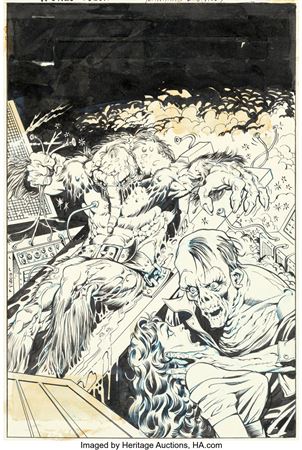
In comics, Ploog is best known for his work on Marvel Comics' 1970s Man-Thing and The Monster of Frankenstein series, and as the initial artist on the features Ghost Rider and Werewolf by Night. His style at the time was heavily influenced by the art of Will Eisner, under whom he apprenticed.
Born in Mankato, Minnesota, Mike Ploog was one of a family of three brothers and a sister raised, initially, on a Minnesota farm. He began drawing while a young child whose imagination was fired by such old-time radio dramas as Sergeant Preston of the Yukon and Gunsmoke, and such thriller anthologies as Inner Sanctum Mysteries and Tales of Horror.
After his parents divorced and sold the farm when Ploog was about 10 or 11 years old, his mother took the children to live with her in Burbank, California. Ploog entered the U.S. Marine Corps, leaving in 1968, after 10 years.
Toward the end of his hitch, he began working on the Corps' Leatherneck Magazine, doing bits of writing, photography and art.
Around 1969 he began working on Batman and Superman animated TV-series at the Los Angeles studio Filmation, doing what he called "cleanup work for other artists." The following season he was promoted to layout work on those' characters' series.
"Layout," Ploog recalled in a 1998 interview, "is what happens between storyboarding and actual animation; you're literally composing the scenes. You're more or less designing the background, putting the characters into it so they'll look like they're actually walking on the surface".
Moving to the Hanna-Barbera studio the following season, he worked on layouts for the animated series Motormouse and Autocat and Wacky Races, as well as "the first Scooby-Doo pilot; nothing spectacular, though. It was okay; it was a salary, y'know? ... I had very few aspirations, because I didn't know where anything I was doing was going to take me".
A Hanna-Barbera colleague passed along a flyer he had gotten from writer-artist Will Eisner seeking an assistant on the military instructional publication PS, The Preventive Maintenance Monthly.
Ploog was familiar with it from his Marine Corps days, and knew well the art, though not the artist's name. "I'd been copying his work for years", Ploog said, "because I was doing visual aids and training aids for the military for a long time".
Eisner in 1978 recalled that, "Mike came in working for me in 1967 [sic; Ploog was still in the Marines that year]. I was looking for someone who could work on the PS magazine ... and Mike sent me his material, or somebody sent it to me, I don't remember which, and I found myself in California, talking Mike into coming to work for us.... We had a very happy relationship for maybe two or three years, four years."
Ploog moved to New York City and remained with Eisner for just over two years. As Ploog recalled:
"Will had worked PS Magazine since about 1952, and [the owners] decided, 'We've got to put it out to somebody else.' You know, it's like he's got this dynasty going. So they said, 'Well, Will, you've got to do something. You've got to either back out of it altogether or find some way of doing this.' So Will came up with the idea: I picked up the contract, and Will became the shadow partner, and I moved across the street from Will's office into another office that he had. I don't know whether he had been leasing it, but we subleased it from Will, and we took over the book. Then it just got to be too much, because it's not that profitable without a partner, but if you've got a partner, then it becomes totally non-profitable."
Eventually, at the suggestion of Eisner letterer Ben Oda, Ploog broke into comics at Warren Publishing, doing stories for the company's black-and-white horror-comics magazines. A Western sample he showed Marvel got him a callback to draw Werewolf by Night, which premiered in Marvel Spotlight #2 (Feb. 1972). As Ploog recalled,
Somebody told me I should go to Marvel, so I got up a Western strip, oddly enough, called Tin Star. ... I went over there and they said the work was too cartoony and it wasn't Marvel-style. So I kind of gave up on it, and went back home, and less than a week later they gave me a call. Wanted me to come back in again. That's when I went in and talked to them about doing "Werewolf by Night."
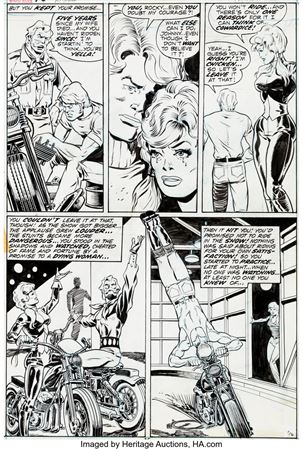
After three stories in Marvel Spotlight, the feature spun off onto its own book. Ploog then helped launched the initial, Johnny Blaze version of the supernatural motorcyclist Ghost Rider, in Marvel Spotlight #5 (Aug. 1972), and drew the next three adventures.
He left Marvel following what he describes as "a disagreement with Jim Shooter. I had moved to a farm in Minnesota, and agreed to do a hand-colored 'Weirdworld' story. Marvel backed out of the deal after I had started. I can't remember the details, but it doesn't matter. I think I was ready to move on. Marvel and I were both changing. I finished off a black-and-white Kull book that was my last comic for many years."
Ploog returned to the movie industry. By his account, he has worked in post-production on the movie Ghostbusters ("All that stuff you saw on cereal boxes are my paintings") and with film director Ralph Bakshi on the animated features Wizards, The Lord of the Rings and Hey Good Lookin'.
He was production designer on Michael Jackson: Moonwalker (1988), and has storyboarded or done other design work on films including John Carpenter's The Thing, Superman II, Little Shop of Horrors and The Unbearable Lightness of Being, and, he says, several Jim Henson Company projects, such as the films The Dark Crystal and Labyrinth and the TV series The Storyteller.
Between movies, Ploog illustrated L. Frank Baum's the Life and Adventures of Santa Claus (1992; ISBN 0-7567-6682-6), a graphic novel adapting The Wonderful Wizard of Oz creator's 1902 novella.
With old colleague Steve Gerber, Ploog drew the Malibu Comics one-shot Sludge: Red X-Mas (Dec. 1994), but otherwise remained away from comics for another decade before teaming with veteran writer J.M. DeMatteis on the CrossGen fantasy Abadazad (May 2004).
Ploog has illustrated cards for the Magic: The Gathering collectible card game.
Source:Wikipedia, 2020Biography from David Duggleby
Michael Ploog is an American storyboard and comic book artist, and a visual designer for films. In comics, Ploog is best known for his work on Marvel Comics' 1970s