Page loaded successfully. Showing biography for Michael James Aleck Snow.
Michael James Aleck Snow BIOGRAPHY
1928 Toronto, Ontario - 2023 Toronto, Ontario. Known for: Minimal abstract painting, photo montage, video.
"Renowned artist Michael Snow mixed conceptualist coups with witty populism in his long career by James Adams and Kate Taylor," Obiturary, The Toronto Globe and Mail, by James Adams and Kate Adams,... Read full biography
"Renowned artist Michael Snow mixed conceptualist coups with witty populism in his long career by James Adams and Kate Taylor," Obiturary, The Toronto Globe and Mail, by James Adams and Kate Adams, January 6, 2023. Millions of Canadians know the art of Michael Snow. His work is familiar to anyone... Read full biography
"Renowned artist Michael Snow mixed conceptualist coups with witty populism in his long career by James Adams and Kate Taylor," Obiturary, The Toronto Globe and Mail, by James Adams and Kate Adams, January 6, 2023. Millions of Canadians know the art of Michael Snow. His work is familiar to anyone who has walked under the glass arcade of the Eaton Centre in Toronto and admired the flock of Canada geese overhead or anyone who has laughed at the figures of gesticulating fans on the facade of the... Read full biography
"Renowned artist Michael Snow mixed conceptualist coups with witty populism in his long career by James Adams and Kate Taylor," Obiturary, The Toronto Globe and Mail, by James Adams and Kate Adams, January 6, 2023. Millions of Canadians know the art of Michael Snow. His work is familiar to anyone who has walked under the glass arcade of the Eaton Centre in Toronto and admired the flock of Canada geese overhead or anyone who has laughed at the figures of gesticulating fans on the facade of the Rogers Centre. And yet, if Snow is a figure of renown in the international art world, it is not for these accessible sculptures but for Wavelength, an experimental film of 1966 that featured a single 45-minute zoom shot. Snow, the Canadian painter,... Read full biography
"Renowned artist Michael Snow mixed conceptualist coups with witty populism in his long career by James Adams and Kate Taylor," Obiturary, The Toronto Globe and Mail, by James Adams and Kate Adams, January 6, 2023. Millions of Canadians know the art of Michael Snow. His work is familiar to anyone who has walked under the glass arcade of the Eaton Centre in Toronto and admired the flock of Canada geese overhead or anyone who has laughed at the figures of gesticulating fans on the facade of the Rogers Centre. And yet, if Snow is a figure of renown in the international art world, it is not for these accessible sculptures but for Wavelength, an experimental film of 1966 that featured a single 45-minute zoom shot. Snow, the Canadian painter, sculptor, filmmaker and jazz musician, was an ever-inventive artist with a long, eclectic career that repeatedly mixed concep... Read full biography
Artist Biography
Biography page for Michael James Aleck Snow ((1928 - 2023)), known for Minimal abstract painting, photo montage, video. Showing 3 biographical entries and 0 sample artworks.
Michael James Aleck Snow - Artist Info
About Michael James Aleck Snow
Biography from the Archives of askART
 "Renowned artist Michael Snow mixed conceptualist coups with witty populism in his long career by James Adams and Kate Taylor," Obiturary, The Toronto Globe and Mail, by James Adams and Kate Adams, January 6, 2023.
Millions of Canadians know the art of Michael Snow. His work is familiar to anyone who has walked under the glass arcade of the Eaton Centre in Toronto and admired the flock of Canada geese overhead or anyone who has laughed at the figures of gesticulating fans on the facade of the Rogers Centre. And yet, if Snow is a figure of renown in the international art world, it is not for these accessible sculptures but for Wavelength, an experimental film of 1966 that featured a single 45-minute zoom shot.
Snow, the Canadian painter, sculptor, filmmaker and jazz musician, was an ever-inventive artist with a long, eclectic career that repeatedly mixed conceptualist coups with witty populism. He died in Toronto Thursday from a respiratory infection at the age of 94. He leaves his wife of more than 40 years, the curator and critic Peggy Gale, their son, Alexander Snow, and his sister Denyse Rynard.
“Michael Snow was undoubtedly the most influential postwar Canadian artist,” said Adelina Vlas, head of curatorial affairs at the Power Plant art gallery in Toronto. “One can hardly imagine the history of Canadian contemporary visual arts without his work, nor can one imagine the history of structuralist film, improvisational music or artists books without Snow’s brilliant and game-changing contributions.”
If Snow can be called the leading Canadian artist of the post-Second World War period, it is because he enjoyed the widest international reputation. In 1976 he became the first Canadian to have a solo show at the Museum of Modern Art in Manhattan; titled Projects: Michael Snow, Photographs, it ran for more than two months. In the late ‘70s, a Snow retrospective prepared by the National Gallery of Canada successfully toured museums in Paris, Rotterdam, Bonn, Munich and Lucerne. In his hometown, Snow was the guy who, as a 2013 magazine profile put it, “single-handedly transformed Toronto from a Group of Seven-worshipping, landscape-loving hayseed backwater into a hub of high-stakes, high-concept art.”
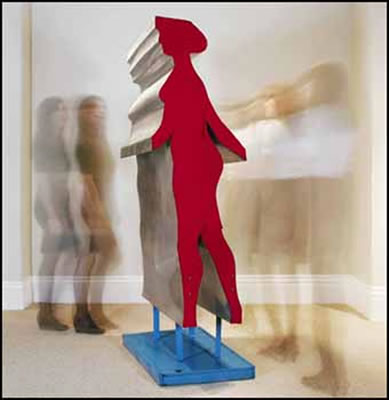
Yet just what that greatness consists of is hard to pin down. Snow’s output, spanning more than 60 years, was protean and prolific, elusive and allusive. His practice, ever-evolving, relentless and marked by a great assuredness, embraced painting and drawing, film, photography, sculpture, music and sound, performance, holography, installation and print-making but rarely in obvious or expected ways. Occasionally, he could charm a wide public, as he did in 1967 at the Expo world fair in Montreal. There, at the Ontario Pavilion, he wowed with a presentation of 11 silhouette-like stainless-steel sculptures drawn from the famous Walking Woman figure he had begun using in 1961.
More often, though, Snow liked to confound, or, perhaps more accurately, to test and contest the limits, protocols and possibilities of diverse media. He was a man with a dry wit yet a ready laugh, piercingly acute yet self-deprecating in his observations on life and art.
Enamoured of process and flux, Snow was perhaps the quintessence of Marcel Duchamp’s most famous credo: “I don’t believe in art. I believe in artists.” He liked to say (or writers liked to quote him saying): “My paintings are done by a filmmaker, sculpture by a musician, films by a painter, music by a filmmaker, paintings by a sculptor, sculpture by a filmmaker, films by a musician, music by a sculptor. … Sometimes they all work together. Also, many of my paintings have been done by a painter, sculpture by a sculptor, films by a filmmaker, music by a musician.” No wonder a 2007 article on him in the arts magazine Border Crossings was titled “The Lord of Missed Rules.”
Snow, who was born in Toronto on Dec. 10, 1928, came from “the best of society.” He and an older sister were raised largely in a 14-room house on the southern edge of the city’s Rosedale neighbourhood. Later, in the mid-1940s, he was enrolled in Upper Canada College, the all-male private school for the Canadian establishment. He reportedly hated it, yet it was there, in 1947, that he produced his first art, a painting, which won him a prize and served as his entrée the next year to what was then called the Ontario College of Art, (now OCAD University.)
Snow’s father, Gerald Bradley Snow, was a peripatetic civil engineer, surveyor and the grandson of a former Toronto mayor. His mother, Marie-Antoinette Lévesque, was the daughter of the mayor of Chicoutimi, Que.; Snow met her there at a party thrown by the lumber-and-hydro baron Sir William Price while he was working as a consultant for a construction company. Shortly thereafter, they eloped. It was not a happy marriage. She was outgoing, a talented pianist, an avid reader who reportedly could speak six languages. He was a First World War veteran, gaunt, reserved, “a classic depressed Torontonian,” as Gale told Toronto writer Adele Freedman in 1994.
(Snow’s parents eventually divorced. Gerald Bradley died at 72 in 1964; Marie-Antoniette remarried, to Cuban-born Toronto art dealer Roberto Roig, and lived until almost 100, dying in 2004.) When Snow was 5, in 1934, his father lost one eye in an explosion in a tunnel while the other was “peppered with dust.” By the early 1950s Gerald Bradley Snow had lost his sight entirely. Later, Snow would suggest that his father’s blindness, his mother’s musicality and his bi-cultural heritage were central to his artistic development. By the ‘50s, he was casting about for some direction. He knew he had what might be called an artistic temperament but how best to express it?
For all his aptitude in visual arts, he was also mad for jazz – Dixieland, bebop, boogie-woogie – which he gamely played on piano, accompanying like-minded buddies in various combos, even though he couldn’t read music. Entering OCA and taking the design program there was a kind of compromise, he told an interviewer in 1971. “I didn’t know whether I was going to turn out to be a commercial artist or what.” Meanwhile, “Father was losing his sight when I was becoming an artist,” he told another interviewer in 1994, “so I guess I stressed the optical aspects of art.” He went on to declare that “the variety of my work ultimately comes from confusion.”
While studying at OCA, Snow got more deeply into painting, familiarizing himself with the works of Paul Klee, Piet Mondrian and Wassily Kandinsky. Graduating in 1952, he scored a short-lived job at an ad agency, then, in 1953, headed to Europe, bumming around for about 15 months, gallery-hopping, playing music and doing the occasional drawing or oil painting. Back in Canada, he showed at the University of Toronto’s Hart House in 1955 with former OCA pal Graham Coughtry – an exhibition that would have passed without comment had Toronto mayor Nathan Phillips not attended and deemed several nude works obscene. By the next year Snow had a dealer, the enterprising Avrom Isaacs, with whom Snow would have a profitable association until the early 1990s when Isaacs retired. The Hart House show did get Snow a job – this time as an animator for TV commercials for Graphic Associates, a new film production house. His boss was George Dunning, who had worked with the legendary Norman McLaren at the National Film Board and who went on, in 1967, to animate and direct The Beatles’s trippy cartoon feature Yellow Submarine. Graphic Associates lasted for about two years, long enough for Snow to make his first two films, both animated shorts, and to date a vivacious co-worker and similarly aspiring artist, Joyce Wieland, roughly two years his junior. They would marry in September, 1956.
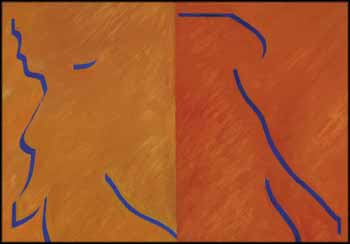
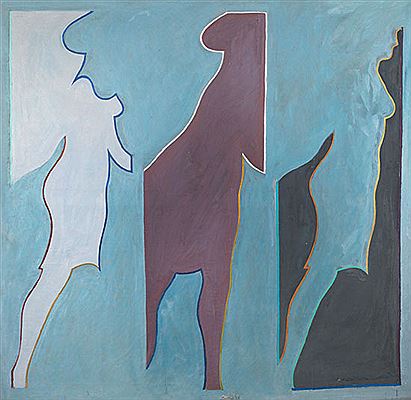
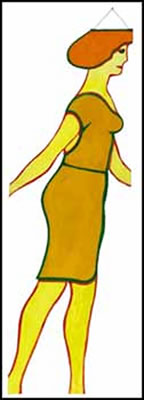
With the collapse of Graphic, Snow decided to get a studio and delve more deeply into his art – without, of course, settling on any one thing. There were paintings, monochromatic and quasi-abstract expressionist, and collages, mixed-media assemblages, room-sized sculptures that, in the words of writer Emily Landau, “resembled lumbering wooden leviathans.” During this time, Snow also created what became his “logo” – the cardboard cut-out known as Walking Woman, a simple figure in profile that would serve as the prototype for literally hundreds of iterations in all media for the next six years. Hauled into the Toronto subway, plastered on hoardings or printed on postcards, she was everywhere in a bold act of guerrilla art that would foreshadow Snow’s public commissions in later years.
Through the period he continued to play piano, making his living from a regular gig with Mike White’s Imperial Jazz band at the Westover Hotel, a funky venue on the eastern edge of Toronto’s downtown that became home to Filmores Hotel.Still, it took a move by Snow and Wieland to New York in the fall of 1962 for Michael Snow to become Michael Snow. There, living and working in cold-water lofts in lower Manhattan, he experienced an immediate expansion of his ideas and techniques in New York’s fertile cultural milieu. He got to know, among many others, Jonas Mekas, Hollis Frampton and Ernie Gehr, titans all of American avant-garde cinema. In early 1966, Snow began to make notes for his own major foray into film.
This was Wavelength, a landmark in the history of the medium – “the Birth of a Nation in underground films,” according to the American painter and film critic Manny Farber – and the work that launched Snow into the international avant-garde. Shot in one week in December, 1966 in the Wieland/Snow loft in Tribeca, Wavelength is a film about film itself, the elements that constitute its grammar, and, for Snow personally, “a summation of my nervous system, religious inklings and aesthetic ideas.” It runs 45 minutes and consists of a single continuous zoom shot slowly heading to a photo of a swelling sea positioned on the opposite side of the loft. En route, the zoom records four “human events,” among them the installation of a shelving unit and a death. Screened in 1967 to both acclaim and bewilderment, Wavelength went on to win the grand prix at the 1968 World Experimental Film Festival in Belgium.
Many other “moving-image” works, including video and film installations, followed over the next five decades. Some – like 1971's three-hour La Région Centrale, shot on a mountaintop in northern Quebec using a remote-controlled camera-activated machine, and 1974's Rameau’s Nephew, 270 minutes long, with no narrative continuity – were hailed as masterpieces by critics but it seems, in the long run, Wavelength’s stature in the cinematic canon is likely the most secure. Today, the Toronto International Film Festival continues to honour it by using the name Wavelengths for its experimental film program.
It seems it was no coincidence that Snow had first achieved public recognition with an image that literally objectified a woman’s body, turning a curvaceous silhouette into a simplified graphic statement that ended at the wrists and ankles, cutting off hands and feet. In retrospect, the avant-garde of the 1960s and 1970s can be recognized as an aggressively laddish scene – the New York filmmakers were exclusively male as were the various jazz ensembles in which Snow played and, although Isaacs represented Wieland too, his stable was dominated by male artists in those early years. Walking Woman was the product of 20 years of ogling, Snow once told Maclean’s magazine, and Wieland, a heart-on-the-sleeve personality in contrast to the cooler Snow, complained of his infidelities to friends.
In New York, she was becoming a political activist – the couple were loudly opposed to the war in Vietnam – but also a feminist and a Canadian nationalist. She got recognition in Canada with her True Patriot Love show at the National Gallery in 1971 and was drawn to the Trudeaumania of Pierre Trudeau’s first years in office. It was the right time for both artists to move back to Toronto in 1972, but their marriage broke up four years later. (Wieland died from complications of Alzheimer’s disease in 1998.)
Snow had now achieved recognition at home and abroad – in 1970, he was the first person to be given a solo show in the Canada Pavilion at the Venice Biennale – and he returned to a culturally awakened Toronto as a triumphant mid-career artist. He became active on the Isaacs Gallery scene, encouraged the development of experimental film in Canada, joined the Artists’ Jazz band and help found the Canadian Creative Music Collective which established Toronto’s Music Gallery as a space for jazz and new music. After his divorce, he married Gale and their son Alexander was born in 1980.
In the subsequent decades, Snow continued to experiment and to show internationally, working with photography and light. In the 1980s, he began to experiment with holographs, creating a series of still lifes that juxtaposed them with real objects to underline the irreality of the holographic. In 2011, he hung a series of single-coloured transparencies on fishing line in a gallery in Lisbon, inviting the spectator to walk among the panels to experience the abstract colour effects, simplifying a similar piece made of framed colour transparencies that he had created at the Montreal Museum of Fine Arts in 1998.
Much of this work is conceptual but Snow’s fame also brought him offers of major public art commissions for which he took a more populist approach. These include the giant fans at the Rogers Centre, and Flight Stop of 1979, the gaggle of geese coming in for a landing under the roof of the Eaton Centre, both in Toronto. To create the work, Snow had a Canada goose killed so he could sketch the bird’s anatomy in detail. The final piece, which must count as one of the most viewed art works in Canada, was also the subject of an important legal decision. In 1981, Eaton Centre decorators tied red bows on the geese for Christmas and Snow sued, arguing that even though he had sold the work he retained a moral right to see its integrity maintained. He won, setting an important precedent in Canadian law covering an artist’s moral rights, and the bows came down.
“[He had a] down-to-earth sense of humour and ability to relate to everyone,” Vlas said. “That aspect of his personality found a form in the public art projects that he created for various sites in Toronto. Playful and witty, these works will always be one of his most visible and enduring legacies.”
In 2013, he executed one of his boldest moves yet in public art, a 65-storey light sculpture (produced with lighting designer Jonathan Speirs) that runs up the side of what was then called the Trump Tower, now the St. Regis hotel, in downtown Toronto. Yet in his final years, he was also working on a much more personal project, My Mother’s Collection of Photographs, a book of 1,500 images assembled from his mother’s albums. He had been working on the project for almost 10 years after including a smaller selection in a catalogue for a 1970 exhibition at the Art Gallery of Ontario.
“We will never be without Michael Snow,” said Concordia University art historian and Snow biographer Martha Langford. “From the Walking Woman Works to his last magnificent book, My Mother’s Collection of Photographs, Michael Snow leaves us in a state of heightened perception which was his greatest gift.”Biography from the Archives of askART
 The following biographical information, submitted August 2006, is from the artist, who was born in Toronto, Canada in 1928.
Michael Snow works in many mediums: painting, sculpture, video, films, photography, holography, drawing, books and music.
BIOGRAPHY
Michael Snow
This artist works in many artistic disciplines: painting, sculpture, video, films, photography, holography, drawing, books and music.
In 2004, the Université de Paris I, Panthéon-Sorbonne awarded him an honorary doctorate. The last previous artist so awarded was Pablo Picasso.
Snow's works are exhibited regularly in museums and galleries, particularly in Paris, Brussels, Berlin, Montreal, Toronto and New York. His works were included in the shows marking the reopening of both the Centre Pompidou in Paris in 2000 and the MoMA in New York in 2005. In March 2006 his works were included in the Whitney Biennial.
In his 2002 Village Voice review of *Corpus Callosum, J. Hoberman wrote "Rigorously predicated on irreducible cinematic facts, Snow's structuralist epics—Wavelength and La Région Centrale—announced the imminent passing of the film era. Rich with new possibilities, *Corpus Callosum heralds the advent of the next. Whatever it is, it cannot be too highly praised." *Corpus Calossum was screened at the Toronto, Berlin, Rotterdam, and the Los Angeles film festivals amongst others.
In January 2003, Snow won the Los Angeles Film Critics Association, Douglas Edwards Independent Experimental Film/Video Award for *Corpus Callosum. His numerous films have premiered in major film festivals all over the world. Five of his films have premiered at the Toronto International Film Festival (TIFF). In 2000, TIFF commissioned Snow with Atom Egoyan and David Cronenburg to make short films, Preludes, for the 25th Anniversary of the Toronto International Film Festival.
His public art works include the iconic geese, Flight Stop, at the Eaton Centre and The Audience at the SkyDome/Rogers Centre, both in Toronto. His works have been in virtually every Canadian pavilion at every world fair since his Walking Women sculpture was in Expo 67 in Montreal.
In 1993 The Michael Snow Project was a many month, multi-venue major retrospective of Snow's works in Toronto including public venues and at the Art Gallery of Ontario and The Power Plant. Concurrently his works were the subjects of four books published by Alfred A. Knopf Canada.
Walking women are the subject of his most recent book work BIOGRAPHIE of the Walking Woman / de la femme qui marche 1961-1967 (2004), published in Brussels by La Lettre vole. It is all images of public appearances of his famous icon.
Anarchive2: Digital Snow describes Michael Snow as "one of the most significant artists in contemporary art and cinema of the past 50 years." This 2002 DVD was initiated by Paris' Centre Pompidou and produced with the support of la foundation Daniel Langlois, Université Paris, Heritage Canada, the Canada Council, Téléfilm Canada and Montreal's Époxy. It is an encyclopaedia of his works in many media, browsed in a manner inimitably and artfully created by Snow. Its 4,685 entries include film clips, sculpture, photographs, audio and musical clips, and interviews.
He is both a jazz pianist and an experimental musician. He performs regularly in Canada and abroad, often with CCMC, the improvisational music ensemble with which he has performed for more than a decade and with which he has released more than a half dozen albums.
EXHIBITIONS: Current and Upcoming
A solo exhibition of Snow's installation works will be presented at MALI (Art Museum of Lima) in Peru, opening June 2006. His work appears in Ethnic Marketing, an international exhibition at the Tehran Museum of Contemporary Art, also opening June 2006.
Sculpture and video by Snow will be in Palindromes at the Biennale d'art contemporain du Havre, France, opening June 2006, continuing to September 2006 (curated by Claude Gosselin). In May 2006, he will present a film program and solo piano concert at Xcèntric, Centro de Cultura Contemporània de Barcelona.
Snow's i new moving-image work titled The Window Suite (formerly known as Exposures) will be installed on the façade of the Pantages hotel/condominium complex in downtown Toronto in spring 2006. His proposal for the site was selected in a competition of June 2003, and has been in production since that date.
At the Whitney Biennial, opening 2 March 2006 (until May) in New York, Snow shows three works: the films SSHTOORTTY, WVLNT… and video installation SHEEPLOOP.
The group exhibition Raconte-moi/Tell me will open in September 2006 at the Forum d'art contemporain in Luxembourg
EXHIBITIONS Just completed:
Snow's projection work Solar Breath (Northern Caryatids) was presented along with a selection of his films by Lumen/Evolution, in a week-long presentation of international experimental cinema in Leeds, UK in April 2006.
His three-screen video installation That/Cela/Dat was included in the international group exhibition Smile Machines, curated by Anne-Marie Duguet, part of Transmediale.06 presented at the Akademie der Künste, Berlin, in February-March 2006.
October Magazine, issue 114 (fall 2005) features three separate articles on Snow's work, and an interview with Annette Michelson.
SSHTOORTY was screened at Berlinale, the Berlin Film Festival, February 2006.
Snow was visiting artist/lecturer at the Ecole Cantonale d'Art du Valais in Sierre, Switzerland, January 2006
His video Sheeploop is projected in the Paris metro (Madeleine) during January 2006.
Snow showed projection works and prints in a two-person exhibition with Sam Taylor-Wood at the Museum of Modern Art in New York September, October and November 2005.
Simultaneously the MOMA cinema showed a retrospective of Snow films.
He lectured at MOMA on October 5, 2005 in a new series of "media" lectures. Snow was a visiting artist/lecturer at the Rhode Island School of Design in November 2005.
Curated by Martha Langford for the Galerie de l'UQAM and Mois de la Photo, an exhibition of Snow's work concentrating on Windows and Framing ran the months of September and October 2005 in Montreal.
Projection works were in a major group exhibition Raconte-moi/Tell me October and November 2005 at The Musée des Beaux Arts, Quebec City.
Snow's most recent film SSHTOORRTY had its Toronto premiere at the Toronto International Film Festival, Sept 13, 2005.
RECENT ACTIVITIES
Snow was included in the important exhibition LisboaPhoto at Centro Cultural de Belem in Lisbon, Portugal (May 2005), in the section "Etats d'Images", co-curated by Raymond Bellour and Sérgio Mah.
Invited to the Getty Foundation (Los Angeles) in April 2005, Snow was part of Filmmakers/Musicians with Tony Conrad for film screenings and a solo piano concert. His films were also screened at UCLA and Film Forum.
Snow's projection work Solar Breath…. Was in an international group exhibition curated by Raymond Bellour in Lisbon, Portugal in April/May 2005
He was a visiting artist/professor at L'Ecole nationale supérieure d'art de Bourges, France, in December 2004 and May 2005. For May, he also presented two exhibitions: Hearing Aid at La Box, and Hue, Chroma, Tint at Transpalette, plus a solo piano concert
In March 2005 Snow presented an evening of projections and music entitled Hue, Chroma, Tint at Daniel Langlois' club 357c in Montreal.
Further, his 1969/1970 slide-carrousel work, Sink, was in Small: The Object in Film, Video and Slide Installations at the Whitney Museum, New York (18 November 2004 - 6 March 2005). His recently-completed two-screen collaboration with Toronto filmmaker Carl Brown, Triage, was shown 22 November 2005 at the Museum of Modern Art, New York, as part of the renovated MoMA's opening exhibitions, and again in December.
Snow had three works in Timelength at Galerie Leonard et Bina Ellen, Concordia University (Montreal) 10 November - 22 December 2004.
Works by Snow were included in a many-media group exhibition called Régarder, observer, surveiller, at Galerie Séquence, Chicoutimi, Quebec, August-September 2004.
Photo-works were presented at PhotoEspana, Madrid, Spain, June-August 2004.
Kino Arsenal in Berlin presented a four-week retrospective of Snow's film works, along with several video installation pieces, in June 2004. He presented a solo piano concert on a program with the performance of his recently-composed Hue, Chroma, Tint, for classical quartet, at the Hamburger Bahnhof. He also signed copies of his recently-published all-image bookwork BIOGRAPHIE, at Galerie/Verlag Barbara Wien.
An honourary degree was conferred on Snow by Emily Carr Institute of Art and Design, Vancouver, on 8 May 2004.
On 15 March 2004 Snow received an honorary doctorate (docteur honoris causa) at l'Université de Paris 1, Panthéon-Sorbonne.
In March 2004, Snow co-exhibited (film retrospective plus photographic work) with Heinz Emigholz at Goethe-Institut Toronto.
During 2003-2004 Snow's work was part of the touring exhibition Sound Tracks at Edmonton, Toronto, and Regina Saskatchewan in Canada. At both Edmonton and Regina Snow also played a solo piano concert.
A thirty-minute two-screen collaboration with Toronto filmmaker Carl Brown, titled Triage, had its world premiere at Goethe -Institut in Toronto, 22 April 2004.
During February-June 2004, Snow's Two Sides to Every Story was included in X-Screen. Filmische Installationen und Aktionen der 60er und 70er Jahre at MUMOK (Museum Moderner Kunst Stiftung Ludwig Wien), Vienna.
New photoworks were presented in an exhibition titled Powers of Two at Jack Shainman Gallery in New York (Feb-March 2004), where Snow's new all-image book BIOGRAPHIE of the Walking Woman / de la femme qui marche 1961-1967 (2004), published in Brussels by La Lettre volée, was also launched. Additional launches for BIOGRAPHIE were held in Toronto and Brussels in March 2004.Biography from the Archives of askART
 askART Footnote:
Interestingly, virtually every obituary for Snow including the one on the website of the National Gallery of Canada has a headline that says Snow was 94 years old and states that he was born on December 10, 1928; however, most of his published biographies such as those in the Who’s Who in American Art books, Benezit, A Checklist of Painters, C1200 - 1994, Abstract Painting in Canada, Contemporary Canadian Art, Biographical Index of Artists in Canada, etc. list Snow’s birth year as 1929.
We contacted Kali at Jack Shainman Gallery in New York who confirmed that they had discussed the birth year discrepancies with Michael Snow several years ago and confirmed that it is in fact 1928.
– M.D. Silverbrooke (January 7, 2023)