Page loaded successfully. Showing biography for Monir Shahroudy Farmanfarmaian.
Monir Shahroudy Farmanfarmaian BIOGRAPHY
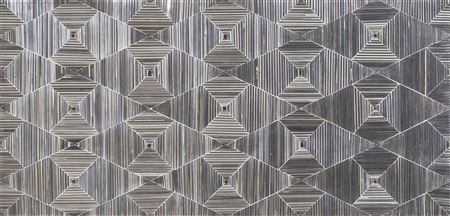
1924 Qazvin, Iran - 2019 Tehran, Iran. Known for: Islamic motif glass mosaics, reverse glass abstract painting, collage, wooden forms.
"Monir Farmanfarmaian, 96, Dies; Artist Melded Islam and the Abstract," Obituary, The New York Times online, by Jason Farago, April 29, 2019. Monir Shahroudy Farmanfarmaian, an Iranian artist whose... Read full biography
"Monir Farmanfarmaian, 96, Dies; Artist Melded Islam and the Abstract," Obituary, The New York Times online, by Jason Farago, April 29, 2019. Monir Shahroudy Farmanfarmaian, an Iranian artist whose mirror-encrusted geometric compositions drew on both Islamic architecture and the abstractions of the... Read full biography
"Monir Farmanfarmaian, 96, Dies; Artist Melded Islam and the Abstract," Obituary, The New York Times online, by Jason Farago, April 29, 2019. Monir Shahroudy Farmanfarmaian, an Iranian artist whose mirror-encrusted geometric compositions drew on both Islamic architecture and the abstractions of the postwar New York avant-garde, died on April 20 in Tehran. She was 96. The death was confirmed by a grandson, Aziz Isham. Ms. Farmanfarmaian (pronounced far-mahn-far-MY-ahn) emerged as a key actor in... Read full biography
"Monir Farmanfarmaian, 96, Dies; Artist Melded Islam and the Abstract," Obituary, The New York Times online, by Jason Farago, April 29, 2019. Monir Shahroudy Farmanfarmaian, an Iranian artist whose mirror-encrusted geometric compositions drew on both Islamic architecture and the abstractions of the postwar New York avant-garde, died on April 20 in Tehran. She was 96. The death was confirmed by a grandson, Aziz Isham. Ms. Farmanfarmaian (pronounced far-mahn-far-MY-ahn) emerged as a key actor in the worldwide development of abstract art in recent years, as curators of American and European museums began to map a global history of postwar painting and sculpture. Her art ranged from decorous early floral painting to stern, memory-haunted... Read full biography
"Monir Farmanfarmaian, 96, Dies; Artist Melded Islam and the Abstract," Obituary, The New York Times online, by Jason Farago, April 29, 2019. Monir Shahroudy Farmanfarmaian, an Iranian artist whose mirror-encrusted geometric compositions drew on both Islamic architecture and the abstractions of the postwar New York avant-garde, died on April 20 in Tehran. She was 96. The death was confirmed by a grandson, Aziz Isham. Ms. Farmanfarmaian (pronounced far-mahn-far-MY-ahn) emerged as a key actor in the worldwide development of abstract art in recent years, as curators of American and European museums began to map a global history of postwar painting and sculpture. Her art ranged from decorous early floral painting to stern, memory-haunted collages. But her most compelling works were polygonal wooden forms, sometimes free-standing and sometimes mounted on the wall, t... Read full biography
Artist Biography
Biography page for Monir Shahroudy Farmanfarmaian ((1924 - 2019)), known for Islamic motif glass mosaics, reverse glass abstract painting, collage, wooden forms. Showing 2 biographical entries and 0 sample artworks.
Monir Shahroudy Farmanfarmaian - Artist Info
About Monir Shahroudy Farmanfarmaian
Name variants
Monir
Biography from the Archives of askART
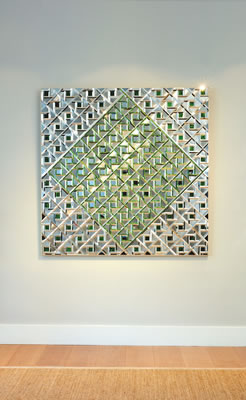 "Monir Farmanfarmaian, 96, Dies; Artist Melded Islam and the Abstract," Obituary, The New York Times online, by Jason Farago, April 29, 2019
Monir Shahroudy Farmanfarmaian, an Iranian artist whose mirror-encrusted geometric compositions drew on both Islamic architecture and the abstractions of the postwar New York avant-garde, died on April 20 in Tehran. She was 96.
The death was confirmed by a grandson, Aziz Isham.
Ms. Farmanfarmaian (pronounced far-mahn-far-MY-ahn) emerged as a key actor in the worldwide development of abstract art in recent years, as curators of American and European museums began to map a global history of postwar painting and sculpture.
Her art ranged from decorous early floral painting to stern, memory-haunted collages. But her most compelling works were polygonal wooden forms, sometimes free-standing and sometimes mounted on the wall, that were covered in thousands of precisely cut small mirrors. She made her first such work in 1969, and soon was producing hexagon-shaped reliefs festooned with mirrors that fractured viewers’ reflections into uncanny multiples.
By her 80s, she was working at architectural scale, producing multipart compositions of polygons covered in mirrors and painted glass, which married the exuberant splendor of Iranian decorative arts with the repeated forms of minimalism and geometric abstraction. Ms. Farmanfarmaian also made intricate drawings whose interlocking circles and hexagons translated the tropes of Islamic decorative arts into a realm of pure form.
Where some theorists of abstraction in Europe and the United States sought to purge painting of all ornament and historical lineage, Ms. Farmanfarmaian produced an abstract art proud of its debts to local architecture, interior design and contemporary fashion. Some were gaudy, and none were afraid of kitsch: Her mirrored spheres of the 1970s could function as disco balls.
New Yorkers discovered her accomplishment in a 50-year retrospective, organized by the Museu de Serralves in Porto, Portugal, that toured to the Solomon R. Guggenheim Museum in 2015 — seven decades after she first arrived in the city.
In a life marked by migration and revolution, spent between Iran and the United States, Ms. Farmanfarmaian befriended countless artists, notably Milton Avery, Andy Warhol and Frank Stella. She hosted salons at her Tehran home — inviting poets and artists to debate the state of Persian culture over abgoosht, a simple lamb stew — and later at her New York penthouse. She collected her friends’ art as well, though most of her collection was lost after the Iranian Revolution of 1979.
Yet for all her cosmopolitanism, Ms. Farmanfarmaian never sought to dissociate her abstractions from the history, geography and society of Iran. As she told the Art Newspaper in 2014, at the inauguration of a museum in Tehran devoted to her work, “My love for my culture is in everything I create.”
Monir Shahroudy was born on Jan. 13, 1923, in Qazvin, a city in northwest Iran. Her mother, Fatemeh, was an Ottoman aristocrat. Her father, Bagher, who founded Qazvin’s first school for girls, was elected to Parliament in 1932 and moved the family to Tehran.
In her teens Monir enrolled at the University of Tehran, where she studied fine arts, but she found the faculty stultified. She dreamed of Paris, but World War II put that city out of reach. So in 1944 she sailed first to India and then, on an American warship, to Los Angeles. From there she traveled cross-country to New York, which, after a three-month journey, struck her as unimpressive.
“For the sheer scale of big-city bustle and the impact of the strange and exotic,” she wrote in her autobiography, A Mirror Garden, in 2008, “New York could hardly compete with Bombay.”
In New York, Ms. Farmanfarmaian studied fashion illustration at the Parsons School of Design, worked on her English, danced with Martha Graham’s company and soon fell in with the artists at the Eighth Street Club, where Jackson Pollock, Willem de Kooning and others debated the course of abstraction, and at the Cedar Tavern, where they continued the debate over liquor.
“I was not drinking; I was a good Muslim at that time,” she recalled in an interview in 2015. “Now,” she added with a laugh, “I’ve become very bad.”
In 1950 she married Manoucher Yektai, a fellow Iranian artist, and had a daughter, Nima, with him. The couple divorced in 1953, and Ms. Farmanfarmaian took a day job at the department store Bonwit Teller (where her drawing of a bouquet of Persian violets, done before she went to work for the store, wound up adorning its shopping bags).
Among her colleagues there was a young Warhol, with whom she collaborated on the store’s newspaper advertisements and gossiped over picnic lunch breaks. They remained friendly for decades. When Warhol died in 1986, a sculpture of hers — a mirror-flecked ball she had given to him when he went to Iran to paint Empress Farah Pahlavi — was sitting on a table in his living room.
In 1957 she married Abol Bashar Farmanfarmaian, a lawyer and scion of one of Iran’s most powerful families and a descendant of the Qajar princes who ruled in the late-18th and 19th centuries. Later that year the couple returned from New York to Tehran, which was then one of the most vibrant art capitals of the Middle East; the first Tehran biennial would take place in 1958, and Persian artists of the 1960s were drawing on local and international influences in the service of a secular modern art.
She traveled extensively, visiting the ruins of Iran’s previous empires and collecting vernacular illustrative artworks known as coffeehouse paintings. She also kept in contact with American artists. In 1966, during a visit to Shiraz with the minimalists Robert Morris and Marcia Hafif, she entered the Shah Cheragh mosque and watched pilgrims wail and chant in front of the mirrors festooning its walls and central dome.
“I cried, too,” she later remembered, “because of all the beautiful reflections. I said to myself, ‘I must do something like that.’ ”
Her mirrored works drew also on the architecture of Safavid palaces, whose walls were decorated with mosaics made of thousands of shards of mirrors cut into tessellated triangles and hexagons. Though informed by religious or mystical designs — she noted that the hexagon was “a polygon associated with heaven in the Islamic pantheon” — her art was above all a study of forms, perceptions and light.
“Sol LeWitt had his square, and it was wonderful how far he went with the square,” she said of the American artist in an interview with the curator Hans Ulrich Obrist for a 2011 catalog. “For me everything connects with the hexagon. And the hexagon has the most potential for three-dimensional sculpture and architectural forms.”
Ms. Farmanfarmaian and her husband were in the United States when the Iranian revolution began. The couple lost most of their belongings, and they spent several years bouncing among apartments until finding a Fifth Avenue penthouse that was going cheap, thanks to the previous tenant’s connection to a grisly murder.
“There was nothing I could do except listen to the bad news from Iran — ‘Khomeini is coming, Khomeini is coming’ — and I just sat in front of the television doing calligraphy with a marker,” she told Mr. Obrist. While in exile she also created her lesser-known “Heartache” boxes, incorporating family fabrics and heirlooms into downcast assemblages.
In 2004, widowed, Ms. Farmanfarmaian returned to a transformed, traffic-choked Tehran and threw herself back into the mirror sculptures, working now with a large workshop of artisans who could scale up her maquettes into ravishing architectural projects.
The capital today is home to a museum of her art, associated with the University of Tehran, which opened in 2017. It is known simply as the Monir Museum, a testament to her stature even in the Islamic Republic, but also a quiet derogation of the name Farmanfarmaian, with its evocations of the old regime.
She is survived by her daughters Nima Isham and Zahra Farmanfarmaian; five grandchildren; and four great-grandchildren.
The mirrored surfaces of her art, and the multiple perspectives and reflections they afford, stand to some degree as a symbol of Ms. Farmanfarmaian’s rich life. In 2015, on the occasion of her Guggenheim show, she told a reporter for The New Yorker:
“Each of these forms has thousands and thousands of ways to see it. Mirrors are a reflection of anything and everything. You become part of that mirror. It is communication — the mirror and yourself, the piece of art and yourself.”Biography from the Archives of askART
 "Recollections: Monir Farmanfarmaian" By Juliet Cestar
Nafas Art Magazine, June 2008
At the age of 84, Monir Shahroudy Farmanfarmaian is witnessing a glittering revival as one of Iran's most inspiring and innovative living artists. She enjoyed her first comeback shows after almost thirty years at the Victoria and Albert Museum in London and the Niyavaran Cultural Centre in Tehran in 2006, followed by the Third Line gallery in Dubai in 2007. On 18 June, a major solo exhibition of her work opens at the Leighton House Museum in London.
Farmanfarmaian's art is deeply rooted in Iranian culture and tradition, both in form and spirit, despite her formal training in New York at the Parsons School of Art and Design and her 12 years spent there as a freelance designer for Vogue, and as a commercial and fashion designer for the department store Bonwit Teller. Now back in Tehran, she displays, in her recent work, a wildly energetic productivity that defies the horizon of a lifetime now in its eighth decade.
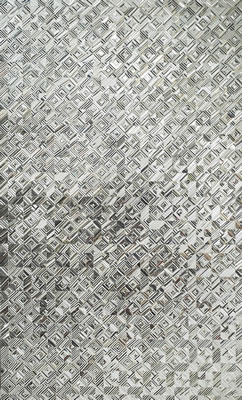
In two of her most recent works - Recollections 1 and 2 (2008) - Monir (as she often signs herself) incorporates reverse-glass painting and some fragments of Qajar painting in her modernist mirrorworks. Like much of her work, Recollections 1 and 2 -as the titles suggest- somehow reflect her life. Despite having to adapt to many changes in circumstance, she has always managed to hold on to fragments of her past, salvaging precious remains from times gone by.
During the 1960s and 70s, in what have been described as her 'golden years of creativity', Monir worked tirelessly in her studio in Tehran where she experimented and refined her unique style. Under the influence of the vernacular architecture that she encountered in Iran, her work was transformed by a new experience: adapting and combining the age-old techniques of reverse-glass painting, mirror mosaics, "Khatam kari" (inlaid marquetry), Islamic geometry and architectural designs.
A uniquely Iranian decorative form, mirror mosaics (aineh-kari) had been used for centuries as interior ornament in shrines and palaces. Monir immediately appreciated the originality and skill of the master craftsmen who created them. She started experimenting with fresh ways of testing new forms, materials and colours and explored the Sufi symbolism of the mirror: a reflection of the self, mirror is also associated with purity, brightness, symmetry, veracity and fortune.
During this time, Monir also traveled widely in Iran, building up unique collections of the arts and crafts of nomadic tribes, coffee house paintings and reverse glass paintings, all of which were, at the time, seen as unconventional and largely unfashionable items to collect. The collections were confiscated during the Islamic Revolution (1979), along with her own artworks and everything else she owned. She became an exile with her family in New York, where she lived with her husband until her return to Iran in 2003, some years after his death.
After returning to Iran, she was both encouraged to recreate some of her lost work and inspired to create new work. Unwilling to copy herself, she warmed up with abstract and drip paintings on glass, adding glitter and mirror mosaics to rediscover the geometrical patterns that she had begun to explore in the 1960s.
In Reflections 1, the reverse glass painting fragments that she incorporates among the mirror mosaics are details of flowers. Pen and ink drawings of flowers have been a constant practice through out Monir's life and she once spent many happy years creating a beautiful garden out of the bare earth around her (now confiscated) home in Tehran.
The Qajar painting fragments in Reflections 2 evoke an Iran of the past- the Qajar era- which ended in 1925, a year after Monir was born. Like many of her compatriots, Monir's life has been largely influenced by the rise and fall of different political regimes in Iran. Fragments of past regimes, along with more personal and intimate memories, are stored somewhere in her memory, eventually, if they endure, becoming immortalised in a work of art.
The mirror mosaics reflect many fragments of the world around them, assembling a constructed identity, a life composed of memories, individually disjointed, but beautiful in their overall effect, held in balance by the act of composition. Monir's compositions, while externally bound and limited, open inwardly to the infinite, underlining the timeless and infinite quality of Islamic geometric concepts.
Monir has a command of a visual vocabulary that many would envy. She relies on instinct and intuition rather than theory, and her recent work is the result of a lifetime's learning and experience. Like Louise Bourgeois, who has only been fully recognized late in life, the evolution of Monir's powerful and original vision over the past four decades will radiate for years to come, and leave its impact on subsequent generations of artists.
Source:
http://universes-in-universe.org/nafas/articles/2008/monir_farmanfarmaian
The author, Juliet Cestar ?Curator, writer, and photographer, specialized in contemporary art from the Middle East. She worked at the Asia House in London, before joining Rose Issa at Beyond Arts Productions.