Page loaded successfully. Showing biography for Morris Rippel.
Morris Rippel BIOGRAPHY
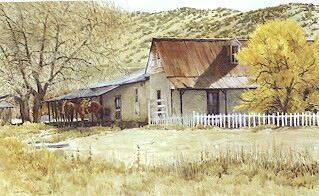
1930 Albuquerque, New Mexico - 2009 Albuquerque, New Mexico. Known for: Western genre, animal and landscape painting.
Following is the obituary of the artist, by Lloyd Jojola, Harding County Journal, published on http://www.hardingcounty.org/news/obituaries_2009.htm . Morris Rippel, a painter whose realistic... Read full biography
Following is the obituary of the artist, by Lloyd Jojola, Harding County Journal, published on http://www.hardingcounty.org/news/obituaries_2009.htm . Morris Rippel, a painter whose realistic representations of the Southwest are in the collections of the National Cowboy and Western Heritage Museum... Read full biography
Following is the obituary of the artist, by Lloyd Jojola, Harding County Journal, published on http://www.hardingcounty.org/news/obituaries_2009.htm . Morris Rippel, a painter whose realistic representations of the Southwest are in the collections of the National Cowboy and Western Heritage Museum in Oklahoma City, The Albuquerque Museum of Art and History, Denver Art Museum and in New York, Chicago and Los Angeles collections, died Tuesday, June 16, 2009 in Albuquerque. The lifelong city... Read full biography
Following is the obituary of the artist, by Lloyd Jojola, Harding County Journal, published on http://www.hardingcounty.org/news/obituaries_2009.htm . Morris Rippel, a painter whose realistic representations of the Southwest are in the collections of the National Cowboy and Western Heritage Museum in Oklahoma City, The Albuquerque Museum of Art and History, Denver Art Museum and in New York, Chicago and Los Angeles collections, died Tuesday, June 16, 2009 in Albuquerque. The lifelong city resident was 79. A family graveside service was being planned at their ranch at Mosquero, NM. An architect turned fine artist, Rippel worked with watercolor and tempera and specialized in landscapes and buildings of the region. His work was once noted for... Read full biography
Following is the obituary of the artist, by Lloyd Jojola, Harding County Journal, published on http://www.hardingcounty.org/news/obituaries_2009.htm . Morris Rippel, a painter whose realistic representations of the Southwest are in the collections of the National Cowboy and Western Heritage Museum in Oklahoma City, The Albuquerque Museum of Art and History, Denver Art Museum and in New York, Chicago and Los Angeles collections, died Tuesday, June 16, 2009 in Albuquerque. The lifelong city resident was 79. A family graveside service was being planned at their ranch at Mosquero, NM. An architect turned fine artist, Rippel worked with watercolor and tempera and specialized in landscapes and buildings of the region. His work was once noted for its "austere, sometimes lonely aspects . always with emphasis on the strong light." AskART.com said he... Read full biography
Artist Biography
Biography page for Morris Rippel ((1930 - 2009)), known for Western genre, animal and landscape painting. Showing 2 biographical entries and 0 sample artworks.
Morris Rippel - Artist Info
About Morris Rippel
Biography from the Archives of askART
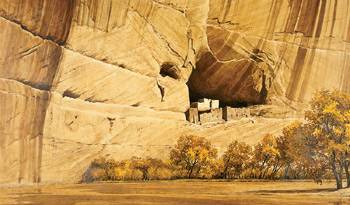 Following is the obituary of the artist, by Lloyd Jojola, Harding County Journal, published on http://www.hardingcounty.org/news/obituaries_2009.htm
Morris Rippel, a painter whose realistic representations of the Southwest are in the collections of the National Cowboy and Western Heritage Museum in Oklahoma City, The Albuquerque Museum of Art and History, Denver Art Museum and in New York, Chicago and Los Angeles collections, died Tuesday, June 16, 2009 in Albuquerque.
The lifelong city resident was 79. A family graveside service was being planned at their ranch at Mosquero, NM.
An architect turned fine artist, Rippel worked with watercolor and tempera and specialized in landscapes and buildings of the region. His work was once noted for its "austere, sometimes lonely aspects ... always with emphasis on the strong light." AskART.com said he is "known for his bold colored and delineated paintings of the Southwest, often with glowing tones of luminism."
In 1979. Rippel received the prestigious Prix de West - National Academy of Western Arts award for his egg tempera work titled Bluebirds, making it part of the Cowboy and Western Heritage Museum's permanent collection. He also received several gold and silver medal awards for selected media from the academy.
Among his many other honors or accomplishments, Rippel had a one-man retrospective at the Gilcrease Museum in Tulsa, Okla. He also exhibited his work in Europe and Asia. And, in 1997, then-Gov. Gary Johnson and the New Mexico Arts Commission named Rippel a recipient of the Governor's Awards for Excellence and Achievement in the Arts.
Rippel used to say "he was born under the freeway where the old Presbyterian Hospital used to be," Betty Rippel. his wife of 47 years, said Friday. And except for a period in the Army, when he served during the Korean War, he lived his entire life in Albuquerque.
After returning from the military, Rippel earned a degree in architecture from the University of New Mexico. Rippel practiced as an architect with several firms for 15 years, his wife said "Then he decided to go into fine art," Betty Rippel said. "And just by happenstance, he painted two paintings, took them to Santa Fe and got a call that said they both sold. "So he was on his way."
Betty Rippel said her husband was drawing and sent to art school as a little boy, and the artist noted in a past news story that his mother had given him art books as a young man.
A 1963 UNM show titled "Taos and Santa Fe: The Artist's Environment" inspired Rippel to paint "the real world," reads a 1978 profile of the artist in The Albuquerque Tribune. "I saw the show and knew my future was in painting," Rippel said. "Edward Hopper's work said the most to me. I told myself I'd give it five years to see if I could make it."
The story told how Rippel was meticulous in his approach -detailed field studies, sketches and comparative studies preceded each of his pieces.
A licensed pilot, Rippel volunteered for 12 years in the photo archives area of The Albuquerque Museum. "He just loved it because he was a historian of Albuquerque," his wife said. Indeed, Albuquerque A Century Ago, a late-1800s depiction of the city that Rippel painted, appears at the museum. Toward the end of the month, the museum plans on displaying a small tribute to Rippel that will show several of his works.
Morris C. Rippel is Survived by his wife, Betty Drake Rippel; children, Becky Rippel, Cheryl Thompson, Cherie Skinner and Greg Burton; grandchildren, Nathan and Bethany Hillson. Wade and Reece Wilson, Holly Stafford and Tara Fansler and great grandchildren Drake! and Erin Wilson and Leila and Levi Fansler.Biography from the Archives of askART
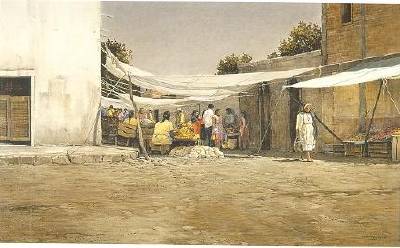 Watercolorist and tempera painter Morris Rippel, born in Albuquerque, New Mexico, is known for his bold colored and delineated paintings of the Southwest, often with glowing tones of luminism. Frequently he studies a particular place for years before painting it so that he can express familiarity and personal involvement. He worked as a registered architect until 1967 when he decided to devote himself full-time to painting.
When he was ten years old, he took art lessons. He attended the University of New Mexico for two years, served in the Korean War, and then returned to the University for architectural study. He graduated in 1957 and for several years did watercolors only as a hobby. In 1964, he got gallery representation in Santa Fe and when he got enough money from his artwork to support his family for one year, he devoted himself full time to painting.
Rippel says that Edward Hopper and Andrew Wyeth have been major influences on his style and subjects--Wyeth for "abstract compositions with realistic focus" (Samuels 442). In 1975, he was invited to become a member of the National Academy of Western Art (NAWA) and exhibited with them, winning gold medals for watercolors in 1976 and 1977. In 1979, his egg tempera painting won the Prix de West of NAWA.
Mostly self-taught, Ripple has exhibition venues that include the New Mexico Art Museum and The American Watercolor Society Annual Exhibition. His work is in the collections of the Diamond Art Museum, The Denver Art Museum, Eiteljorg Collection, and the Valley National Bank in Phoenix as well as several private collections in the United States.
Sources include:
Susan E Meyer, 40 Watercolorists and How They Work
Peggy and Harold Samuels, Contemporary Western Artists