Page loaded successfully. Showing biography for Mose Ernest Tolliver.
Mose Ernest Tolliver BIOGRAPHY
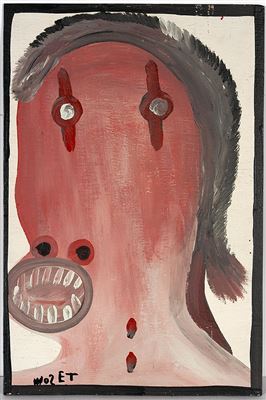
1920 Pike Road Community, Alabama - 2006 Montgomery, Alabama. Known for: Naive figure, self portrait, animals-Outsider art.
One of the most highly regarded American self- taught artists began life as the son of a sharecropper and farm overseer on the Rittenour farm. Mose Tolliver was the youngest of seven sons born into... Read full biography
One of the most highly regarded American self- taught artists began life as the son of a sharecropper and farm overseer on the Rittenour farm. Mose Tolliver was the youngest of seven sons born into the Ike Tolliver family of twelve children. He attended Mt. Olive School briefly through the third... Read full biography
One of the most highly regarded American self- taught artists began life as the son of a sharecropper and farm overseer on the Rittenour farm. Mose Tolliver was the youngest of seven sons born into the Ike Tolliver family of twelve children. He attended Mt. Olive School briefly through the third grade. "I didn't like school. I remember I wanted to be outdoors working with my older brothers or even stacking wood . One thing I remember about our farm house, it was just a shack, but my Mama had... Read full biography
One of the most highly regarded American self- taught artists began life as the son of a sharecropper and farm overseer on the Rittenour farm. Mose Tolliver was the youngest of seven sons born into the Ike Tolliver family of twelve children. He attended Mt. Olive School briefly through the third grade. "I didn't like school. I remember I wanted to be outdoors working with my older brothers or even stacking wood . One thing I remember about our farm house, it was just a shack, but my Mama had pictures all over the walls." . He worked through his teen years for a truck farmer gathering and selling produce. Then after his father had died, when his mother was elderly, he moved with her into the city of Montgomery and lived in the same house.... Read full biography
One of the most highly regarded American self- taught artists began life as the son of a sharecropper and farm overseer on the Rittenour farm. Mose Tolliver was the youngest of seven sons born into the Ike Tolliver family of twelve children. He attended Mt. Olive School briefly through the third grade. "I didn't like school. I remember I wanted to be outdoors working with my older brothers or even stacking wood . One thing I remember about our farm house, it was just a shack, but my Mama had pictures all over the walls." . He worked through his teen years for a truck farmer gathering and selling produce. Then after his father had died, when his mother was elderly, he moved with her into the city of Montgomery and lived in the same house. Mose became a gardener and took care of many fine yards. Known for having an artistic flare for landscaping, he was given free rein by some... Read full biography
Artist Biography
Biography page for Mose Ernest Tolliver ((1920 - 2006)), known for Naive figure, self portrait, animals-Outsider art. Showing 2 biographical entries and 0 sample artworks.
Mose Ernest Tolliver - Artist Info
About Mose Ernest Tolliver
Name variants
Mose Toliver
Biography from the Archives of askART
 One of the most highly regarded American self- taught artists began life as the son of a sharecropper and farm overseer on the Rittenour farm. Mose Tolliver was the youngest of seven sons born into the Ike Tolliver family of twelve children. He attended Mt. Olive School briefly through the third grade. "I didn't like school. I remember I wanted to be outdoors working with my older brothers or even stacking wood . . . . One thing I remember about our farm house, it was just a shack, but my Mama had pictures all over the walls."
He worked through his teen years for a truck farmer gathering and selling produce. Then after his father had died, when his mother was elderly, he moved with her into the city of Montgomery and lived in the same house. Mose became a gardener and took care of many fine yards. Known for having an artistic flare for landscaping, he was given free rein by some of his clients to arrange bedding plants. Occasionally, he also painted houses inside and out, and was a 'jack-of-all-trades' for repair jobs involving plumbing and carpentry. Mose met and married Willie Mae Thomas in the early 1940's and fathered eleven children, seven sons and four daughters. Two other children died in infancy.
Mose worked "on and off for years" with McLendon Furniture Company in the shipping and delivery area. There in the late 1960's a crate of marble fell from a fork-lift and crushed Mose's left ankle and damaged leg tendons and muscles which left him unable to walk without assistance. A couple of years after the accident and after a period of drunken depression, Mose was encouraged to try oil painting by Raymond McLendon, one of his former employers. McLendon painted with oils on canvas and Mose had, on occasion watched him paint. Noting his fascination, McLendon tried to persuade Mose to take lessons at his expense intending to provide an alternative pastime to Mose's drinking alcohol.
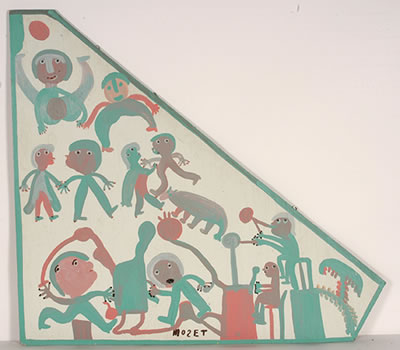
Mose elected to teach himself and painting became routine activity for him. It was a rehabilitative experience. At first he painted birds, flowers and tree forms later adding people and other animals. "I probably would never have painted if I hadn't gotten hurt. I would still be working with plants and yards." He began to obey an inner compulsion to create art in his own unique way at an amazing rate. Mose began to paint on any surface-furniture, scraps, plywood packing crate sides, Masonite, metal trays, board remnants, old bureaus, table tops, or other abandoned surfaces given to him.
Mose uses what he calls "pure paint," which is house paint--oil base at first, and more recently water-based latex. Although his palette almost always is limited to two or three hues from the cans available at hand, Mose's color schemes are generally harmonious and sophisticated. His inventive use of a variety of improvised hanging devises (and later metal can rings) on his work indicated a natural creativity that often goes hand in hand with poverty and necessity.
His work first caught the attention of people walking past his house on Morgan Avenue where he began his painting, but none sold. Then after moving to his present Sayre Street home, his front porch became a virtual gallery with Mose offering to sell paintings to anyone who admired them. An early admirer who brought his work to public attention was Mitchell Kahan, former curator at the Montgomery Museum of Fine Arts. In 1981, the museum mounted a one-man exhibition of Mose's work.
In an essay published in the exhibition brochure, Kahan pointed out the element of humor in Mose's work, "...the naiveté of the improbable and bizarrely constructed animals is comical in a charming way. The humor... results from the unintentional discrepancy between the painted image and the real-life source...Often the humor is linked to elements of fantasy and eroticism."
In the first article published about Mose in February 1981 in the Montgomery Advertiser, he is quoted as saying, "I'm not interested in Art. I just want to paint my pictures." In the same article the late Dr. Robert Bishop, Director of the Museum of American Folk Art said of Mose's paintings, "You can hang him beside a Picasso, and you have the same kind of creativity and deep personal vision."
A year after this article, Mose's work was placed at the forefront of the art world with the exhibition, Black Folk Art in America 1930-1980, in which his work was exhibited at the Corcoran Gallery, associated with the Smithsonian Institution. More than a decade has passed since these major exhibitions. Mose's wife, Willie Mae, died in the Spring of 1991 and two of Mose's children, Annie and Charles, have emerged as painters, on their own. Creating art has remained virtually the same for Mose except for a marked increase in his notoriety.
Mose still paints while seated on the edge of his bed, his walker at arm's length away. At the foot of his bed is a paint-spattered cabinet holding, at hand, his materials. "I love to paint. I paint what I feel like painting--what is in my head." Hardly a day goes by that Mose is without a visitor seeking his work. Often works are requested; sometimes photographs are left with Mose on which to base "commissions" which he routinely seeks help to fulfill.
Two aspects of his work, among others, have remained constant throughout his career: Mose gives names to his paintings that show a strong connection to fantasy; and images that are popular with the purchasers are likely to be found repeated frequently. Mose has lived in his same modest home for more than twenty years, seemingly unaffected by his tremendous creative accomplishments.
Source:
Marcia Weber Art ObjectsBiography from The Johnson Collection
MOSE ERNEST TOLLIVER (circa 1920–2006)
In an interview, Mose Tolliver claimed that he initially began painting landscapes on tree roots and glass as a teenager, learning from other people who were doing similar work. A forklift accident in the 1960s left him unable to walk without assistance when, while working at McLendon Furniture Company, a half-ton slab of marble fell on his legs. It was a turning point: no longer able to work he took up art making, developing a distinctive figurative style that was simple, flat, and colorful.
The day—July fourth—of Tolliver’s birth has been established, but not the year. It has been given variously as between 1919 and 1924. His birthplace was Pike Road, Alabama, sixteen miles southeast of Montgomery. His parents were sharecroppers, and he was one of 12 children. He attended school only until he was eight or nine, expressing little interest in education. He described his home as “just a shack, but my mamma had pictures all over the walls.” These were probably in newspapers, commonly used to paper and insulate humble dwellings.
Tolliver worked a variety of odd jobs, mostly as a gardener and truck farmer, but also took on general maintenance tasks such as house painting and even plumbing. In October 1940 Tolliver was drafted into the military; he signed his registration card with an X, and it is not known how long or where he served. In the early 1940s, he moved into the city of Montgomery and married his childhood best friend, Willie Mae Thomas, with whom he had 13 children, 11 of whom survived until adulthood. Following the accident at McLendon Furniture Company in the late 1960s he was offered art lessons by his employer, but declined. However, he was given some supplies, with his preference being house paint.
After his accident, he had more time and possibly found painting rehabilitative; it became Tolliver’s passion and he declared he did it “to keep my head together.” He painted on wood; “the first picture I did on wood was a red bird.” He depicted other creatures, in particular birds, and did a whole series of turtles. He enhanced the oval shapes of their shells with daubs of paint. He also painted trees and flowers, but figures dominated, along with many self-portraits. Whether singly or in pairs, male or female, his subjects faced forward, and had large round heads and prominent eyes. Some were based on religious themes, such as a black Virgin Mary and Jesus Christ, but his most notorious group represented women in erotic positions. They display a sense of humor and appear to have been based on a Time Life book about ancient Egypt. He also painted on three dimensional objects such as a suitcase, coffee table, and bird house, usually decorating them with bird motifs and dots of paint. All of his subjects were painted from his own personal observations of life.
In 1981, the Montgomery Museum of Fine Arts mounted a one-man show of his work. The following year, the Corcoran Gallery of Art in Washington, DC, mounted the exhibition Black Folk Art in America, featuring fellow Montgomery artist (whom Tolliver had not previously known) Bill Traylor. Shortly after this, demand for Tolliver’s work outgrew the pace at which he could paint. He taught some of his children his signature style, notably his daughter, Annie, so they could help duplicate his pictures and even sign his name.
After his wife’s death in 1991, Tolliver once again underwent a difficult period, but he continued his painting. A New York Times review of the 1982 Corcoran exhibition summarized: “It was the role of black folk art to make the unbearable bearable.”
He will be remembered as a picture maker, always signing his work Mose T (with a backwards “s”) and one of America’s first African American vernacular artists whose works were drawn from his own life experiences.
The Johnson Collection, Spartanburg, South Carolina
thejohnsoncollection.org