Page loaded successfully. Showing biography for Moshe Elazar Castel.
Moshe Elazar Castel BIOGRAPHY
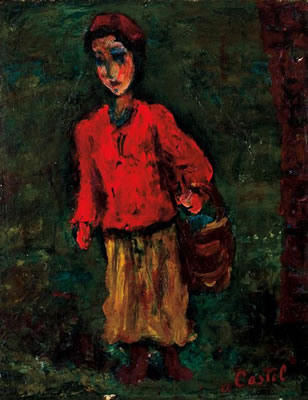
1909 Jerusalem, Israel - 1991/92. Known for: Abstract, landscape and figure painting, sculpture.
Moshe Elazar Castel born in Jerusalem to his father Rabbi Yehuda Castel and his mother Rachel. They were descendants of a Spanish family which came from Castiie to establish themselves in Israel in... Read full biography
Moshe Elazar Castel born in Jerusalem to his father Rabbi Yehuda Castel and his mother Rachel. They were descendants of a Spanish family which came from Castiie to establish themselves in Israel in 1492. The family lived for many generations in Hebron. His father, Rabbi Yehuda Castel who was born... Read full biography
Moshe Elazar Castel born in Jerusalem to his father Rabbi Yehuda Castel and his mother Rachel. They were descendants of a Spanish family which came from Castiie to establish themselves in Israel in 1492. The family lived for many generations in Hebron. His father, Rabbi Yehuda Castel who was born in Hebron, was a scholar and outstanding Herbalist, wrote parchment and Torah scrolls. Moshe Castel arrived in Paris in 1927 with the help of his brother Yosef. He attended the Academie Julien and... Read full biography
Moshe Elazar Castel born in Jerusalem to his father Rabbi Yehuda Castel and his mother Rachel. They were descendants of a Spanish family which came from Castiie to establish themselves in Israel in 1492. The family lived for many generations in Hebron. His father, Rabbi Yehuda Castel who was born in Hebron, was a scholar and outstanding Herbalist, wrote parchment and Torah scrolls. Moshe Castel arrived in Paris in 1927 with the help of his brother Yosef. He attended the Academie Julien and studied at the Louvre Museum. After 13 years of work in Paris, he returned to Israel in 1940, settled in Safed a medieval town of Zohar and Kaballa. Castel was born in 1909 and died in 1992. He lived in Paris from 1927 until 1940. There he used the... Read full biography
Moshe Elazar Castel born in Jerusalem to his father Rabbi Yehuda Castel and his mother Rachel. They were descendants of a Spanish family which came from Castiie to establish themselves in Israel in 1492. The family lived for many generations in Hebron. His father, Rabbi Yehuda Castel who was born in Hebron, was a scholar and outstanding Herbalist, wrote parchment and Torah scrolls. Moshe Castel arrived in Paris in 1927 with the help of his brother Yosef. He attended the Academie Julien and studied at the Louvre Museum. After 13 years of work in Paris, he returned to Israel in 1940, settled in Safed a medieval town of Zohar and Kaballa. Castel was born in 1909 and died in 1992. He lived in Paris from 1927 until 1940. There he used the backdrop of the street scenes for his subject matter and exhibited his paintings in the salons of Paris.... Read full biography
Artist Biography
Biography page for Moshe Elazar Castel ((1909 - 1991/92)), known for Abstract, landscape and figure painting, sculpture. Showing 2 biographical entries and 0 sample artworks.
Moshe Elazar Castel - Artist Info
About Moshe Elazar Castel
Name variants
Moshe Castel, Moshe Kastel
Biography from RoGallery
Moshe Elazar Castel born in Jerusalem to his father Rabbi Yehuda Castel and his mother Rachel. They were descendants of a Spanish family which came from Castiie to establish themselves in Israel in 1492.
The family lived for many generations in Hebron. His father, Rabbi Yehuda Castel who was born in Hebron, was a scholar and outstanding Herbalist, wrote parchment and Torah scrolls.
Moshe Castel arrived in Paris in 1927 with the help of his brother Yosef. He attended the Academie Julien and studied at the Louvre Museum. After 13 years of work in Paris, he returned to Israel in 1940, settled in Safed a medieval town of Zohar and Kaballa.
Castel was born in 1909 and died in 1992. He lived in Paris from 1927 until 1940. There he used the backdrop of the street scenes for his subject matter and exhibited his paintings in the salons of Paris. On his return to Israel he became famous for his work using basalt found in the black rock, which is indigenous to several areas of Israel. Many of his paintings are characterized by his creation of what appears to be an ancient form of writing. These symbols are painted in relief utilizing the black rock material. His portraits and street scenes often possess a Spanish influence, probably based on his Castilian Sephardic heritage. The strong reds, greens and blacks are indicative of this phase of his paintings. From 1959 the artist spent his time between Paris, New York and Israel. He is also famous for his large murals, which can be found in many important edifices around the world.
In 1946, he was awarded the Dizengoff Prize on behalf of the Tel-Aviv Municipality. In 1947, he initiated and founded, together with other painters and sculptors the group "New Horizons" ("Offakim Hadashim"). In 1959, he came to Paris, acquired a studio in Montparnasse where he spent a few months every year.
He was awarded the prize, "Premier do Estado", at the Sao Paulo Biennale, Brazil.
1928/40, and he participated in individual and group exhibitions in well known galleries and "salons" in Paris.
In 1955, he had an exhibition on the entire top floor of the Tel Aviv Museum. This was the first exhibition of abstract art in Israel. He also did a mural painting (9 x 4 m) for Hotel Accadia and a mural painting for "El Al" offices at Rockefeller Center, New York. In 1958, he finished the mural glass painting Face to the Future (18x3.5 m) at the National Convention Center, Jerusalem.
Other Work
1966: Executed a large basalt mural painting Glory to Jerusalem (7 x 3 m) for the Knesset (Israel Parliament) in Jerusalem.
1970/71: Executes two large basalt mural-paintings for the ceremonial hall of the Presidential Mansion in Jerusalem. Wall of Glory to Jerusalem and Golden Scroll.
1984: Portrait of an artist,Moshe Castel - Israel Film Service producer.
1984/85: Years of Creativity: 1924-1984 - Jubilee Exhibition at the Knesset the House of Parliament, in Jerusalem.
1989 Opening Exhibition of Beer-Sheva Museum of Israeli Art.
1987 Yurek Gallery, Ramat Hasharon Dania Art Gallery, Haifa
Works in public collections
The Museum of Modern Art, New York
The Tate Gallery, London
Museum of Fine Arts, Boston
The Jewish Museum, New York
The Museum of Fine Arts, Houston-Texas
Phoenix Art Museum, Arizona
Art Museum Berkeley University, California
Brandeis University, Boston
Smith College Museum, Northampton, Mass
Fogg Art Museum, Harvard University
Wadsworth Athenaeum, Art Museum, Conn
The High Museum of Art, Atlanta, Georgia
Baltimore Museum of Art
John Hopkins University, Baltimore
American Public Insurance Company, Des Moines
The Knesset House of Parliament, Jerusalem
The Brooklyn Museum of Art
Fairleigh Dickinson Fine Arts Museum, NJ
U.S. Steel, Pittsburg
Rehovot House of Sir Isaac and Lady Edith
Wolfson at the Weizman Institute
Temple B'nai Shalom, Rockville Center, New York
Temple Emanu-El, Providence, Rhode Island
San Francisco Museum of Art
The Dropsie College, Philadelphia
Albright Knox Art Gallery, Buffalo, New York
Temple Beth-El of Great Neck, New York
Museum of the Vatican, Rome
The presidential Mansion, Jerusalem.Biography from Tiroche Auction House
Moshe Castel was born in Jerusalem in 1909 to a religious family from Castile. He studied at the Bezalel Academy of Art and Design and later in France. Castel's works were exhibited in important salons in Paris, London, and Warsaw. He returned to Israel in 1933 and lived in Tel Aviv before moving to Safed. Castel founded the group Ofakim Hadashim, which embraced the foundations of abstract European art. He added oriental motifs to the abstract expressive style, influenced by what he called "Canaanite art". Castel's later works include elements such as the ancient letters of the Hebrew alphabet and are dealing with national and root themes and biblical stories combined with marks of archaic script. Castel's art aspires from Jewish sources on the one hand, and on the other hand is based on in-depth knowledge of world culture. Castel participated in various exhibitions in Israel and around the world, including the Venice Biennial and the San Paolo Biennial in Brazil in which he won an award. His murals and reliefs can be found in many places in Israel and around the world.