Page loaded successfully. Showing biography for Nathaniel The Younger Hone.
Nathaniel The Younger Hone BIOGRAPHY
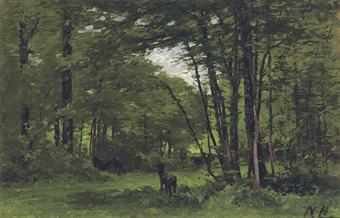
1831 Dublin, Ireland - 1917. Known for: Barbizon style landscape painting, teaching.
Nathaniel Hone the Younger RHA (1831-1917). The famous exponent of landscape painting, Nathaniel Hone was born in Dublin to a family of great artistic renown. He was the great grand-nephew of... Read full biography
Nathaniel Hone the Younger RHA (1831-1917). The famous exponent of landscape painting, Nathaniel Hone was born in Dublin to a family of great artistic renown. He was the great grand-nephew of Nathianiel Hone the Elder (1718-1784), and related to the portrait painters Horace Hone (1756-1825) and... Read full biography
Nathaniel Hone the Younger RHA (1831-1917). The famous exponent of landscape painting, Nathaniel Hone was born in Dublin to a family of great artistic renown. He was the great grand-nephew of Nathianiel Hone the Elder (1718-1784), and related to the portrait painters Horace Hone (1756-1825) and John Camillus Hone (1759-1836), as well as the future painter and stained glass artist Evie Hone (1894-1955). Nathaniel Hone started his career as a railway engineer, but at 21 determined to become a... Read full biography
Nathaniel Hone the Younger RHA (1831-1917). The famous exponent of landscape painting, Nathaniel Hone was born in Dublin to a family of great artistic renown. He was the great grand-nephew of Nathianiel Hone the Elder (1718-1784), and related to the portrait painters Horace Hone (1756-1825) and John Camillus Hone (1759-1836), as well as the future painter and stained glass artist Evie Hone (1894-1955). Nathaniel Hone started his career as a railway engineer, but at 21 determined to become a professional painter. In 1853, he began his art studies in Paris, and he remained in France for seventeen years. During his first four years he was taught drawing and figure drawing by Yvon and Thomas Couture (1815-1879) and studied the human form. Like... Read full biography
Nathaniel Hone the Younger RHA (1831-1917). The famous exponent of landscape painting, Nathaniel Hone was born in Dublin to a family of great artistic renown. He was the great grand-nephew of Nathianiel Hone the Elder (1718-1784), and related to the portrait painters Horace Hone (1756-1825) and John Camillus Hone (1759-1836), as well as the future painter and stained glass artist Evie Hone (1894-1955). Nathaniel Hone started his career as a railway engineer, but at 21 determined to become a professional painter. In 1853, he began his art studies in Paris, and he remained in France for seventeen years. During his first four years he was taught drawing and figure drawing by Yvon and Thomas Couture (1815-1879) and studied the human form. Like all classically trained artists he also studied fine art painting by copying the pictures by the Old Masters in the Louvre Museum.... Read full biography
Artist Biography
Biography page for Nathaniel The Younger Hone ((1831 - 1917)), known for Barbizon style landscape painting, teaching. Showing 2 biographical entries and 0 sample artworks.
Nathaniel The Younger Hone - Artist Info
About Nathaniel The Younger Hone
Biography from the Archives of askART
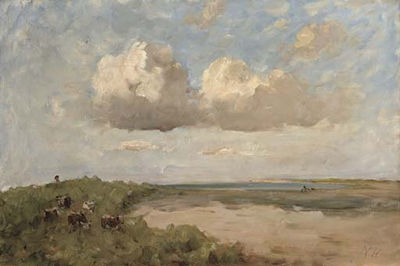 Nathaniel Hone the Younger RHA (1831-1917)
The famous exponent of landscape painting, Nathaniel Hone was born in Dublin to a family of great artistic renown. He was the great grand-nephew of Nathianiel Hone the Elder (1718-1784), and related to the portrait painters Horace Hone (1756-1825) and John Camillus Hone (1759-1836), as well as the future painter and stained glass artist Evie Hone (1894-1955). Nathaniel Hone started his career as a railway engineer, but at 21 determined to become a professional painter.
In 1853, he began his art studies in Paris, and he remained in France for seventeen years. During his first four years he was taught drawing and figure drawing by Yvon and Thomas Couture (1815-1879) and studied the human form. Like all classically trained artists he also studied fine art painting by copying the pictures by the Old Masters in the Louvre Museum. After this, he travelled to Barbizon to study landscape painting. It was here that he encountered other artists such as Millet, Corot and Harpignies. This rigorous training in composition, and the portrayal of light on the canvas, helped him to absorb the essential painting techniques needed to become a master. In particular, it helped him to develop a deep feeling for the colour of a landscape and the skill to reproduce it, which made him one of the foremost Irish landscape artists. He retained a preference for tone rather than pure colour and, as with many Impressionist landscape artists a lifelong fascination with light. This is evident from his feeling for the muted tones of the Irish countryside, the variable light on different coastlines, shafts of sunlight on a field, and suddenly threatening clouds.
Nathaniel Hone left Barbizon in about 1870, moving to Brittany, Normandy, Paris, and Italy before finally returning to Ireland in 1872. There, he married, honeymooned on the Continent then returned to Dublin, where he exhibited regularly averaging about four paintings in each annual exhibition of the Royal Hibernian Academy (RHA). He continued to travel widely, visiting Greece, Turkey, Holland, Egypt, and many other countries. In 1879, Hone was elected an associate member of the RHA, becoming a full member the following year. In 1894, he was elected Professor of Painting at the RHA, a post he held until his death. He settled in Malahide, where the local neighbourhood provided him with the scenes for many of his finest paintings. During this time Hone also befriended the master artist Walter Osborne, whose portrait he painted. As well as oil painting, Hone also produced a number of watercolour paintings.
Paintings by Nathaniel Hone The Younger appear in many collections, including: The Ulster Museum, Belfast; Crawford Art Gallery, Cork; Hugh Lane Art Gallery, Dublin; National Gallery of Ireland; Royal Irish Yacht Club; National University of Ireland; British Museum; Tate Gallery, London; and many more.
Source:
Online Encyclopedia of Irish and World Art
http://www.visual-arts-cork.com/irish-artists/nathaniel-hone-the-younger.htmBiography from Adam's (James Adam & Sons Ltd.)
Nathaniel Hone was the first native artist to introduce the influence of 19th century French Naturalism to Irish painting. Nathaniel Hone (also known as Nathaniel The Younger Hone) was born in Fitzwilliam Place, Dublin in 1831, the son of Brindley Hone, a merchant and director of the Midland Great Western Railway. He was the great-grandnephew of the 18th century painter of the same name. Though a member of this very artistic family, his initial training was as an engineer at Trinity College Dublin followed by a brief period of work for the Irish Railway before going to Paris in 1853, at the age of twenty-one to study painting. When Hone returned to Ireland in 1872 it was almost twenty years since he had first gone to Paris to study at the studio of Yvon. On his return he married and settled at Seafield, Malahide, the family estate. While there he continued to paint and to farm. Many of his paintings from this period carry the influences of his Barbizon period and it can be difficult to distinguish untitled landscapes or coastal views as to whether they are French or Irish. The paintings which he completed in Ireland after his return from France maintain the mood and muted tonality characteristic of the Barbizon School. He chose similar subjects to those he had portrayed in France: woodlands, pastures and coastline; the major part of his output was of scenes around Dublin Bay although he also painted in Wicklow, Donegal, Mayo and Clare. Two of Hone’s favourite themes in his Irish paintings were the pastoral idyll, and the open sea with billowing cumulus clouds, both using rapid, flecked brushstrokes suggesting an awareness of Impressionism. We are indebted to Dr. Julian Campbell whose writings on this artist have informed this note. Nathaniel Hone passed away in 1917.