Page loaded successfully. Showing biography for Nikolai Konstantinovich Kalmakov.
Nikolai Konstantinovich Kalmakov BIOGRAPHY
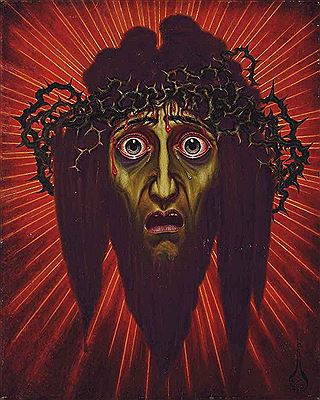
1873 Italy - 1955 near Chelles. Known for: Symbolist, mystical painting.
Branded a decadent and an eccentric, over fifty years after his death Nikolas Kalmakoff remains a fascinating figure. A Russian aristocrat by birth, Kalmakoff was born in Nervi on the Italian... Read full biography
Branded a decadent and an eccentric, over fifty years after his death Nikolas Kalmakoff remains a fascinating figure. A Russian aristocrat by birth, Kalmakoff was born in Nervi on the Italian Riviera, the son of a Russian General. The actor Alexander Mgebrov, who became acquainted with Kalmakoff in... Read full biography
Branded a decadent and an eccentric, over fifty years after his death Nikolas Kalmakoff remains a fascinating figure. A Russian aristocrat by birth, Kalmakoff was born in Nervi on the Italian Riviera, the son of a Russian General. The actor Alexander Mgebrov, who became acquainted with Kalmakoff in St Petersburg, recalled the artist's fascination with the devil and his insistence that he appeared to him late at night. Given the consistent blurring of the sexes as a prevalent theme in his work,... Read full biography
Branded a decadent and an eccentric, over fifty years after his death Nikolas Kalmakoff remains a fascinating figure. A Russian aristocrat by birth, Kalmakoff was born in Nervi on the Italian Riviera, the son of a Russian General. The actor Alexander Mgebrov, who became acquainted with Kalmakoff in St Petersburg, recalled the artist's fascination with the devil and his insistence that he appeared to him late at night. Given the consistent blurring of the sexes as a prevalent theme in his work, including Les femmes des Nadjis in which two beautiful women are surrounded by malevolent asexual heads, it is interesting to note the testimony of Kalmakoff's contemporaries of his membership of the Skoptzy movement. The sect called for abstinence... Read full biography
Branded a decadent and an eccentric, over fifty years after his death Nikolas Kalmakoff remains a fascinating figure. A Russian aristocrat by birth, Kalmakoff was born in Nervi on the Italian Riviera, the son of a Russian General. The actor Alexander Mgebrov, who became acquainted with Kalmakoff in St Petersburg, recalled the artist's fascination with the devil and his insistence that he appeared to him late at night. Given the consistent blurring of the sexes as a prevalent theme in his work, including Les femmes des Nadjis in which two beautiful women are surrounded by malevolent asexual heads, it is interesting to note the testimony of Kalmakoff's contemporaries of his membership of the Skoptzy movement. The sect called for abstinence and castration where necessary; Kalmakoff appears to have interpreted this stance to indicate... Read full biography
Artist Biography
Biography page for Nikolai Konstantinovich Kalmakov ((1873 - 1955)), known for Symbolist, mystical painting. Showing 3 biographical entries and 0 sample artworks.
Nikolai Konstantinovich Kalmakov - Artist Info
About Nikolai Konstantinovich Kalmakov
Name variants
Nicolas Kalmakoff, Nicholas Kalmikoff
Biography from MacDougall's Auctions
Nikolai Kalmakov was one of the most enigmatic and controversial figures in Russian art of the first half of the 20th century. His whole life and work were dogged by extraordinary legends, in which a tangled web of truth and fiction was steeped in an aura of mystery. Kalmakov was born in Italy into the family of a Russian general and an Italian opera singer. Moving to Russia at the age of 22, the young man graduated with a degree in law from the University of St Petersburg.
A self-taught artist, with extraordinary ability and rare industriousness, Kalmakov never had any desire to obtain a formal artistic education, which might have exerted some influence on his standalone art and would most probably have stripped away its mystical craziness and charm. In Russia in the 1900s, the artist was literally racing up to the peak of Symbolism, a movement which was just blossoming and for which Kalmakov, with his decadent inclinations, turned out to be very well suited. The hypnotic Hoffmannesque extravaganza of phantasmagorical visions and his sludgy colour palette with its sickly aftertaste gained Kalmakov a reputation as a kind of fatalistic artist-aesthete and “medium”. Against the background of the passion for occultism that had seized the whole of Europe and Russia, Kalmakov’s images made a real impression on the mood of the bourgeois bohemians of the capital. Without his art, it would have been impossible for us to imagine that other, decadent, opium-shrouded Petersburg of the early 20th century.
The Bacchanalia now offered for auction is utterly characteristic of Kalmakov, with his exceptional technical skill and the originality of his nimble imagination. Painted in 1930 after he had emigrated, this picture maintains the general atmosphere of his invented world, a world which unquestionably enriched the international fine art scene of the first half of the 20th century.Biography from Christie's London, King Street
Branded a decadent and an eccentric, over fifty years after his death Nikolas Kalmakoff remains a fascinating figure. A Russian aristocrat by birth, Kalmakoff was born in Nervi on the Italian Riviera, the son of a Russian General. The actor Alexander Mgebrov, who became acquainted with Kalmakoff in St Petersburg, recalled the artist's fascination with the devil and his insistence that he appeared to him late at night.
Given the consistent blurring of the sexes as a prevalent theme in his work, including Les femmes des Nadjis in which two beautiful women are surrounded by malevolent asexual heads, it is interesting to note the testimony of Kalmakoff's contemporaries of his membership of the Skoptzy movement. The sect called for abstinence and castration where necessary; Kalmakoff appears to have interpreted this stance to indicate that women as a source of temptation should be condemned. Much of his work, particularly from this early period, including Les femmes des Nadjis, associates the female form with ominous symbols.
Les femmes des Nadjis, which was exhibited with the Mir Iskusstvo [World of Art] in 1913, adheres to the St Petersburg emphasis on line and a strongly decorative aesthetic, richly enhanced with gold. Rhythmically painted, erotic, even frenzied, the women pose provocatively while the scaled bodies of the dark figures beside them warn of the dangers of succumbing to their charms.
Despite the critical success he enjoyed in his lifetime, not to mention the notoriety he achieved following his sexually-charged stage design for a production of Oscar Wilde's Salome in 1908, Kalmakoff died in abject poverty at the hôpital de Lagny, near Chelles. It was only after the discovery in 1962 by Bertrand Collin du Bocage and Georges Martin du Nord of forty 'lost' works in the Marché aux Puces, a flea market not far from Paris and their subsequent exhibition at Galerie Motte in 1964 that Kalmakoff's work again caught the attention of the general public. Both Les femmes des Nadjis and Le Calice (executed in 1924, the year the artist emigrated from Russia) were exhibited at Musée-galerie de la Seita in 1986.Biography from Auctionata
Nicolai (or Nicolas and Nicholas) Kalmakoff (1873-1955) was of Italian-Russian descent and grew up in Italy. From 1890 till 1895, he studied law in St. Petersburg and afterwards painting and anatomy in Italy. From 1900 he lived alternately in St. Petersburg and Moscow and got in contact with the artistic movement ‘Mir Iskusstva’ (World of Art) and the St. Petersburg theater world. He created numerous set designs.
After the Russian Revolution he lived in Constantinople and Tallinn. In 1924, he settled in Paris, where he worked as a painter until 1947. Kalmakoff’s works received increasing popularity in the auction market in recent years.