Page loaded successfully. Showing biography for Paul Evans Jr.
Paul Evans Jr BIOGRAPHY
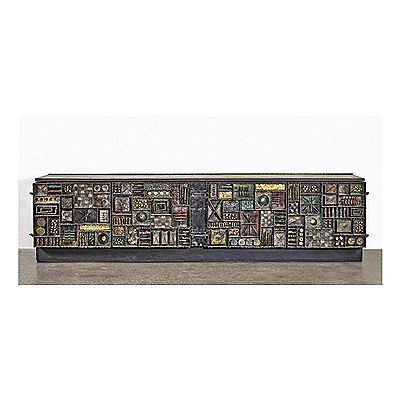
1931 Newtown, Pennsylvania - 1987 Nantucket Island, Massachusetts. Known for: Mixed-metal modernist sculpture, furniture design.
A furniture designer and mixed-metal sculptor in bronze, silver and gold, Paul Evans first earned public notice with an exhibition that included his work in 1957 at the Museum of Contemporary Crafts... Read full biography
A furniture designer and mixed-metal sculptor in bronze, silver and gold, Paul Evans first earned public notice with an exhibition that included his work in 1957 at the Museum of Contemporary Crafts in New York City. In 1964, he became the designer for Directional, a furniture manufacturing... Read full biography
A furniture designer and mixed-metal sculptor in bronze, silver and gold, Paul Evans first earned public notice with an exhibition that included his work in 1957 at the Museum of Contemporary Crafts in New York City. In 1964, he became the designer for Directional, a furniture manufacturing company, where his special series was called "Argent". Evans studied at the Cranbrook Academy of Art. Source:. www.merrillantiques.com... Read full biography
A furniture designer and mixed-metal sculptor in bronze, silver and gold, Paul Evans first earned public notice with an exhibition that included his work in 1957 at the Museum of Contemporary Crafts in New York City. In 1964, he became the designer for Directional, a furniture manufacturing company, where his special series was called "Argent". Evans studied at the Cranbrook Academy of Art. Source:. www.merrillantiques.com... Read full biography
A furniture designer and mixed-metal sculptor in bronze, silver and gold, Paul Evans first earned public notice with an exhibition that included his work in 1957 at the Museum of Contemporary Crafts in New York City. In 1964, he became the designer for Directional, a furniture manufacturing company, where his special series was called "Argent". Evans studied at the Cranbrook Academy of Art. Source:. www.merrillantiques.com... Read full biography
Artist Biography
Biography page for Paul Evans Jr ((1931 - 1987)), known for Mixed-metal modernist sculpture, furniture design. Showing 3 biographical entries and 0 sample artworks.
Paul Evans Jr - Artist Info
About Paul Evans Jr
Biography from the Archives of askART
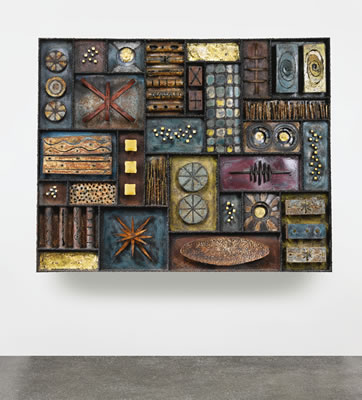 A furniture designer and mixed-metal sculptor in bronze, silver and gold, Paul Evans first earned public notice with an exhibition that included his work in 1957 at the Museum of Contemporary Crafts in New York City. In 1964, he became the designer for Directional, a furniture manufacturing company, where his special series was called "Argent".
Evans studied at the Cranbrook Academy of Art.
Source:
www.merrillantiques.comBiography from Rago Arts and Auction
Paul Evans studied silver smithing at the School for American Craftsmen in Rochester, New York. With the help of art patron Aileen Vanderbilt Webb, Evans received a scholarship to attend the Cranbrook Academy of Art. Evans did not complete his degree, but spent time working as a silversmith at Sturbridge Village in Massachusetts. There, Evans demonstrated traditional silver-smithing techniques, as he also became a celebrated artist in his own right. (1)
In 1951, Evans stopped by the shop of New Hope, Pennsylvania artist Phillip Lloyd Powell, who sold modern furnishings by some of the more well-known designers of the time including lamps by Isamu Noguchi.
In 1955, Evans moved permanently to New Hope, and began collaborating with Phillip Powell. By the fifties New Hope, an historical arts community, had become a hub of artists interested in modern art and design. Powell and Evans combined their talents in wood and metal, respectively, crafting one-of-a-kind cabinets, screens, and shelving units. In 1958, Evans began making steel-front cabinets with his unique style of revealing the welding joints.
Evans' work was greatly aided by collaboration with the machinist Dorsey Reading who began working with Evans in 1959, crafting the base structures for Evans pieces and completing modifications under Evans' direction. Their work was innovative and featured metals with pigment and acid treatments and edges treated with gold leaf. (2)
Evans quickly attracted attention for his unconventional, yet brilliantly crafted work. In 1961 Powell and Evans held a two-man show featuring thirty pieces at the America House exhibition at the Museum of Contemporary Crafts in New York, now named the Museum of Arts & Design. Around this time, Evans began work on the "bronze series" for the furniture manufacturer Directional, which was released in 1964. Another large commission for Evans included more than thirty pieces, worked in collaboration with Phillip Powell, completed for puppeteer ad children's television star, Shari Lewis. The two also created furniture for Rina and Norman Indictor.
However, it was Evans' work for Directional that spanned the course of his career. One of the most iconic works from this collection was the Disc Bar, a circular cabinet with sculpted-bronze doors that appeared as if they had been worked in clay. Evans created new lines for Directional yearly, including the popular Argente line featuring welded aluminum and the ultra-modern Cityscape line in brass and chrome that Evans developed in the early 70s. Evans worked for Directional until 1980.
He retired seven years later and died of a heart attack at age fifty-six.
Footnotes:
1. Iovine, Julie V. "Paul Evans & Phillip Lloyd Powell" in ed. Todd Merrill and Julie V. Iovine, Modern Americana (New York: Rizzoli, 2008)p.92
2. Ibid, p.95Biography from Wright
Paul Evans exhibited talent for design at an early age. He studied woodworking in high school and briefly attended the Philadelphia Textile Institute. Evans was awarded the Aileen O. Webb Scholarship in 1950 and studied at the prestigious Rochester Institute of Technology’s School for American Craftsmen. He would continue his studies at Cranbrook in 1952 with a focus on metalwork. In 1953 he took a position as the metal craftsman at the living museum, Old Sturbridge Village. Feeling that his creativity was being stifled, Evans left the museum in 1955 to find a more stimulating environment. He opened a showroom with fellow designer Phillip Lloyd Powell and the two began a decade long collaboration.
Evans’ experiments with welded and enameled sculpture in the early 1960's caught the eye of the Directional furniture company. Directional was looking for handmade furniture with distinctive character and Evans’ new American craft designs were a perfect fit. In 1971, Evans developed the brass and chrome Cityscape line for Directional marking a departure from his earlier sculptural works. In the 1980's, working with his son Keith, an electrical engineer, he continued to experiment with new materials and design increasing minimal forms with kinetic elements. Together, they formed Zoom, Inc. in 1983 and began a relationship with the Design Institute of America. In 1987, just one day after his retirement, Evans suffered his third heart attack and died.