Page loaded successfully. Showing biography for Pere Ysern Y Alie.
Pere Ysern Y Alie BIOGRAPHY
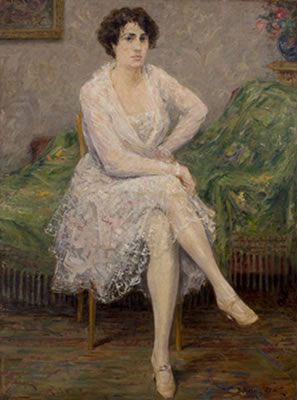
1875/76 Barcelona, Spain - 1946 Barcelona, Spain. Known for: Impressionist and realist painting, landscape.
A notable figure of Catalan post-Modernisme, Pere Ysern devoted part of his painting to a prolific representation of two main themes: dancers and the landscapes of the island of Mallorca. In the... Read full biography
A notable figure of Catalan post-Modernisme, Pere Ysern devoted part of his painting to a prolific representation of two main themes: dancers and the landscapes of the island of Mallorca. In the first case, it was his move to Paris in 1899, where he shared a studio with the painter Marià... Read full biography
A notable figure of Catalan post-Modernisme, Pere Ysern devoted part of his painting to a prolific representation of two main themes: dancers and the landscapes of the island of Mallorca. In the first case, it was his move to Paris in 1899, where he shared a studio with the painter Marià Pidelaserra and the sculptor Emili Fontbona, former members of the El Rovell de l’Ou group, which led to his recognition for compositions of this kind dealing with the frivolous night life of the city. Such was... Read full biography
A notable figure of Catalan post-Modernisme, Pere Ysern devoted part of his painting to a prolific representation of two main themes: dancers and the landscapes of the island of Mallorca. In the first case, it was his move to Paris in 1899, where he shared a studio with the painter Marià Pidelaserra and the sculptor Emili Fontbona, former members of the El Rovell de l’Ou group, which led to his recognition for compositions of this kind dealing with the frivolous night life of the city. Such was his interest and dedication that from 1909 he began to take dance and music-hall subjects to the Salon des Indépendants. That was the origin of his nickname “peintre de danseuses”, although the success that sphere brought him led to a certain... Read full biography
A notable figure of Catalan post-Modernisme, Pere Ysern devoted part of his painting to a prolific representation of two main themes: dancers and the landscapes of the island of Mallorca. In the first case, it was his move to Paris in 1899, where he shared a studio with the painter Marià Pidelaserra and the sculptor Emili Fontbona, former members of the El Rovell de l’Ou group, which led to his recognition for compositions of this kind dealing with the frivolous night life of the city. Such was his interest and dedication that from 1909 he began to take dance and music-hall subjects to the Salon des Indépendants. That was the origin of his nickname “peintre de danseuses”, although the success that sphere brought him led to a certain reiteration and caused the public at large to forget about his more enquiring earlier works. Concerning the second, his adventure in Mallorca w... Read full biography
Artist Biography
Biography page for Pere Ysern Y Alie ((1875/76 - 1946)), known for Impressionist and realist painting, landscape. Showing 2 biographical entries and 0 sample artworks.
Pere Ysern Y Alie - Artist Info
About Pere Ysern Y Alie
Name variants
Pedro Isern Alie
Biography from the Archives of askART
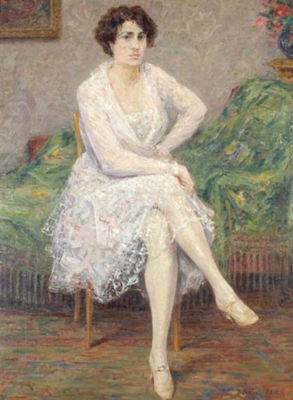 A notable figure of Catalan post-Modernisme, Pere Ysern devoted part of his painting to a prolific representation of two main themes: dancers and the landscapes of the island of Mallorca. In the first case, it was his move to Paris in 1899, where he shared a studio with the painter Marià Pidelaserra and the sculptor Emili Fontbona, former members of the El Rovell de l’Ou group, which led to his recognition for compositions of this kind dealing with the frivolous night life of the city.
Such was his interest and dedication that from 1909 he began to take dance and music-hall subjects to the Salon des Indépendants. That was the origin of his nickname “peintre de danseuses”, although the success that sphere brought him led to a certain reiteration and caused the public at large to forget about his more enquiring earlier works.
Concerning the second, his adventure in Mallorca was a result of the words of praise and enthusiasm of his fellow student in France Hermen Anglada Camarasa, who discovered Pollença in 1907 and conveyed his love for the place to him. From the 1920s, Ysern confessed to his biographer Georges Turpin that he divided the twelve months of the year into two parts: six months of winter in Paris and another six enjoying the marvellous atmosphere of the island.
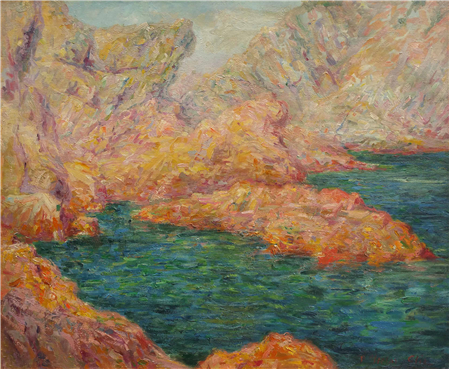
The landscape from 1918 is highly representative of that genre in Pere Ysern’s painting. In 1915 La Veu de Catalunya had written that “Ysern is a sincere landscape painter who, rather than searching for a new, exalted expression of things, goes in pursuit of an adaptation of the beautiful spectacles provided by nature, collecting its harmonies to work on the canvas. His studies […] show an enthusiastic calling, a lively struggle of the painter’s spirit. Hence that spontaneous freshness breathed by his paintings, which is the cornerstone of the interest they arouse.”
Source:
"Pere Ysern Alie," Sabadell, Web, Feb. 2018Biography from Le chef d'oeuvre inconnu
 Pere Ysern i Alié was a Catalan painter who was born during the full effervescence of Catalonia, economic, cultural, political. He lived most of his life in Paris, where he discovered Impressionism. His painting owes much to the French Impressionists; he knew how to assimilate the spirit of art of that time
Then, on April 3, 1899, he and his comrades from the Académie Borrell, Pidelaserra and Fontbona went to Paris, at a time when it was a moment of great splendor magnified by the celebration of its universal exhibition, with the Eiffel Tower which is the symbol of European change.
He arrived in Paris with different aesthetic opinion and the appearance of another way of thinking proper to the old continent. In the field of art, this resulted in a reaction against the idealism of the liberal empire, which was made around Gustave Courbet, as well as the school of Barbizon with Corot, Pissarro and Louis Dauvigny ... This foundation of the landscape school would have profound repercussions on Catalan society, on artistic change.
It was a France full of vitality and enriched by the industrial revolution that Pere Ysern i Alié found on arriving there. There he discovered the wall decors of the Pantheon of Puvis de Chavannes, but also the Impressionists at the Luxembourg Museum, and it was in this museum that he was for the first time confronted with the Impressionist phenomenon;
He learned that shapes are what one thinks he is seeing: an appearance, and that it is necessary to abandon the drawing of the outline by substituting it with fragmented touches; He studied the great impressionists, such as Monet, Bazille, Sisley and Pissarro. He was immersed in Parisian life and frequented the Catalan circle, who lived in Paris and was very familiar with the famous Parisian cabarets such as the Moulin Rouge, owned by the Catalan Josep Oller, alongside Toulouse-Lautrec.
He returned to Barcelona] in 1904, but his painting was not appreciated as he thought he deserved. It confirmed his residence in Paris, where he becomes accustomed to the Salon des Independants.
Nevertheless, World War I precipitated a change of the city of Paris; the Moulin Rouge was closed for example; Montmartre lost its animation (the fire of 1915 Moulin Rouge touched Pere Ysern i Alié, who remained faithful In Montmartre). Montparnasse would become the new neighborhood where one must be.
But Father Ysern i Alié continued to paint, under cover of new aesthetic movements and remained always as faithful to cafes, cabarets. Once the war was over, an optimistic revival would take place in Paris with the Roaring Twenties (the 1920s), which will be marked by North American presence, fox trotting and jazz.