Page loaded successfully. Showing biography for Piotr Uklanski.
Piotr Uklanski BIOGRAPHY
Born 1968 Warsaw, Poland. Known for: Politically charged fantasy portraits, sculpture and films.
"An Artist Who Appropriates With a Wink," Exhibition Review in Art & Design Section, The New York Times, September 25, 2019, by Ted Loos. Piotr Uklanski has a brush with fantasy portraits in... Read full biography
"An Artist Who Appropriates With a Wink," Exhibition Review in Art & Design Section, The New York Times, September 25, 2019, by Ted Loos. Piotr Uklanski has a brush with fantasy portraits in “Ottomania,” his new gallery show that melds East and West. For someone who has ricocheted from one medium... Read full biography
"An Artist Who Appropriates With a Wink," Exhibition Review in Art & Design Section, The New York Times, September 25, 2019, by Ted Loos. Piotr Uklanski has a brush with fantasy portraits in “Ottomania,” his new gallery show that melds East and West. For someone who has ricocheted from one medium to another long before it was fashionable — installations, photography, collages, performances, films — the Polish artist Piotr Uklanski sure has a lot of different kinds of paintbrushes in his... Read full biography
"An Artist Who Appropriates With a Wink," Exhibition Review in Art & Design Section, The New York Times, September 25, 2019, by Ted Loos. Piotr Uklanski has a brush with fantasy portraits in “Ottomania,” his new gallery show that melds East and West. For someone who has ricocheted from one medium to another long before it was fashionable — installations, photography, collages, performances, films — the Polish artist Piotr Uklanski sure has a lot of different kinds of paintbrushes in his Greenpoint, Brooklyn, studio. Ranging from a wide wallpaper brush to tiny-bristled detailers, they seemed to signal that for his new series, “Ottomania,” he is taking the most traditional art form quite seriously. His new paintings remake, with much... Read full biography
"An Artist Who Appropriates With a Wink," Exhibition Review in Art & Design Section, The New York Times, September 25, 2019, by Ted Loos. Piotr Uklanski has a brush with fantasy portraits in “Ottomania,” his new gallery show that melds East and West. For someone who has ricocheted from one medium to another long before it was fashionable — installations, photography, collages, performances, films — the Polish artist Piotr Uklanski sure has a lot of different kinds of paintbrushes in his Greenpoint, Brooklyn, studio. Ranging from a wide wallpaper brush to tiny-bristled detailers, they seemed to signal that for his new series, “Ottomania,” he is taking the most traditional art form quite seriously. His new paintings remake, with much creative leeway, Orientalist pictures from the past. But lest he seem too serious, he got to the heart of the matter right... Read full biography
Artist Biography
Biography page for Piotr Uklanski ((Born 1968)), known for Politically charged fantasy portraits, sculpture and films. Showing 4 biographical entries and 0 sample artworks.
Piotr Uklanski - Artist Info
About Piotr Uklanski
Name variants
Piotr Uklansky
Biography from the Archives of askART
 "An Artist Who Appropriates With a Wink," Exhibition Review in Art & Design Section, The New York Times, September 25, 2019, by Ted Loos.
Piotr Uklanski has a brush with fantasy portraits in “Ottomania,” his new gallery show that melds East and West.
For someone who has ricocheted from one medium to another long before it was fashionable — installations, photography, collages, performances, films — the Polish artist Piotr Uklanski sure has a lot of different kinds of paintbrushes in his Greenpoint, Brooklyn, studio.
Ranging from a wide wallpaper brush to tiny-bristled detailers, they seemed to signal that for his new series, “Ottomania,” he is taking the most traditional art form quite seriously. His new paintings remake, with much creative leeway, Orientalist pictures from the past.
But lest he seem too serious, he got to the heart of the matter right away. The big question was, “How much of a wink to include?” For starters, most of his “Ottomania” works are painted on velvet, a background better known for pictures of Elvis found on motel walls.
Mr. Uklanski, 50, has been something of an art world bad boy, bringing a dark-humored, ironic touch to varied projects, including a Polish spaghetti western film he wrote and directed in 2006, Summer Love, that starred Val Kilmer as a slumped-over corpse. Before that, in 2003, there was his two-page photograph in Artforum featuring the bare derrière of his girlfriend (and now wife) Alison Gingeras. A former curator at Centre Pompidou, Ms. Gingeras wrote that the image tried to “confront the projection of taboo.”
Now, with his new series of portraits at the Istanbul Biennial and at Luxembourg & Dayan gallery in Manhattan (through Oct. 29), the artist is again tackling a Conceptual project that may raise eyebrows.
A trip to his native Poland brought him to museums where he saw old master paintings of the late 1500s, “with men dressed up as Ottomans,” he recalled. That planted the seed of a project: He would do his own versions of existing Orientalist portraits.
His “Ottomania” works include a masked and bejeweled Amalie of Württemberg, the Duchess of Saxe-Altenburg, which Mr. Uklanski based on a 19th-century work by Ludwig Doell.
Another portrait, Untitled (Lukasz Trzcinski), depicts a mustachioed 17th-century Polish nobleman wearing fur trim. In addition to inspiration from old masters, he included more recent sources: “Untitled (Tamara de Lempicka)” is a portrait of the Polish Art Deco painter.
The common thread is Turkish garb, including turbans and robes, which had been appropriated by the original painters. Mr. Uklanski, who has always relied on the push-pull of contradictory forces in his work, said that his own paintings functioned as both “critical tool and homage.”
“I have a long history of appropriation in my practice, and reinventing it in my own way,” he added.
Recently, old pictures of Prime Minister Justin Trudeau of Canada wearing a turban at an “Arabian Nights”-themed party, with darkened face, neck and hands, have surfaced, amid charges of cultural insensitivity.
And as far back as 1978, Edward Said, the Columbia University scholar, critic and author, criticized what he considered patronizing representations of the East in his landmark book, Orientalism. Said defined Orientalism as a romanticized view of Arabic culture by French, British and, later, American writers to create a narrative of an exotic land.
In some ways, Mr. Uklanski said, the new works were his response to Said’s critiques.
“Maybe it was a cultural appropriation,” Mr. Uklanski mused about the early works, “but many of the painters didn’t travel anywhere, they were fantasizing.” By donning Ottoman garb, he added, “Maybe they were actually trying to find a common denominator.”
At his studio in Greenpoint, a neighborhood he chose partly for its longtime Polish character, the artist said that his own heritage is at the core of “Ottomania.”
Since the 15th century, Mr. Uklanski said, Poland and its predecessor states had close relations with the Ottoman Empire; the Polish national costume, he added, has Turkish roots. “Poles sought Ottomanic traditions to bolster their own identity,” he said. The affinity lasted hundreds of years, though interrupted by war along the way.
The artist, who has a mop of unruly hair that transitions into mutton-chop sideburns, said the series came about after his 2015 photography show at the Metropolitan Museum of Art, “Piotr Uklanski: Fatal Attraction.” That two-part show featured his own work, as well as selections he edited from the museum’s collection, presaging his interest in older art and traditional methods.
Of the inspirations he found for “Ottomania,” he explained, “Some are beautiful, and some of them are quite weird.”
“They’re a little trashier than the originals,” he admitted. “All my work involves using something that the high discourse rejects.”
Nicolas Bourriaud, the curator of the Istanbul Biennial, said that “the layered quality of ‘Ottomania’” suits the biennial because of the city’s traditional role as gateway between East and West. He installed 11 of Mr. Uklanski’s pictures at the Pera Museum, which focuses on Orientalist art.
“The whole building will be dominated by the idea of fiction, a civilization that never existed,” Mr. Bourriaud said.
Mr. Uklanski has never minded a little controversy during his shifts among various media. One of his signature photographic works was The Nazis, in 1998, a grid of 164 head shots of actors portraying Nazis on film.
At the time of its debut, Mr. Uklanski responded to an outcry by defending the piece, but he says now, “The project feels a little dated.”
Douglas Eklund, the Met photography curator who organized Fatal Attraction, said the artist was “criminally under-known” because he has “different modes and frames of reference.” The New York investor David Shuman, who owns more than a dozen works by Mr. Uklanski, said that he prizes the lack of a signature style.
“Visually, I just love the ‘Ottomania’ pictures,’” Mr. Shuman said. “If you put those pictures in front of a dozen art collectors, they won’t be able to guess who the artist is.”
Ms. Gingeras, the artist’s wife, said in an email that at the start of the “Ottomania,” Mr. Uklanski was somewhat inhibited. “He sees himself foremost as a conceptual artist,” she said. But she added that she relished that instead of keeping an ironic distance from painting, he let himself go and indulged in his “hand.”
Indeed, viewers may see that in the delicate modeling of the blue robe worn by a boy depicted in “Untitled (Eastern Promises V),” at Luxembourg & Dayan, which he had in front of him in the studio.
Mr. Uklanski said a curator once called him “a painter who was running away from the brush,” noting that he was now returning to a medium he worked in more frequently 30 years ago. On this project, he added, “There’s some attention to detail, a little bit of the quest for perfection.”Biography from the Archives of askART
 Working from a studio in Greenpoint, Brooklyn, New York and sometimes from his hometown of Warsaw, Poland, Piotr Uklanski does painting, sculpture and filmmaking that often reflects his heritage of a communist dominated country.
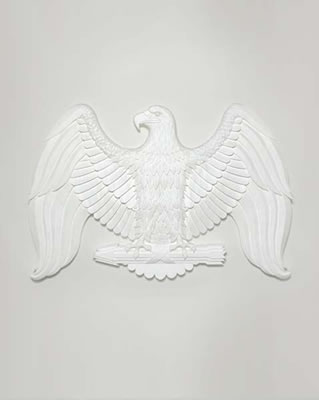
In a 2008 New York gallery exhibit, he had large size, blocky Styrofoam letters that spelled out "Bialo-Czerwona", meaning white/red which is slang for the Polish flag. Six paintings represented neighborhoods of Warsaw, and he also "fabricated a version of the heraldic emblem of Poland as a 13-by-7-by-12 foot eagle that stood sentinel" (Leffingwell) to the accompanying work.
Much of his work seems to be shifting out of text pop images that on the surface seem ordinary but become much more with his unique abilities of conversion.
He wrote, directed and produced a film, Summer Love: The First Polish Western (2007), a rough and tumble and violent Wild West movie for which he made props such as decapitated heads. The film, with a main character that was a bloated corpse, had a seven week showing at the Whitney Museum in New York. Another film, The Nazis, is a series of stills of fascist soliders and in October 2006, sold at auction for $1.1 million dollars.
Uklanski lives with his girlfriend, Alison Gingeras, curator and the mother of their two-year old daughter. He studied painting at the Warsaw Academy of Fine Arts and photography at Cooper Union in New York.
Sources:
http://www.mensvogue.com/arts/articles/2007/11/uklanski?currentPage=3
Edward Leffingwell, "New York: Piotr Uklanski", Art in America, June 2008, p. 186Biography from Desa Unicum
Piotr Uklanski is one of those painters whose artistic debut took place during the turbulent transformation of the late 1980s and mid-1990s. Once considered an artistic rebel, today he is undoubtedly in the pantheon of Polish artists with a strong position in the community. Consistently and courageously, he still uses topics that are forbidden or uncomfortable for many.
With his art, he tries to enter into relations with current socio-political problems, reaching for various artistic media, e.g. photography, installation, performance or painting. In 1991, after graduating from the Academy of Fine Arts in Warsaw, he moved to New York, where he worked as a photographer. He lives and works in New York. Uklanski uses various media - from photography, installation, through video and performance. He plays an ironic, critical game with the seductive charm of popular culture stereotypes and visual clichés.
The artist uses the degraded areas of pop culture as material for his works, showing their unquestionable magic. His works speak as much about the spontaneous enjoyment of beauty as about the guilt that comes with experiencing it. Uklanski finds beauty in trivial and well-known things, in forgotten places or where he appears completely unexpectedly, engaging the audience in situations created in order to create a "good" mood, which evokes a feeling of nostalgia and sentiment.
Uklanski's "specialty" is to transfer various aesthetic phenomena in time and space. The work from 1996 entitled DANCE FLOOR is a floor "quoted" from a nightclub pulsating with lights to the rhythm of dance music. Installed inside the gallery, it becomes an unmissable element for visitors. They are confronted with a space whose atmosphere resembles a disco, but their frustration may be caused by the fact that they are unable to fully indulge in this mood. This work is also a dialogue with traditional minimalist sculpture.
In 1999, Uklanski, invited by the Foksal Gallery, made a mosaic on a pillar at the entrance to the "Smyk" department store in the center of Warsaw, made of porcelain plates, production waste from factories in Cmielów and Pruszków. The inspiration for the work was the artist's trip around Poland, during which he noticed houses decorated with mirrors and pieces of tableware. The artist picked up the kitschy way of decorating provincial architecture and used this method in a different social and aesthetic context, changing the scale of the realization into a monumental one, and low culture into high.
Uklanski's exhibition NAZISTS, shown in November 2000 at the Zacheta Gallery in Warsaw, ended in a scandal, the destruction of several works and the closure of the exhibition. It presented a series of 164 color photographs depicting well-known foreign and Polish actors playing Nazi characters in films. Using a tool typical of mass culture, the artist juxtaposed film images of the "bad German" that inhabit the collective imagination of the viewer. The photos show handsome, elegant men, film toughs seducing the viewer with their attractive image, which blurs the truth about Nazism.
As the artist himself comments on this work: "The portrait of a Nazi in mass culture is the most expressive example of distorting the truth about history, about people. It is all the more important to me because it is the main source of information about those times, and for many it is the only one." During the exhibition, the well-known actor Daniel Olbrychski entered the gallery with a saber and, in the presence of a previously arranged television crew, cut up some of the stills, thus protesting against the use of his film image by the artist. The Minister of Culture did not agree to the reopening of the exhibition. film tough guys seducing the viewer with their attractive image, which blurs the truth about Nazism. As the artist himself comments on this work: "The portrait of a Nazi in mass culture is the most expressive example of distorting the truth about history, about people. It is all the more important to me. . . .Biography from Desa Unicum
Piotr Uklanski is one of those painters whose artistic debut took place during the turbulent transformation of the late 1980s and mid-1990s. Once considered an artistic rebel, today he is undoubtedly in the pantheon of Polish artists with a strong position in the community. Consistently and courageously, he still uses topics that are forbidden or uncomfortable for many. With his art, he tries to enter into relations with current socio-political problems, reaching for various artistic media, e.g. photography, installation, performance or painting. In 1991, after graduating from the Academy of Fine Arts in Warsaw, he moved to New York, where he worked as a photographer.
He lives and works in New York. Uklanski uses various media - from photography, installation, through video and performance. He plays an ironic, critical game with the seductive charm of popular culture stereotypes and visual clichés. The artist uses the degraded areas of pop culture as material for his works, showing their unquestionable magic. His works speak as much about the spontaneous enjoyment of beauty as about the guilt that comes with experiencing it. Uklanski finds beauty in trivial and well-known things, in forgotten places or where he appears completely unexpectedly, engaging the audience in situations created in order to create a "good" mood, which evokes a feeling of nostalgia and sentiment.
Uklanski's "specialty" is to transfer various aesthetic phenomena in time and space. The work from 1996 entitled DANCE FLOOR is a floor "quoted" from a nightclub pulsating with lights to the rhythm of dance music. Installed inside the gallery, it becomes an unmissable element for visitors. They are confronted with a space whose atmosphere resembles a disco, but their frustration may be caused by the fact that they are unable to fully indulge in this mood. This work is also a dialogue with traditional minimalist sculpture. In 1999, Uklanski, invited by the Foksal Gallery, made a mosaic on a pillar at the entrance to the "Smyk" department store in the center of Warsaw, made of porcelain plates, production waste from factories in Cmielów and Pruszków.
The inspiration for the work was the artist's trip around Poland, during which he noticed houses decorated with mirrors and pieces of tableware. The artist picked up the kitschy way of decorating provincial architecture and used this method in a different social and aesthetic context, changing the scale of the realization into a monumental one, and low culture into high. Uklanski's exhibition NAZISTS, shown in November 2000 at the Zacheta Gallery in Warsaw, ended in a scandal, the destruction of several works and the closure of the exhibition.
It presented a series of 164 color photographs depicting well-known foreign and Polish actors playing Nazi characters in films. Using a tool typical of mass culture, the artist juxtaposed film images of the "bad German" that inhabit the collective imagination of the viewer. The photos show handsome, elegant men, film toughs seducing the viewer with their attractive image, which blurs the truth about Nazism.
As the artist himself comments on this work: "The portrait of a Nazi in mass culture is the most expressive example of distorting the truth about history, about people. It is all the more important to me because it is the main source of information about those times, and for many it is the only one." During the exhibition, the well-known actor Daniel Olbrychski entered the gallery with a saber and, in the presence of a previously arranged television crew, cut up some of the stills, thus protesting against the use of his film image by the artist.
The Minister of Culture did not agree to the reopening of the exhibition. film tough guys seducing the viewer with their attractive image, which blurs the truth about Nazism. As the artist himself comments on this work: "The portrait of a Nazi in mass culture is the most expressive example of distorting the truth about history, about people. It is all the more important to me because