Page loaded successfully. Showing biography for Prunella Clough.
Prunella Clough BIOGRAPHY
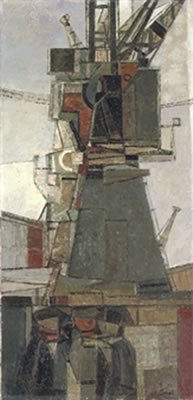
1919 London, England - 1999. Known for: Abstract landscape painting, printmaking, found object assemblage, teaching.
Prunella Clough was a prominent British artist. She is known mostly for her paintings, though she also made prints and created assemblages of collected objects. "Her subjects are closely observed... Read full biography
Prunella Clough was a prominent British artist. She is known mostly for her paintings, though she also made prints and created assemblages of collected objects. "Her subjects are closely observed details and scenes from the landscape. The images are combined and filtered through memory, and evolve... Read full biography
Prunella Clough was a prominent British artist. She is known mostly for her paintings, though she also made prints and created assemblages of collected objects. "Her subjects are closely observed details and scenes from the landscape. The images are combined and filtered through memory, and evolve through a slow process of layering and re-working.". Born on 11 November 1919 in Chelsea, London to an affluent upper-middle-class family, she was initially educated privately by her father, the poet... Read full biography
Prunella Clough was a prominent British artist. She is known mostly for her paintings, though she also made prints and created assemblages of collected objects. "Her subjects are closely observed details and scenes from the landscape. The images are combined and filtered through memory, and evolve through a slow process of layering and re-working.". Born on 11 November 1919 in Chelsea, London to an affluent upper-middle-class family, she was initially educated privately by her father, the poet Eric Taylor, before enrolling as a part-time student at the Chelsea School of Art (now Chelsea College of Art and Design) in 1937. In 1938, she took classes at Chelsea with the sculptor Henry Moore. Her aunt was Irish designer Eileen Gray. Clough... Read full biography
Prunella Clough was a prominent British artist. She is known mostly for her paintings, though she also made prints and created assemblages of collected objects. "Her subjects are closely observed details and scenes from the landscape. The images are combined and filtered through memory, and evolve through a slow process of layering and re-working.". Born on 11 November 1919 in Chelsea, London to an affluent upper-middle-class family, she was initially educated privately by her father, the poet Eric Taylor, before enrolling as a part-time student at the Chelsea School of Art (now Chelsea College of Art and Design) in 1937. In 1938, she took classes at Chelsea with the sculptor Henry Moore. Her aunt was Irish designer Eileen Gray. Clough lived in London throughout her career. Apart from wartime service, during which she worked as a cartographer for the Office of War Informa... Read full biography
Artist Biography
Biography page for Prunella Clough ((1919 - 1999)), known for Abstract landscape painting, printmaking, found object assemblage, teaching. Showing 3 biographical entries and 0 sample artworks.
Prunella Clough - Artist Info
About Prunella Clough
Biography from the Archives of askART
 Prunella Clough was a prominent British artist. She is known mostly for her paintings, though she also made prints and created assemblages of collected objects.
"Her subjects are closely observed details and scenes from the landscape. The images are combined and filtered through memory, and evolve through a slow process of layering and re-working."
Born on 11 November 1919 in Chelsea, London to an affluent upper-middle-class family, she was initially educated privately by her father, the poet Eric Taylor, before enrolling as a part-time student at the Chelsea School of Art (now Chelsea College of Art and Design) in 1937. In 1938, she took classes at Chelsea with the sculptor Henry Moore. Her aunt was Irish designer Eileen Gray.
Clough lived in London throughout her career.
Apart from wartime service, during which she worked as a cartographer for the Office of War Information, Clough painted full-time until her death in 1999, supplementing her income with teaching posts at Chelsea (1956–69) and Wimbledon School of Art (1966-97).
The Clough-Taylor family often holidayed in Southwold, and in 1945 Clough's mother Thora Clough purchased Woldside house in Southwold, which became an important base for the artist until it was sold after Thora's death in 1966.
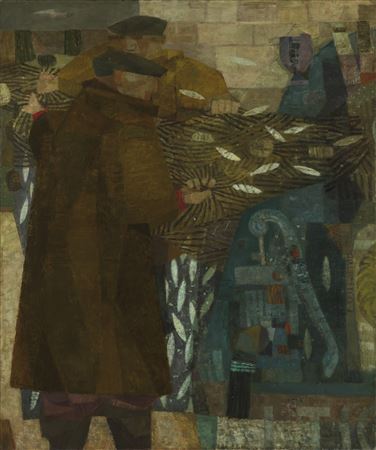
Clough retained strong links with the area throughout her career; the coastal landscape, a local quarry, and fishermen at nearby Lowestoft and Yarmouth harbours provided significant early subjects. Clough also produced a number of still lifes.
Clough had her first solo show at the Leger Gallery in London in 1947. In 1951, Clough participated in the exhibition 60 Paintings for '51, organised by the Arts Council to coincide with the 1951 Festival of Britain, for which they commissioned 60 artists to produce paintings of 4 by 5 feet or more. Clough's submission was entitled Lowestoft Harbour (1951), a painting of two fishermen weighing a catch of fish. The painting was subsequently purchased by the Arts Council Collection.
Clough's early subject matter led to her being linked with Neo-Romantic artists such as John Minton and Michael Ayrton. From the 1950s onwards, she increasingly painted the industrial landscapes of post-WWII Britain. Although based in London, she made frequent trips to East Anglia and the Midlands.
During the 1950s, Clough became close friends with the painter and critic John Berger; they went drawing together in the marshalling yards at Willesden Junction. Clough also visited a number of factories and industrial sites with the sculptor Ghisha Koenig, and became close friends with the painter David Carr, who also shared her interest in the industrial landscape as a subject.
These trips resulted in a number of paintings of men and women at work in factories and on building sites, together with images of power stations, electrical plants and chemical works. The novelist Margaret Drabble has noted that while many of her early paintings included the human figure, it gradually disappeared from her works, and Clough's canvases became more abstract during the 1960s and 1970s.
In 1960, Clough had her first retrospective at the Whitechapel Art Gallery, under the directorship of the curator Bryan Robertson. During a 1982 interview with Robertson, which was published in the catalogue for an exhibition of Clough's work held that year at the Warwick Arts Trust, the artist described how: "I prefer to look at the urban or industrial scene or any unconsidered piece of ground."
In the latter decades of her career, Clough made a number of abstract works that reference fragments of urban detritus and rubbish that she found on the streets of London, such as plastic bags, discarded gloves, and oil stains.
The first time she exhibited these paintings was in 1989 in a show entitled "Prunella Clough: Recent Paintings, 1980-1989"at Annely Juda Fine Art Gallery in London. The exhibition was a “critical and financial success” and helped Clough gain recognition and popularity.
The early 1980s saw Clough embark on a series of paintings that focused on an abstracted 'gate' motif, and she also became fascinated by the shadows cast by passing people on subway walls, creating a number of works on this theme.
Although Clough worked predominantly as a painter, she was also an accomplished printmaker.[8] Clough created lithographs early in her career, and from the early 1960s often worked at the Curwen Studio in Plaistow. Throughout her career, Clough also made a number of assemblages from found objects that she gathered on her trips to industrial sites, the extent of which only became clear when these were discovered in her studio after her death.
Clough's work enjoyed increasing recognition from the 1970s onwards, with exhibitions at the Serpentine Gallery in 1976, followed by shows at the Warwick Arts Trust, the Camden Arts Centre and Kettle's Yard. From 1988 Clough was represented by Annely Juda Fine Art.
In 1999, the year of her death, she was awarded the Jerwood Prize for Painting, and in 2007 she received a retrospective exhibition at Tate Britain.
Prunella Clough is recognized as an accomplished artist, yet did not become as famous as some of her peers. A contributing factor to this was her love of privacy. She also was very generous in regards to money and her art. She would let people reproduce her work, but did not want money for it. When she sold or gave away a painting, she did not try to exercise authority or ownership over it anymore.
Prunella Clough’s paintings often share a mild or neutral color palette, sometimes with punctuating strong or harsh colors. Clough cites the weather in England as the probable cause for this trend. Clough often made changes to her paintings after she had begun working on them. In doing this she left traces of the old lines and shapes, creating a many-layered surface.
Her actual painting techniques furthered this by adding more texture. “Clough employed thick impasto, she daubed, she scraped, she gauged and scratched, she obliterated, experimenting with a variety of mixed media”.
Gerard Hastings has described how Clough used a variety of tools and materials to apply paint to her canvas and create a variety of visual effects, including sandpaper, wire wool, rollers, wallpaper scrapers, and pieces of wire mesh.[25] She would sometimes mix textured materials like sand into her paint.
Clough’s paintings gave unique views of everyday features of the urban landscape. Prunella Clough sometimes took photographs of her subject matter, but more important to her was the memory of the experience of seeing something.
In an interview with Bryan Robertson she said, “I work from the subject matter, things perceived, and the things that I see tend to be somewhat murky”.
Awards • The City of London Midsummer Prize (1977)[27]
• The £30,000 Jerwood Prize for painting (1999)[28]
• She declined an OBE in 1968 and a CBE in 1979.
Selected exhibitions • Leger Gallery, London (1947)
• Roland, Browse and Delbanco, London (1949)
• Leicester Galleries, London (1953)
• Whitechapel Gallery, London (1960) (this was her first retrospective)[14]
• Grosvenor Gallery, London (1964, 1968)
• Bear Lane Gallery, Oxford (1971)
• Graves Art Gallery, Sheffield (1972)
• New Art Centre, London (1973, 1976)
• Serpentine Galleries, London (1976)[29]
• Perth, Western Australia (1974)
• Edinburgh (1976)
• Aberdeen (1981)
• Warwick Arts Trust (1982)
• Hiroshima (1988)
• Annely Juda Fine Art, London (1989)
• Camden Arts Centre, London (1996)[30]
• Austin/Desmond Fine Art, London (1996, 2012)
• Kettle's Yard, Cambridge (1999)
• The Olympia Fine Art & Antiques Fair (2004, retrospective)[31]
• Tate Gallery (2007, retrospective)[32]
Source:"Prunella Clough," Wikipedia, Jun. 2018Biography from Leland Little Auctions
Born into an affluent and "minor" aristocratic family, Clough eschewed her early years in Belgravia and gravitated towards the grittier life near urban and industrial environs. Clough's maternal aunt was Eileen Gray, a pioneering modernist designer and architect, and likely influenced and encouraged Clough's artistic nature.
Her work of the 1950s and early 1960s was representational that morphed into an edgy and somewhat lyrical abstraction in her mature work.
Clough was favored by collectors in her lifetime with works in important public collections including Tate Modern, London, Kettle's Yard at the University of Cambridge, and the Metropolitan Museum of Art in New York. Grosvenor Gallery, London, UKBiography from Lyon & Turnbull
Prunella Clough emerged in the post-war British art world after training at Chelsea School of Art and Camberwell School of Art. She followed her own artistic path, creating work infused with an unconventional sense of beauty. Clough's paintings are described as traditionally made objects, focusing on the nature and structure of objects from the real world. She had a teaching career spanning over forty years and influenced younger generations of artists. Clough won the Jerwood prize for painting in 1999 and her final decade of work showcased a triumphant maturity and celebration of sight. Her contribution to art history is significant and not fully understood.