Page loaded successfully. Showing biography for Purvis Young.
Purvis Young BIOGRAPHY
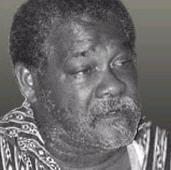
1943 Liberty City, Florida - 2010 Miami, Florida. Known for: Mod naive urban views, installation.
The work of the urban black vernacular artist, Purvis Young, has roots in the dreamy fields of high art subject matter-evoking Picasso in its riders, its elegant horses, its nudes. At the same time... Read full biography
The work of the urban black vernacular artist, Purvis Young, has roots in the dreamy fields of high art subject matter-evoking Picasso in its riders, its elegant horses, its nudes. At the same time it is filled with the energy and syncretism of the world's vanguard-American urban Black culture. It... Read full biography
The work of the urban black vernacular artist, Purvis Young, has roots in the dreamy fields of high art subject matter-evoking Picasso in its riders, its elegant horses, its nudes. At the same time it is filled with the energy and syncretism of the world's vanguard-American urban Black culture. It is to "outsider art" what be bop is to the blues. The subject matter rides on a thick layer of color, attention, choice, free-swinging composition that refers to a thousand years of composition before... Read full biography
The work of the urban black vernacular artist, Purvis Young, has roots in the dreamy fields of high art subject matter-evoking Picasso in its riders, its elegant horses, its nudes. At the same time it is filled with the energy and syncretism of the world's vanguard-American urban Black culture. It is to "outsider art" what be bop is to the blues. The subject matter rides on a thick layer of color, attention, choice, free-swinging composition that refers to a thousand years of composition before it. Young lives and works in Overtown, a neighborhood in Miami cut off by the highway overpasses that loom over it. He is "of the community, but is also, now, of the larger art world as well." He has researched art history avidly and has seen what... Read full biography
The work of the urban black vernacular artist, Purvis Young, has roots in the dreamy fields of high art subject matter-evoking Picasso in its riders, its elegant horses, its nudes. At the same time it is filled with the energy and syncretism of the world's vanguard-American urban Black culture. It is to "outsider art" what be bop is to the blues. The subject matter rides on a thick layer of color, attention, choice, free-swinging composition that refers to a thousand years of composition before it. Young lives and works in Overtown, a neighborhood in Miami cut off by the highway overpasses that loom over it. He is "of the community, but is also, now, of the larger art world as well." He has researched art history avidly and has seen what other artists have done, spending years in the libraries that have supported his work. He has chosen... Read full biography
Artist Biography
Biography page for Purvis Young ((1943 - 2010)), known for Mod naive urban views, installation. Showing 4 biographical entries and 0 sample artworks.
Purvis Young - Artist Info
About Purvis Young
Name variants
Pervis Young
Biography from the Archives of askART
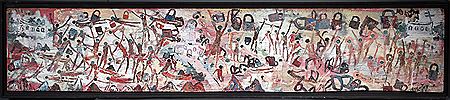 The work of the urban black vernacular artist, Purvis Young, has roots in the dreamy fields of high art subject matter-evoking Picasso in its riders, its elegant horses, its nudes. At the same time it is filled with the energy and syncretism of the world's vanguard-American urban Black culture. It is to "outsider art" what be bop is to the blues. The subject matter rides on a thick layer of color, attention, choice, free-swinging composition that refers to a thousand years of composition before it.
Young lives and works in Overtown, a neighborhood in Miami cut off by the highway overpasses that loom over it. He is "of the community, but is also, now, of the larger art world as well." He has researched art history avidly and has seen what other artists have done, spending years in the libraries that have supported his work. He has chosen his imagery out of Overtown and his own life, and out of the resonances of the past as well.
Young's choices of materials-the discarded boards he uses to paint on and to "frame" works; the fragments of text, the use of books to mount the works-are not made by happenstance, though early on they may have been the fruit of necessity. Now these are elements of meaning. Now they insist on the presence of the street, full of stuff, humanity, words, scraps, full of the exchanges that create the most exciting cultural milieu in the world, creative, tragic, excessive, beautiful, wasteful.
- Ann Klefstad
Source:
Skot Foreman Fine Art, Ltd.Biography from the Archives of askART
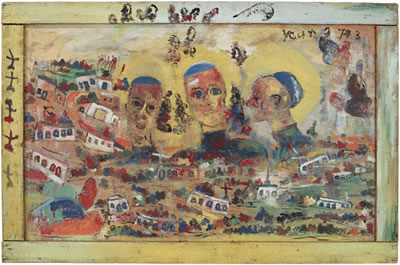 Although Purvis Young enjoyed painting as a child it wasn't until after having been imprisoned as a young man, that he took up drawing again. Purvis was inspired by the urban murals of Chicago and Detroit and painting became a way to express his anger and frustration. He wanted to paint the stories of his own neighborhood.
His first public art in the early 70s was the Goodbread Alley project. The art consisted of hundreds of pictures hung on boarded up buildings along Fourteenth Street in Overton, his Miami neighborhood. The heart of the neighborhood had been destroyed when I-395 was routed through the community. Through art Purvis Young has continued to channel his anger at the injustices of our society.
Purvis Young's style is naive, expressionist and symbolic. He continues to be a prolific painter motivated by the need to express his views of social injustice.
Source:
Art in America, January 2003Biography from Outsider Folk Art Gallery
Purvis Young has substituted a lack of formal education with intensive reading and study and is sophisticated about the history of art. He applies his personal world view to the medium of paint to create a visual language that expresses his concerns as much as it captures the life of the people and city that surround him.
After learning of the "Freedom Walls" created by artists in Detroit and Chicago, Young decided in 1972, to create his own public mural at the intersection of Northwest Third Avenue an 14th Street in Overtown, Miami's inner-city coined "Good Bread Alley." The installation was visible from the newly constructed Interstate 95, which had all but dissected and consequently isolated his community from the rest of South Florida.
Representing Young's unique view on life is a symbolic vocabulary where city street scenes move to the rhythm of life, wild horses roam free, "eyes of establishment" loom over, ancient warriors do battle, immigrant-laden boats set sail, legendary jazz and blues performers rip. It is here that Purvis Young easily, yet effectively, expresses his true feelings.Biography from The Johnson Collection
PURVIS YOUNG (1943-2010)
The old adage “one man’s trash is another man’s treasure” held true for Purvis Young, who took discarded magazines, books, and pieces of wood and transformed them into art. Much of what he created was public—on display in a Miami neighborhood that had been drastically altered by interstate highways.
Young was born in Liberty City, an area of Miami whose population held one of the largest concentrations of black residents in south Florida. It is also the location of the earliest federal housing project in the South. Young did not finish high school; as a teenager he was charged with breaking and entering and was incarcerated at the Raiford State Penitentiary in north Florida from 1961 to 1964.
His uncle, a well-known sign painter, had introduced him to drawing earlier in his life, and he began to pursue it during his confinement. While there he also studied art books, which became a lifelong passion that he continually sought out at the local library. He particularly admired Rembrandt, Gauguin, Picasso, and Fredrick Remington. Following his release Young produced thousands of small expressionist drawings which he mounted into old books and magazines.
In 1971 Young took up residence in Overtown, a neighborhood known as “Colored Town” during the Jim Crow era. Before the late 1950s and urban renewal it was a commercially thriving district with an active nightlife that attracted noted entertainers such as Billie Holiday, Nat King Cole, and Ella Fitzgerald. When Interstate I-95 split the community, the number of residents dropped significantly, and the area became an impoverished ghetto. Inspired by the mural arts movements of the late 1960s and early 1970s, Young began a mural along Good Bread Alley, so named because of the Jamaican bakeries that had been there in the past. He mounted panels of wood, cardboard, and metal on abandoned storefronts and filled them with expressively drawn paintings.
People stole some of the panels from his mural, but he just replaced them with new ones. His mural garnered local attention, and eventually he was discovered by tourists—mostly white—and began to sell his work, even gaining a few celebrity clients like Jane Fonda and Dan Aykroyd. Bernard Davis, owner of the Miami Art Museum, became a patron, supporting Young with art supplies for a few years before his death.
In 1999 the Rubell family—founders of Miami’s Rubell Museum—purchased the entire contents of Young’s studio, around three thousand pieces. Subsequently, they donated 108 works to Morehouse College in Atlanta. Over time he achieved notoriety and money which led to a dispute with his manager, Martin Siskind, whom he sued for mismanagement. In retaliation, Siskind had Young declared incompetent over the objections of the artist’s friends. Posthumously, in 2018 the Florida Artists Hall of Fame saluted him and the following year, there was an exhibition of his work at Palazzo Mora in Venice, Italy.
Young was extraordinarily prolific and developed a distinctive personal style of painting and collage-making which included various discarded items such as old rugs, mirrors, and broken furniture. To these he applied paint, sometimes with brushes, other times with his fingers. The end result is expressionistic and colorful, with little concern for traditional perspectival devices. In an autobiographical interview Young, clearly a storyteller, described some of his sources: “When I started with the figure painting, I liked to show good peoples, heroes like that. They fight for a cause. They done good things, they helped the struggle, you know. They’re not necessarily just black peoples. I got good white peoples in my paintings. … I painted a lot of angels back there.”
He also painted horses, boats, railroad tracks, graveyards, soldiers, and athletes, using his own imagery, symbolism, and folklore to forge connections between the world he lived in and the one he painted. In 2015, The Bass Museum of Art donated roughly 400 pieces of Young's art to the permanent collection in the Black Archives History and Research Foundation of South Florida. The Foundation was founded as a non-profit organization “to collect and preserve the rapidly vanishing material that reflects the African American experience in Miami-Dade County.” This selection of works continues to be shown in the Historic Lyric Theater of Overtown.
Source: The Johnson Collection, Spartanburg, South Carolina
thejohnsoncollection.org