Page loaded successfully. Showing biography for Pyotr Belenok.
Pyotr Belenok BIOGRAPHY
1938 - 1991. Known for: Collage, figure.
In Soviet Non-conformist art, Pyotr Belenok was a pioneer of photo-realism. In the 1960s he developed his own variation of this international art trend, calling it panic realism. His collages,... Read full biography
In Soviet Non-conformist art, Pyotr Belenok was a pioneer of photo-realism. In the 1960s he developed his own variation of this international art trend, calling it panic realism. His collages, executed both on canvas and on paper, reveal an almost cosmic space, invaded by gigantic vortexes,... Read full biography
In Soviet Non-conformist art, Pyotr Belenok was a pioneer of photo-realism. In the 1960s he developed his own variation of this international art trend, calling it panic realism. His collages, executed both on canvas and on paper, reveal an almost cosmic space, invaded by gigantic vortexes, splashes and a small figure of a scared, running man. Exodus is a series of 150 works on paper created in 1969; the year marking the beginning of the mass emigration of Soviet artists and intellectuals.... Read full biography
In Soviet Non-conformist art, Pyotr Belenok was a pioneer of photo-realism. In the 1960s he developed his own variation of this international art trend, calling it panic realism. His collages, executed both on canvas and on paper, reveal an almost cosmic space, invaded by gigantic vortexes, splashes and a small figure of a scared, running man. Exodus is a series of 150 works on paper created in 1969; the year marking the beginning of the mass emigration of Soviet artists and intellectuals. During the next ten years many distinguished artists, musicians and scholars, including Svayatoslav Rostropovich and Oscar Rabin, were forced to leave the country. The combination of the dramatic rhythm of swirls with the fragile and vulnerable human... Read full biography
In Soviet Non-conformist art, Pyotr Belenok was a pioneer of photo-realism. In the 1960s he developed his own variation of this international art trend, calling it panic realism. His collages, executed both on canvas and on paper, reveal an almost cosmic space, invaded by gigantic vortexes, splashes and a small figure of a scared, running man. Exodus is a series of 150 works on paper created in 1969; the year marking the beginning of the mass emigration of Soviet artists and intellectuals. During the next ten years many distinguished artists, musicians and scholars, including Svayatoslav Rostropovich and Oscar Rabin, were forced to leave the country. The combination of the dramatic rhythm of swirls with the fragile and vulnerable human figures makes Exodus a true political statement about the tumultuous Brezhnev era. Typical motif by... Read full biography
Artist Biography
Biography page for Pyotr Belenok ((1938 - 1991)), known for Collage, figure. Showing 1 biographical entries and 0 sample artworks.
Pyotr Belenok - Artist Info
About Pyotr Belenok
Name variants
Petr Belenok
Biography from Christie's London, King Street
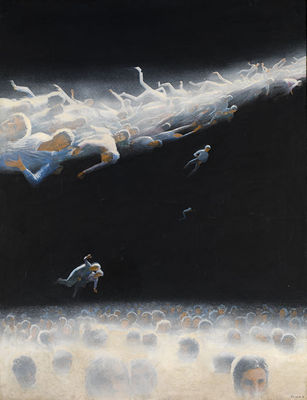
In Soviet Non-conformist art, Pyotr Belenok was a pioneer of photo-realism. In the 1960s he developed his own variation of this international art trend, calling it panic realism. His collages, executed both on canvas and on paper, reveal an almost cosmic space, invaded by gigantic vortexes, splashes and a small figure of a scared, running man.
Exodus is a series of 150 works on paper created in 1969; the year marking the beginning of the mass emigration of Soviet artists and intellectuals. During the next ten years many distinguished artists, musicians and scholars, including Svayatoslav Rostropovich and Oscar Rabin, were forced to leave the country. The combination of the dramatic rhythm of swirls with the fragile and vulnerable human figures makes Exodus a true political statement about the tumultuous Brezhnev era.
Typical motif by the Russian artist in a gestural style of painting. Pjotr Belenok's figures move in cosmic spaces in which they are pursued by phantoms and fictive creatures. Belenok deals with the human being of the modern society, which is haunted by uncontrollable catastrophes. Magma, rocks and extra-terrestrial substances appear as threatening monsters overhead the people. Belenok once said about his works: 'Detailed observations of the everyday person do not interest me; I observe the world and its problems from a neutral position in outer space.'