Page loaded successfully. Showing biography for Ralph William Holmes.
Ralph William Holmes BIOGRAPHY
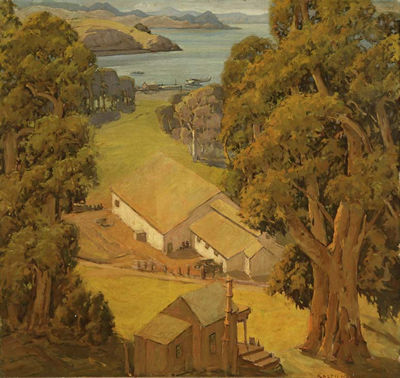
1876 La Grange, Illinois - 1963 San Luis Obispo, California. Known for: Landscape and mural painting, teaching.
Painter, muralist who helped the Colony artistically in many different ways before he moved permanently to Los Angeles c. 1923. Manager of Cloisters at Morro Beach where he painted murals and hung... Read full biography
Painter, muralist who helped the Colony artistically in many different ways before he moved permanently to Los Angeles c. 1923. Manager of Cloisters at Morro Beach where he painted murals and hung his paintings. Taught a class in painting, July 1920. “He was, between 1917 and 1923, E. G. Lewis’... Read full biography
Painter, muralist who helped the Colony artistically in many different ways before he moved permanently to Los Angeles c. 1923. Manager of Cloisters at Morro Beach where he painted murals and hung his paintings. Taught a class in painting, July 1920. “He was, between 1917 and 1923, E. G. Lewis’ staff artist, and his graceful, two-dimensional murals, elegant in line with hints of art nouveau, were displayed in the Colony’s public buildings and finer private homes. An experienced teacher and... Read full biography
Painter, muralist who helped the Colony artistically in many different ways before he moved permanently to Los Angeles c. 1923. Manager of Cloisters at Morro Beach where he painted murals and hung his paintings. Taught a class in painting, July 1920. “He was, between 1917 and 1923, E. G. Lewis’ staff artist, and his graceful, two-dimensional murals, elegant in line with hints of art nouveau, were displayed in the Colony’s public buildings and finer private homes. An experienced teacher and administrator, he was also involved in architectural planning, Lewis’ many publicity fliers and civic beautification. His oils were reproduced on colony bulletins, magazines and brochures. He was regarded in those early days not only as a painter, but as... Read full biography
Painter, muralist who helped the Colony artistically in many different ways before he moved permanently to Los Angeles c. 1923. Manager of Cloisters at Morro Beach where he painted murals and hung his paintings. Taught a class in painting, July 1920. “He was, between 1917 and 1923, E. G. Lewis’ staff artist, and his graceful, two-dimensional murals, elegant in line with hints of art nouveau, were displayed in the Colony’s public buildings and finer private homes. An experienced teacher and administrator, he was also involved in architectural planning, Lewis’ many publicity fliers and civic beautification. His oils were reproduced on colony bulletins, magazines and brochures. He was regarded in those early days not only as a painter, but as a respected friend. A story in this paper said more than 60 years ago, ‘If there is anyone in Atascadero more willing and more able to help out in... Read full biography
Artist Biography
Biography page for Ralph William Holmes ((1876 - 1963)), known for Landscape and mural painting, teaching. Showing 3 biographical entries and 0 sample artworks.
Ralph William Holmes - Artist Info
About Ralph William Holmes
Biography from the Archives of askART
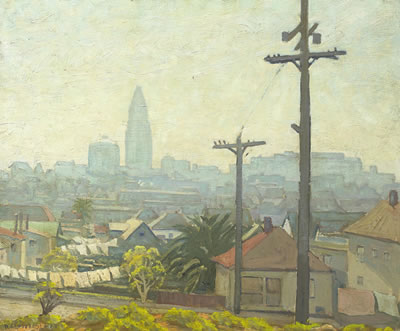 Known as a writer as well as artist and teacher, Ralph Holmes distinguished himself as a mural painter in Pittsburgh and New York before moving to California where he had a long teaching and painting career. "His landscapes of Yosemite and Bryce Canyon as well as the desert and rolling hills of southern California have brought him national fame." (Hughes, 540)
He was born in La Grange, Illinois, and growing up in Illinois attended Northwestern University for three years, and the Art Institute of Chicago for four years. He studied in Paris, and from 1903-1912, was on the faculty of the Art Institute of Chicago. He then spent five years as Chair of the Department of Painting and Decorating at Carnegie Institute of Technology in Pittsburgh.
In 1916, he went West, spending the summer on the Hopi Reservation in Arizona, and from that time, he continued to paint in the Southwest. In 1918, he moved to Atascadero in Southern California, and became a teacher at the Otis Art Institute from 1923 to 1948, and for twenty-five years was also art instructor at the Marlborough School for girls. He served as art editor and writer for E.G. Lewis's Illustrated Review, was a four-term President of the California Art Club, President of "Art in National Defense", and a member of the Academy of Western Painters.
He died in San Luis Obispo.
Memberhips:
Academy of Western Painters, Los Angeles; Long Beach Art Association; Laguna Beach Art Association
Exhibitions:
Carnegie Institute, 1915 (silver medal); Atascadero Art Association, 1918; Oakland Art Gallery, 1919; California Art Club, 1924-38; Painters & Sculptors of Los Angeles, 1926-32 (gold medal); Pasadena Art Institute, 1928; California State Fair, 1930; Santa Cruz Art League, 1934; Los Angeles Art Association, 1937; City Hall, Los Angeles, 1938; American Artists Congress, Los Angeles, 1938; Chamber of Commerce (Santa Paula), 1938; Los Angeles County Museum of Art, 1939 (solo); Sanity in Art (Los Angeles, 1940; Santa Paula, 1940 (1st prize); Golden Gate International Exposition, 1940; Gump's (San Francisco), 1940; Ebell Club (Los Angeles), 1942; Glendale Art Association, 1950.
Sources:
Edan Hughes, Artists in California, 1786-1940
Doris Dawdy, Artists of the American West, Vol. IIIBiography from the Archives of askART
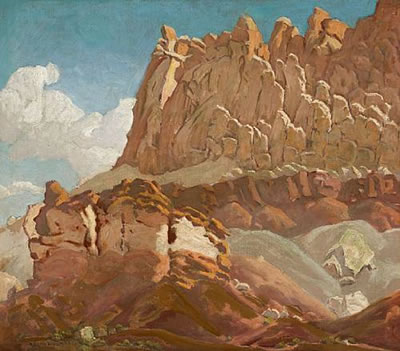 Ralph Holmes (1876-1963) (Atascadero/Los Angeles)
Listed as an artist tangential to art in Morro Bay per “Rachel Knott Compiled List of Local Artists, Authors,” Sun, Oct. 24, 1958, p. ? [sic. 12], col. 1-3 (Appendix I).
“Ralph Holmes … made his home at The Cloisters [on the Morro sands] where he did the decorations on the two chimneys and in the lobby. Later he gained prominence for his landscapes and desert scenes, and last year he held an outstanding exhibition at Community Church, Atascadero. For a number of years his home has been Los Angeles.” per “Morro Bay Art Colony Boasts Famous Names,” SLO Telegram-Tribune, June 8, 1940, p. 4 (Appendix I).
Source: Nancy Dustin Wall Moure, MORRO BAY (including LOS OSOS, BAYWOOD PARK and CAYUCOS) ART AND PHOTOGRAPHY BEFORE 1960 (Publications in [Southern] California Art, vol. 13, no. I), Los Angeles: Dustin Publications, 2016.Biography from Nancy Moure - biographer
Painter, muralist who helped the Colony artistically in many different ways before he moved permanently to Los Angeles c. 1923. Manager of Cloisters at Morro Beach where he painted murals and hung his paintings. Taught a class in painting, July 1920. “He was, between 1917 and 1923, E. G. Lewis’ staff artist, and his graceful, two-dimensional murals, elegant in line with hints of art nouveau, were displayed in the Colony’s public buildings and finer private homes. An experienced teacher and administrator, he was also involved in architectural planning, Lewis’ many publicity fliers and civic beautification. His oils were reproduced on colony bulletins, magazines and brochures. He was regarded in those early days not only as a painter, but as a respected friend. A story in this paper said more than 60 years ago, ‘If there is anyone in Atascadero more willing and more able to help out in any emergency than Ralph Holmes, the noted artist, he has not yet been found.’ In many ways Holmes was the quintessential early 20th century California artist. He was born near Chicago, Ill., and trained in that city at the famed school of the Chicago Art Institute. After the obligatory bohemian tour to Europe – he worked out his passage on board a cattle ship – he returned to the institute, and became a major force there on the staff. In 1912 he accepted a position as head of the Department of Art at the Carnegie Institute of Technology in Pittsburgh, Pennsylvania. In addition, he executed murals and smaller oil works on commission in Pittsburgh and New York. When summoned to Atascadero by Lewis, Holmes was 41. As has happened to many other artists coming here from the east, he was struck by the incredibly beautiful and varied landscape. The dramatic effect of strong sunlight and sharp shadows cast over rugged terrain fascinated him. He was to spend the bulk of his remaining creative life as a California landscapist and nature painter. Not that Holmes’ oils and sketches are stark imitations of trees, oceans and mountains. They were, rather, stylized perceptions of forms utilizing broad planes of flat color. ‘He thinks of a picture as a mural,’ said one critic, ‘preserving its flat plane on the wall.’ This approach gives much of Holmes’ work a hewn elegance that gets to ‘the bones of things’, transmuting objects into near abstraction. One gets the feeling that Holmes’ landscapes were largely internal, and that nature, for him, was simply a road toward his own imagination. He strove for a personal realism. Herman Reuter of the Hollywood Citizen-News said, in 1919, of a Holmes exhibition,” … “Ralph Holmes’ Daughter, a Longtime Local Resident, Patricia Holmes Bissell was only five years old when her father, painter Ralph Holmes, and mother Esther Holmes, came to Atascadero. It was 1917, and the family spent their first night at the Atascadero Inn. The Holmes’ separated following their six-year stay in the Lewis colony and Ms. Bissell’s memories of her father, and her early girlhood, are vague. But she still has images of her father working, of a town dance – bits and pieces of a time when Atascadero was a blank canvas, a vision carried in the mind of E. G. Lewis. Of her father, she said, ‘His whole life was painting. He would go out into the hills and set up his easel and paint. He didn’t have a studio, and I don’t know how much painting he did here. I know when he got to LA.… …‘He gave the town founder art lessons,’ said Ms. Bissell, who met Lewis, and remembers him. ‘He was a small man. My father was over six feet tall, so in comparison he was small. It seemed like he always wore gray. I was too young to judge about his personality, but I guess he must have had a lot of charisma, the things he did. He sort of gave my father a con job. My father was head of the art department at Carnegie Tech, and (Lewis) called him out here to work for him. And then he really didn’t know what to do with him when he got him here.’ Ms. Bissell said, in addition to art lessons, Holmes was art editor of Lewis’ Illustrated Review, and painted several murals. Only those in the Masonic Temple survive,” per “Artist in Residence: Ralph Holmes Captured the Colony on Canvas,” Atascadero News, Oct. 18, 1989, “Colony Days Edition” with port. and repros. of “Stonework” (a SW pueblo), “In the Park” and “The Picnic.”