Page loaded successfully. Showing biography for Robert Ball Hughes.
Robert Ball Hughes BIOGRAPHY
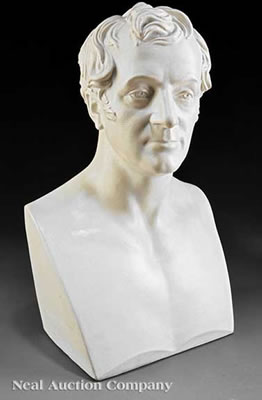
1806 London, England - 1868 Dorchester, Massachusetts. Known for: Portrait bust sculpture of prominent persons.
Robert Ball Hughes (January 19, 1804 — March 5, 1868), often known as Ball Hughes, was a British-American sculptor, born in England and active in the United States. He was born in London.His birth... Read full biography
Robert Ball Hughes (January 19, 1804 — March 5, 1868), often known as Ball Hughes, was a British-American sculptor, born in England and active in the United States. He was born in London.His birth year has been confirmed to be 1804 according to his baptismal record on the International Genealogical... Read full biography
Robert Ball Hughes (January 19, 1804 — March 5, 1868), often known as Ball Hughes, was a British-American sculptor, born in England and active in the United States. He was born in London.His birth year has been confirmed to be 1804 according to his baptismal record on the International Genealogical Index, and not 1806 as has been widely reported. His given name was Robert Balls Hughes according to his baptismal record. He early exhibited a decided taste for modeling, and at 12 years of age made... Read full biography
Robert Ball Hughes (January 19, 1804 — March 5, 1868), often known as Ball Hughes, was a British-American sculptor, born in England and active in the United States. He was born in London.His birth year has been confirmed to be 1804 according to his baptismal record on the International Genealogical Index, and not 1806 as has been widely reported. His given name was Robert Balls Hughes according to his baptismal record. He early exhibited a decided taste for modeling, and at 12 years of age made out of wax candle ends a bas-relief copy of a picture representing the wisdom of Solomon, which was afterward cast in silver. He later studied under Edward Hodges Baily for seven years. During this time, the Royal Academy awarded him a large silver... Read full biography
Robert Ball Hughes (January 19, 1804 — March 5, 1868), often known as Ball Hughes, was a British-American sculptor, born in England and active in the United States. He was born in London.His birth year has been confirmed to be 1804 according to his baptismal record on the International Genealogical Index, and not 1806 as has been widely reported. His given name was Robert Balls Hughes according to his baptismal record. He early exhibited a decided taste for modeling, and at 12 years of age made out of wax candle ends a bas-relief copy of a picture representing the wisdom of Solomon, which was afterward cast in silver. He later studied under Edward Hodges Baily for seven years. During this time, the Royal Academy awarded him a large silver medal for the best copy in bas-relief of the Apollo Belvedere. He also received a silver medal from the Society of Arts and Sciences for a copy... Read full biography
Artist Biography
Biography page for Robert Ball Hughes ((1806 - 1868)), known for Portrait bust sculpture of prominent persons. Showing 2 biographical entries and 0 sample artworks.
Robert Ball Hughes - Artist Info
About Robert Ball Hughes
Name variants
Ball Hughes
Biography from the Archives of askART
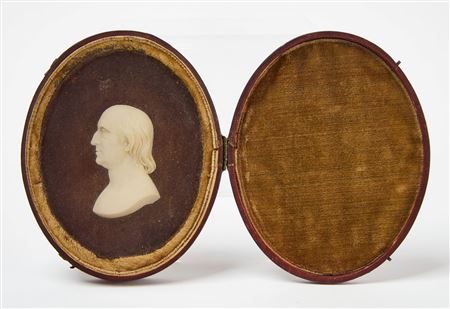 Robert Ball Hughes (January 19, 1804 — March 5, 1868), often known as Ball Hughes, was a British-American sculptor, born in England and active in the United States. He was born in London.His birth year has been confirmed to be 1804 according to his baptismal record on the International Genealogical Index, and not 1806 as has been widely reported. His given name was Robert Balls Hughes according to his baptismal record.
He early exhibited a decided taste for modeling, and at 12 years of age made out of wax candle ends a bas-relief copy of a picture representing the wisdom of Solomon, which was afterward cast in silver. He later studied under Edward Hodges Baily for seven years. During this time, the Royal Academy awarded him a large silver medal for the best copy in bas-relief of the Apollo Belvedere. He also received a silver medal from the Society of Arts and Sciences for a copy of the Barberini Faun, a large silver medal for the best original model from life, and a gold medal for an original composition, Pandora brought by Mercury to Epimetheus. In 1830 he was elected into the National Academy of Design as an Honorary Academician.
Hughes was commissioned to sculpt busts of various members of Britains nobility and Royal family, including the Duke of Sussex, the Duke of Cumberland and most notably King George IV. Robert Ball Hughes emigrated to New York City in 1829. His first major commission in America, was a high-relief marble memorial to Bishop John H. Hobart for Trinity Church, New York, followed by a statue of New York Governor DeWitt Clinton, and subsequently a statue of Alexander Hamilton (placed atop of the Merchants' Exchange Building New York, but destroyed by fire in 1835). The original plaster study for that work is held by the Museum of the City of New York.
After a short stay in New York, and then Philadelphia, he settled in Boston, where he produced busts of Washington Irving (1836) and Edward Livingston, and a large bronze of mathematician Nathaniel Bowditch for Mount Auburn Cemetery (1847). Ball Hughes' statue of Nathaniel Bowditch was the first large bronze to be cast in America. He made Little Nell and the group Uncle Toby and Widow Wadman, whose plaster models went to the Boston Athenaeum, but were never carved in marble. Among his later works were a model of an equestrian statue of Washington, intended for the city of Philadelphia, a Crucifixion, and a Mary Magdalen.
Ball Hughes also designed numerous wax medallions, as well as coins for the United States mint, including modifications of Christian Gobrecht's design for the Seated Liberty quarter (1838), and the half dime (1859).
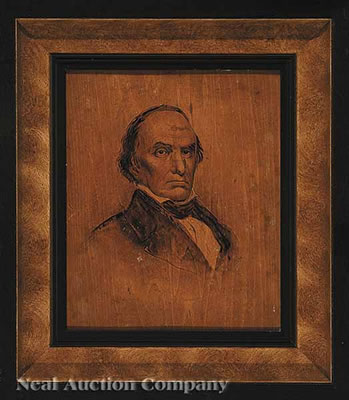
In his final years, he began to produce burnt wood pictures (pyroengravings or "poker pictures"), including The Witches of MacBeth (c. 1840), Babylonian Lions (1856), Don Quixote in His Study (1863), The Trumpeter (1864), General Grant Proclaiming the Surrender of Richmond (1865), The Last Lucifer Match (1865), and The Monk (1866). He also lectured on art. Hughes is buried in the Cedar Grove Cemetery, Dorchester, Massachusetts.
The National Portrait Gallery contains Ball Hughes' busts of Nathaniel Bowditch, Washington Irving, James Kent, John Marshall, and his medallion of John Trumbull.
Source:
"Robert Ball Hughes," Wikipedia, Nov. 2016Biography from the Archives of askART
 Known as Ball Hughes and also using that as a signature, this man was a sculptor and wax-portrait artist. He was born in London, England, and died in Dorchester, Massachusetts. He studied and exhibited at the Royal Academy in London as well as at the Pennsylvania Academy of the Fine Arts and the National Academy of Design in New York City.
He emigrated to New York in 1829, having earned much prestige in England. In New York, he received many commissions for portrait busts in bronze and wax. Among his subjects were John Trumbull, Alexander Hamilton, and Washington Irving.
From 1838 to 1840, he worked in Philadelphia and from 1840, worked in Boston. By the mid 1850s, his work was not much sought after, but he did cameo cutting and wax portraiture and also with a poker did burnt pictures into wood.
Source:
Kathleen Menendez of the E-Museum of Pyrographic Art in Falls Church, Virginia, provided the information about the signature and the artist's use of the name being Ball Hughes.
Menedez writes: "The above reference is to the Cornell University Making of America series, for a particular article by J. William Fosdick in six pages (pp. 495-500) reprinted there. It was originally published in 1896. That wonderful article (a 100-year-old antique itself) contains on page 499 an image of a pyrographic work by Ball Hughes (which was owned by the author and artist himself) and talks about Ball Hughes' work."
"I would also like to note that I have an image of another Ball Hughes' pyrograph in my E-Museum of Pyrographic Art and hope to soon display a second that has come across my desk.