Page loaded successfully. Showing biography for Roberto Fallola.
Roberto Fallola BIOGRAPHY
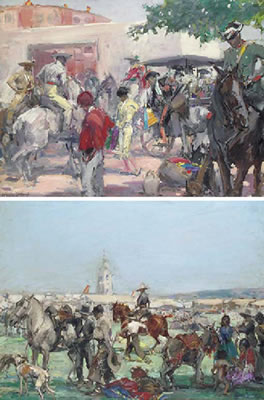
1883 - 1956. Known for: Bullfighting scenes, landscape, genre and animal paintings, drawings.
Domingo began his artistic training in Paris with his father, the painter Francisco Domingo Marqués. There he also got to know French impressionism at first hand. In 1906 he moved to Madrid and... Read full biography
Domingo began his artistic training in Paris with his father, the painter Francisco Domingo Marqués. There he also got to know French impressionism at first hand. In 1906 he moved to Madrid and entered the San Fernando Academy of Fine Arts, where he was a disciple of Antonio Muñoz Degraín. He took... Read full biography
Domingo began his artistic training in Paris with his father, the painter Francisco Domingo Marqués. There he also got to know French impressionism at first hand. In 1906 he moved to Madrid and entered the San Fernando Academy of Fine Arts, where he was a disciple of Antonio Muñoz Degraín. He took part in national and foreign exhibitions, winning the third medal at the National Exhibition of Fine Arts in 1908, second in the 1910 edition and first in 1915. In 1911 he held a solo exhibition in... Read full biography
Domingo began his artistic training in Paris with his father, the painter Francisco Domingo Marqués. There he also got to know French impressionism at first hand. In 1906 he moved to Madrid and entered the San Fernando Academy of Fine Arts, where he was a disciple of Antonio Muñoz Degraín. He took part in national and foreign exhibitions, winning the third medal at the National Exhibition of Fine Arts in 1908, second in the 1910 edition and first in 1915. In 1911 he held a solo exhibition in Rome at the Fine Arts Pavilion. He also showed his work continuously in various Spanish and London galleries, such as Baillie and Tooth. A genre painter, he specialised in bullfighting themes, which brought him great fame and prestige. His work is... Read full biography
Domingo began his artistic training in Paris with his father, the painter Francisco Domingo Marqués. There he also got to know French impressionism at first hand. In 1906 he moved to Madrid and entered the San Fernando Academy of Fine Arts, where he was a disciple of Antonio Muñoz Degraín. He took part in national and foreign exhibitions, winning the third medal at the National Exhibition of Fine Arts in 1908, second in the 1910 edition and first in 1915. In 1911 he held a solo exhibition in Rome at the Fine Arts Pavilion. He also showed his work continuously in various Spanish and London galleries, such as Baillie and Tooth. A genre painter, he specialised in bullfighting themes, which brought him great fame and prestige. His work is characterised by the expressiveness of the stain and the stroke, capturing reality through a sensibility that is linked to the tr... Read full biography
Artist Biography
Biography page for Roberto Fallola ((1883 - 1956)), known for Bullfighting scenes, landscape, genre and animal paintings, drawings. Showing 2 biographical entries and 0 sample artworks.
Roberto Fallola - Artist Info
About Roberto Fallola
Name variants
Roberto Domingo, Robert Domingo Falloia, Roberto Domingo Fallola
Biography from Setdart
Domingo began his artistic training in Paris with his father, the painter Francisco Domingo Marqués. There he also got to know French impressionism at first hand. In 1906 he moved to Madrid and entered the San Fernando Academy of Fine Arts, where he was a disciple of Antonio Muñoz Degraín.
He took part in national and foreign exhibitions, winning the third medal at the National Exhibition of Fine Arts in 1908, second in the 1910 edition and first in 1915. In 1911 he held a solo exhibition in Rome at the Fine Arts Pavilion. He also showed his work continuously in various Spanish and London galleries, such as Baillie and Tooth.
A genre painter, he specialised in bullfighting themes, which brought him great fame and prestige. His work is characterised by the expressiveness of the stain and the stroke, capturing reality through a sensibility that is linked to the tradition of Goya, Lucas and Alenza. The spontaneity, fluidity and dynamism of his work is largely due to his ability to memorise reality in his retina and then transfer it to painting with his own nuance, simplifying the lines and diluting the colours.
This vibrant emotion was also appreciated by great international artists of the time, such as John Singer Sargent and Gerald Kelly, who were among his clients. Roberto Domingo is represented in the Prado Museum, the Fine Arts Museum of Granada, the Provincial Museum of Cadiz, the Municipal Museum of Madrid, the Bullfighting Museums of Las Ventas in Madrid, La Maestranza in Seville, Valencia and Viana de Cega (Valladolid), the Drawing Museum of Castillo de Larrés (Huesca) and those of Havana and Hemingway in Cuba, among many others.Biography from Setdart
Roberto Domingo was a Spanish artist who was born in the late 19th century. He began his artistic training in Paris with his father, Francisco Domingo Marqués, and later studied at the San Fernando Academy of Fine Arts in Madrid. He specialized in bullfighting themes and his work was characterized by the expressiveness of the stain and the line. He participated in national and foreign exhibitions, winning several medals. His work is represented in various museums in Spain