Page loaded successfully. Showing biography for Rod Frederick.
Rod Frederick BIOGRAPHY
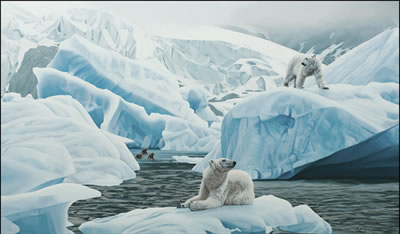
Born 1956. Known for: Wildlife in landscape and glacier settings.
Rod Frederick: . The serene outdoors seem at odds with the wild and crazy character of this artist, who is as famous for his paintings as he is for his sense of humor and gaudy shirts! If seen on his... Read full biography
Rod Frederick: . The serene outdoors seem at odds with the wild and crazy character of this artist, who is as famous for his paintings as he is for his sense of humor and gaudy shirts! If seen on his constant excursions into the wilds, many a collector would tell of an eccentric pirate come to... Read full biography
Rod Frederick: . The serene outdoors seem at odds with the wild and crazy character of this artist, who is as famous for his paintings as he is for his sense of humor and gaudy shirts! If seen on his constant excursions into the wilds, many a collector would tell of an eccentric pirate come to life, only this swashbuckling, seemingly fearless explorer was more anxious to gain and share the treasure of knowledge rather than riches. "I grew up in a house full of pets," he says. "My mom had a... Read full biography
Rod Frederick: . The serene outdoors seem at odds with the wild and crazy character of this artist, who is as famous for his paintings as he is for his sense of humor and gaudy shirts! If seen on his constant excursions into the wilds, many a collector would tell of an eccentric pirate come to life, only this swashbuckling, seemingly fearless explorer was more anxious to gain and share the treasure of knowledge rather than riches. "I grew up in a house full of pets," he says. "My mom had a degree in fine arts and although my dad was a lawyer, he was a weekend painter." So his love of animals and art was sown early (also inspired when he received a gift of Roger Tory Peterson's Field Guide to the Birds) and he attended Willamette University... Read full biography
Rod Frederick: . The serene outdoors seem at odds with the wild and crazy character of this artist, who is as famous for his paintings as he is for his sense of humor and gaudy shirts! If seen on his constant excursions into the wilds, many a collector would tell of an eccentric pirate come to life, only this swashbuckling, seemingly fearless explorer was more anxious to gain and share the treasure of knowledge rather than riches. "I grew up in a house full of pets," he says. "My mom had a degree in fine arts and although my dad was a lawyer, he was a weekend painter." So his love of animals and art was sown early (also inspired when he received a gift of Roger Tory Peterson's Field Guide to the Birds) and he attended Willamette University with a major in art and a minor in biology. "So I could know my subjects outside and in," he says. He put that... Read full biography
Artist Biography
Biography page for Rod Frederick ((Born 1956)), known for Wildlife in landscape and glacier settings. Showing 1 biographical entries and 0 sample artworks.
Rod Frederick - Artist Info
About Rod Frederick
Biography from the Archives of askART
 Rod Frederick:
The serene outdoors seem at odds with the wild and crazy character of this artist, who is as famous for his paintings as he is for his sense of humor and gaudy shirts! If seen on his constant excursions into the wilds, many a collector would tell of an eccentric pirate come to life, only this swashbuckling, seemingly fearless explorer was more anxious to gain and share the treasure of knowledge rather than riches.
"I grew up in a house full of pets," he says. "My mom had a degree in fine arts and although my dad was a lawyer, he was a weekend painter." So his love of animals and art was sown early (also inspired when he received a gift of Roger Tory Peterson's Field Guide to the Birds) and he attended Willamette University with a major in art and a minor in biology.
"So I could know my subjects outside and in," he says. He put that education to good use as he embarked on a fine art career that would allow him to do what he enjoyed most; explore and learn.
Frederick built his house in the middle of the Oregon wilderness and filled it with birds and animals. He's hiked and camped in mountains and forests throughout the northwest U.S., Central America and East Africa. He knows the lakes and mountains as well as he knows the plains and deserts, not to mention almost all the creatures who live there, from the smallest bird to the largest elephant. And he will paint them on whatever size canvas suits them best.
In addition to his peaceful views of animals in their natural habitats, he is also known for his paintings' many different sizes and shapes, each chosen to best suit his perfectly balanced images of wildlife and wilderness
Artist Statements
"I've lived in Oregon my entire life," says Rod Frederick. "I currently live on the mountain side, but for years I lived on the coast. In late autumn, the sea begins to churn, the weather gets rough and the landscape is soaked with rain. I love to travel to that side of the state every once in a while in the fall and see the black-tailed deer emerging from the forest. The colors of the vine and big leaf maple leaves have intensified with the rain and the entire atmosphere is charged and heavy. The black-tailed buck feels the change of seasons acutely; the autumn has made him aggressive and ready to defend his territory."
Inspiration for some painting "came from the early successes in re-populating the West Coast with the bald eagle, our national symbol that had landed on the endangered species list in 1967. Loss of habitat, hunting and the suspected effects of the insecticide DDT on eagle fertility contributed to their steep decline throughout the 19th century. In 2007, the Interior Department took the eagle off the Endangered Species list but the Bald and Golden Eagle Protection Act continues to make it illegal to take, sell, trade or collect eagles or eagle parts. It's one of my favorite subjects to paint," says Rod Frederick. "I see them all the time here in the Cascades." Over two thirds of the world's bald eagle population has "come home" to breed and thrive in Alaska and British Columbia, largely due to the undeveloped land and the salmon fisheries. "
"No two animals personify the spirit of the North American wilderness better than the wolf and the bear. While few of us will ever chance upon either in our backwoods excursions, the knowledge that they exist is what truly makes the wilderness wild."
"The greatest part of venturing out into the wilderness," Rod Frederick observes, "is that you can't determine what kind experience it will deliver. I took my son to Yellowstone for a special father/son adventure his senior year in high school. Our plan was to track wolves. Soon after we set out we found ourselves enveloped by a herd of the park's bison. They can range two miles in a day while grazing, and we had the treat of a lifetime."
"On a larger scale, the great migrations that spanned the North American Plains were driven by the buffalo's never ending quest for food. Their movement was timed to when their primary food source, grass, would be most full of nutrients. Non-competing species such as the Pronghorn Antelope often migrated as well, feeding on a different portion of the stalk or type of grass all together. The relationship between animal and land was symbiotic, the buffalo maintained the Plains, the Plains maintained the buffalo."
No other animal is more strikingly beautiful than the pronghorn as he poses in the eastern Oregon outback Frederick calls home. With a buck in the sunlight and the others in long shadows, Frederick, in some of his paintings, gives us his take on one of the truly unique Western animals.
"Antilocapra Americana (literally the "American goat-antelope") is found nowhere else in the world. Having roamed the plains and deserts of North America for at least a million years, the pronghorn antelope are the fastest North American mammal, whose powerful legs can carry them to speeds of 60 miles per hour across even the roughest terrain.This curious species has exceptionally keen sight.Their large eyes offer wide peripheral vision and the ability to detect motion as far as four miles away."
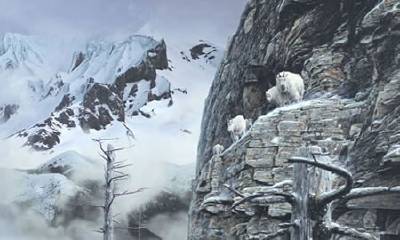
"Open spaces are exciting," Frederick says."In them I have a chance to get away and perhaps get a glimpse of my favorite animal, the mountain goat"—
As fall turns to winter in the mountains, the sense of impending snowstorms is in the air. After a summer of grazing, the mule deer feel the change and know it's time for their annual migration from higher to lower elevations on the mountain range. Their coats have changed from the orange/yellow of summer to gray. "I live in a mule deer range and have them in my yard all the time," says artist Rod Frederick on the subject he depicts in his painting: "Although the bucks become scarce during hunting season, I chose to show a buck and doe in a scene.They're fascinating to watch and I wanted to show the seasonal migration in this painting. The buck is in full glory, his antlers at full growth. He'll shed his antlers in the late winter and they'll start growing again the next spring, each year growing progressively larger."
I'm surprised that 45 penguins made it into The Emperors' Ball," his painting. Rod Frederick acknowledges, "but it seemed like every time I came back to the easel, another had shown up. That's the tricky thing about flightless birds, they waddle in low so you don't see them coming. "Emperor penguins, in fact all penguins, live in the Southern Hemisphere. A flightless bird of this size could never have developed in the Arctic with hunters such as polar bears, foxes and wolves. But Emperors thrive in the Antarctic where there are no four-legged predators. "
"People love penguins and today I find myself especially attracted to them. I don't fly or jump as high as I used to on the basketball court, so maybe that's it. But there is something special about them. Think about, the guys, just the guys, who stay home to watch the eggs over a long dark winter where the temperature can fall to -40, while the girls enjoy a two-month long ladies night out. I bet there is some serious celebrating when the summer finally comes along and that's the idea behind The Emperors' Ball."
"Bald eagles, our national symbol, have come back dramatically from near extinction over the last fifty years. They're a very common sight where I live in the Cascade Mountains in Oregon. I never get tired of looking at bald eagles, nor do I ever tire of the sunsets we get here, looking toward the West and the Cascades. This horizon in particular lends itself to a longer image, one where you can look in every direction and see something. I wanted to show the eagles as they flew across the skyline, using the last fading rays of sunlight to find a place to roost for the night. They're surfing the sunset, riding those last thermals before they go to bed."
Source:
"The Art of Rod Frederick", Art From the Best, //www.riverwindgalleryart.com/rod-frederick.html