Page loaded successfully. Showing biography for Ross Sterling Turner.
Ross Sterling Turner BIOGRAPHY
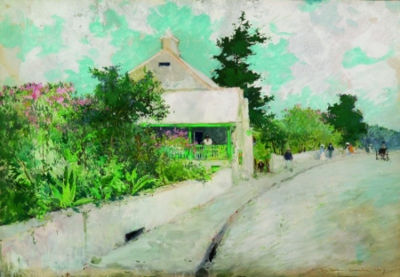
1847 Westport, New York - 1915 Nassau, Bahamas. Known for: Marine, genre, landscape, floral.
A long-time teacher of watercolor painting and noted watercolor painter of landscapes, still lifes and marine scenes, Ross Sterling Turner painted both in realist and impressionist styles. He was... Read full biography
A long-time teacher of watercolor painting and noted watercolor painter of landscapes, still lifes and marine scenes, Ross Sterling Turner painted both in realist and impressionist styles. He was born in 1847 in Westport, New York, and in 1862, his family moved to Alexandria, Virginia. His first... Read full biography
A long-time teacher of watercolor painting and noted watercolor painter of landscapes, still lifes and marine scenes, Ross Sterling Turner painted both in realist and impressionist styles. He was born in 1847 in Westport, New York, and in 1862, his family moved to Alexandria, Virginia. His first job was as a mechanical draftsman, working for a time in the U.S. Patent Office in Washington, D.C. In 1876, he went to Europe, first to Paris and then to study at the Munich Academy, where he met... Read full biography
A long-time teacher of watercolor painting and noted watercolor painter of landscapes, still lifes and marine scenes, Ross Sterling Turner painted both in realist and impressionist styles. He was born in 1847 in Westport, New York, and in 1862, his family moved to Alexandria, Virginia. His first job was as a mechanical draftsman, working for a time in the U.S. Patent Office in Washington, D.C. In 1876, he went to Europe, first to Paris and then to study at the Munich Academy, where he met fellow Americans William Merritt Chase and Frank Duveneck. Like them, Turner developed a thick, painterly style. He became close friends with Constantin Bolonachi, a Greek painter whose marine subject matter would influence Turner's work. About 1879,... Read full biography
A long-time teacher of watercolor painting and noted watercolor painter of landscapes, still lifes and marine scenes, Ross Sterling Turner painted both in realist and impressionist styles. He was born in 1847 in Westport, New York, and in 1862, his family moved to Alexandria, Virginia. His first job was as a mechanical draftsman, working for a time in the U.S. Patent Office in Washington, D.C. In 1876, he went to Europe, first to Paris and then to study at the Munich Academy, where he met fellow Americans William Merritt Chase and Frank Duveneck. Like them, Turner developed a thick, painterly style. He became close friends with Constantin Bolonachi, a Greek painter whose marine subject matter would influence Turner's work. About 1879, Turner traveled to Florence, Rome and Venice to study the Old Masters, and in Italy his work became increasingly concerned with the effects of ligh... Read full biography
Artist Biography
Biography page for Ross Sterling Turner ((1847 - 1915)), known for Marine, genre, landscape, floral. Showing 3 biographical entries and 0 sample artworks.
Ross Sterling Turner - Artist Info
About Ross Sterling Turner
Biography from the Archives of askART
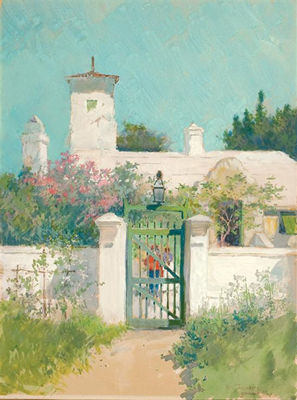 A long-time teacher of watercolor painting and noted watercolor painter of landscapes, still lifes and marine scenes, Ross Sterling Turner painted both in realist and impressionist styles.
He was born in 1847 in Westport, New York, and in 1862, his family moved to Alexandria, Virginia. His first job was as a mechanical draftsman, working for a time in the U.S. Patent Office in Washington, D.C. In 1876, he went to Europe, first to Paris and then to study at the Munich Academy, where he met fellow Americans William Merritt Chase and Frank Duveneck. Like them, Turner developed a thick, painterly style. He became close friends with Constantin Bolonachi, a Greek painter whose marine subject matter would influence Turner's work. About 1879, Turner traveled to Florence, Rome and Venice to study the Old Masters, and in Italy his work became increasingly concerned with the effects of light and color.
In 1883, Turner returned to America and settled in Boston, exhibiting his watercolors and oils at the Boston Art Club and annually at Doll and Richards gallery on Newbury Street. He entered the intimate circle of Childe Hassam and the artistic community surrounding Celia Thaxter at Appledore, where he painted gardens in short, quick, colorful strokes that are similar to Hassam's style.
Upon his marriage to Louise Blaney (artist Dwight Blaney's oldest sister) in 1885, he moved to Salem, but maintained a Boston studio for private lessons. Teaching formed a large part of Turner's career, both in person and through books such as his "Use of Water Color for Beginners," published by Louis Prang and Company in 1886. He was an instructor in the architecture department at the Massachusetts Institute of Technology (1884-85, 1886-1914) and in 1909, he began to teach at the Massachusetts Normal Art School.
Turner frequently traveled in search of new subject matter; his talents as a colorist and his love of the sea took him to Mexico, the Caribbean, and Venice where he was considered one of Duveneck's Boys, painting companions of Ohio painter, Frank Duveneck. He also spent time painting with Childe Hassam in the 1880s at Appledore, Isle of the Shoals, New Hampshire.
Turner died in Nassau, the Bahamas, where he had gone for health reasons. A memorial exhibition was held at the Guild of Boston Artists in 1915.
Turner's work is represented in many public and private collections including the Boston Museum of Fine Arts, Boston Public Library, Fogg Museum at Harvard University, National Museum of American Art, Worcester Museum of Art, Peabody Museum of Salem, and Denver Art Museum. In recent years, Turner's work has been well represented in several major traveling museums exhibitions including "The Bostonians: Painters of an Elegant Age, 1870-1930" and "Awash in Color; Homer, Sargent and the Great American Watercolor."
Sources include:
http://www.childsgallery.com/artist_bio.php?artist_id=112
Peter Falk, "Who Was Who in American Art"Biography from the Archives of askART
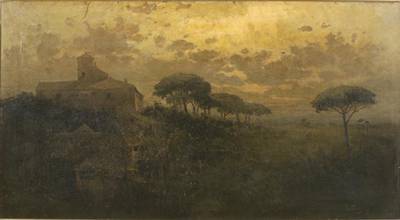 A note from Ken Clarke (June 2025):
I was reading the biography of Ross Turner (1847-1915) on Askart and did not see a mention of his short, but significant, time in Wilton, NH most likely as a summer resident. I can confirm that he worked there and that the house where he worked together with a large barn studio remains though I have not been past the spot in a few years.
Most significantly, the presence of Turner in Wilton at the earliest point in time for this "colony" suggests his presence played a role in the succession of artists who chose this place as summer location.
From the Wilton, New Hampshire Website:
Ross Turner (1847-1915), who came to live in Wilton in the late 1880’s, was in the vanguard of this incipient artist colony. After spending several years studying in Europe, he began his career working with the noted painter Childe Hassam in Boston and went on to become one of the pre-eminent New England-based American Impressionists. He lived and worked in one of the oldest houses in Wilton, which he called Rossmore (on Isaac Frye Highway near Putnam Hill Rd), and created an art studio in a barn on the property. By the early 1900’s many people from Boston and New York had re-discovered Wilton Center as a summer retreat (which since the 1850’s had functioned less and less as the center of town life since the coming of the railroad and the mills to the East Village), and beginning around 1910 and continuing on into the 20’s, 30’s and 40’s several major American artists followed Turner here, locating in and around the Center.
Source: Ken Clarke, Peterborough, NH and the Wilton, New Hampshire WebsiteBiography from The Lusher Gallery LLC
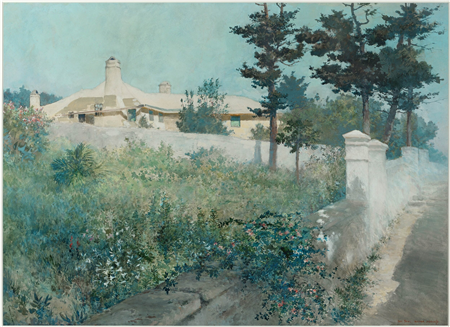 ROSS STERLING TURNER, born in Westport, NY in 1847, is recognized as one of his era’s most influential teachers of watercolor painting, as well as one of its superior painters of landscapes, still lifes and marine scenes, both in the realist and impressionist styles.
His initial career path, following his family’s move to Alexandria, Virginia in 1862, was that of mechanical draftsmanship, and his first job was as a mechanical draftsman at the U.S. Patent Office in Washington, D.C. However, his artistic inclinations soon took him far from the drafting table, and in 1876 he traveled to Europe, where a new world was afoot amongst the rapidly industrializing and politically changing societies there, and where, on that continent, as elsewhere, many schools and colonies were springing up to train aspiring and leading members of a new artistic and cultural world.
Americans in particular were flocking to places like Paris, Rome, Florence, Venice, Munich, and London to learn their craft, and to be inspired by those who had come before them. Turner first went to Paris, then moved on to Munich, where he became a student at the prestigious Munich Academy, which emphasized a thick, painterly style marked by dark tones and vigorous brush strokes (The Munich Style, as it came to be known). While there he received tutelage from the German realist painter William Liebl (who would later gain fame for his painting Three Women in a Church) and met fellow Americans Frank Duveneck (a Cincinnati, Ohio based artist and teacher whose work Turner admired and whose students were known as Duveneck’s Boys) and William Merritt Chase (considered by many to be one of the most influential American artists working at the end of the 19th century who painted en plein air).
He also established a close friendship with Constantin Bolonachi, a Greek painter whose marine subject matter would later have a profound effect on Turner’s work. About 1879, Turner traveled to Rome, Florence, and Venice (where he became known as one of Duveneck’s Boys) to study the Old Masters, and it was here in Italy that he began a close examination of the effects of light and color on his work. He returned to America in 1883, settling in Boston and entering the intimate circle of artist Childe Hassam (one of America’s most noted Impressionist painters of this period) and the artistic community arising out of poet/painter Celia Thaxter’s art colony at Appledore Island off the coast of New Hampshire, where he continued to reflect upon the effects of light and color while concentrating on painting the colony’s famous gardens, an endeavor for which he employed short, quick, colorful strokes similar to the style of his friend and painting companion Hassam.
In 1885 Turner married Louise Blaney (artist Dwight Blaney’s oldest sister) and moved to Salem, but maintained a Boston studio for private instruction. Teaching and writing came to form a core component of his career from this point forward, with his securing teaching positions at both the Massachusetts Institute of Technology’s architecture department (1884–85, 1886–1914) and at the Massachusetts Normal Art School (1909–). He was the author of several books, including On the Use of Watercolors for Beginners (1886) and Art for the Eye-School Room Decoration (1897). He also illustrated books for the publisher Houghton Mifflin and Co. Unbeknownst to many, Turner was an accomplished musician, playing cello at his church in Salem, Massachusetts and at the Salem Club, one of many organizations in his hometown of which he was an active member.
Turner was constantly on the lookout for new subject matter. This, as well as his love of the sea and passion for painting en plein air – especially using watercolors – took him to many seaborne locales, such as Mexico, Central America, and the Caribbean, but he forged a particularly special relationship with the island of Bermuda, which he first visited in 1889, and which he repeatedly frequented for a period of nearly 20 years.
His watercolor and gouache painting Fairylands, Bermuda (ca. 1890) is recognized as one of his finest efforts. A review of the painting in the Boston Journal (from an exhibition at the Doll and Richards Gallery in 1892) described it as having been ‘executed with the delicate and just perception of color, the ease and crispness of touch, and the subdued brilliancy characteristic of Mr. Turner’s best watercolor work.’ Jonathan Land Evans, in his reference book, Bermuda in Painted Representation, called painting ‘perhaps the late-Victorian apogee of Bermuda art.’
Another work from this period singled out by Evans for special distinction is the simply titled Bermuda (ca. 1892), of which Evans notes: ‘In works such as these, Bermuda’s unique and gracious appeal shines forth with a gentle radiance that has perhaps never been surpassed.’ Other Bermudian works of import include three offerings from 1908: The White Way, Bermuda; Hamilton, Bermuda; and a work entitled The Lane, Bermuda, which was included in the ‘Annual Exhibition of Paintings by Prominent Artists’ at the Poland Spring Art Gallery in South Poland, Maine, that year.
Over the course of his career Turner held memberships in numerous art associations, including the New York Watercolor Club, the American Watercolor Society (New York City), the Boston Watercolor Club, and the Copley Society of Artists (Boston). His work was showcased and exhibited at a wide variety of venues, including the Pennsylvania Academy of Fine Arts, the National Academy of Design (New York City), the Boston Art Club, Harcourt Studios (Boston), the Doll and Richards Gallery (Boston; annually), the Art Institute of Chicago, the Peabody Museum (Salem), the Pan-American Exposition (Buffalo; medal awarded, 1901), and the American Watercolor Society (prize awarded, 1908).
Turner died in 1915 in Nassau, the Bahamas, where he had gone for health reasons. A memorial exhibition was held for him at the Guild for Boston Artists that same year. Today, his work is represented in many public and private collections, including the Boston Museum of Fine Arts, the Boston Public Library, the Fogg Museum at Harvard University, the National Museum of American Art, the Worcester Museum of Art, the Peabody Museum of Salem, and the Denver Art Museum. In recent years, his work has been included in several major traveling museum exhibitions, most prominently The Bostonians: Painters of an Elegant Age, 1870–1930 (1987) and Awash in Color; Homer, Sargent, and the Great American Watercolor (1993).
Written September 2014 by Brian Flon, author of "Hell's Kitchen Requiem" (2014), available as an e-book at Amazon, ITunes, and Barnes & Noble.
Permission to reproduce on askART provided by Lusher Gallery LLC on August 22, 2019.
Copyright note: ©The Lusher Gallery LLC 2014. This biography may NOT be reproduced in whole or in part without the prior written consent of The Lusher Gallery LLC.