Page loaded successfully. Showing biography for Rudolf Epp.
Rudolf Epp BIOGRAPHY
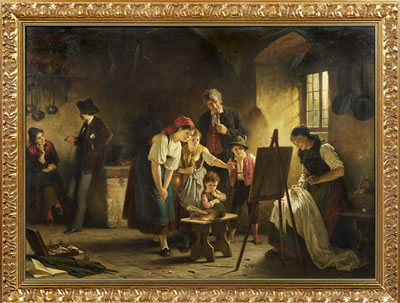
1834 Eberbach, Germany - 1910 Munich, Germany. Known for: Munich School genre and figure painting.
A German Munich School realist painter, Rudolf Epp was born in 1834 in Eberbach am Neckar, the son of a decorative painter. From his youth he did much drawing on his own initiative and took his first... Read full biography
A German Munich School realist painter, Rudolf Epp was born in 1834 in Eberbach am Neckar, the son of a decorative painter. From his youth he did much drawing on his own initiative and took his first lessons from landscape painter Charles Ludwig Seeger. He then studied at the Grand Ducal Baden Art... Read full biography
A German Munich School realist painter, Rudolf Epp was born in 1834 in Eberbach am Neckar, the son of a decorative painter. From his youth he did much drawing on his own initiative and took his first lessons from landscape painter Charles Ludwig Seeger. He then studied at the Grand Ducal Baden Art School Karlsruhe as a student of Johann Wilhelm Schirmer and attended the Art Academy in Düsseldorf. Due to his obvious talent, he was recognized by the then rulers and later Grand Duke Friedrich I... Read full biography
A German Munich School realist painter, Rudolf Epp was born in 1834 in Eberbach am Neckar, the son of a decorative painter. From his youth he did much drawing on his own initiative and took his first lessons from landscape painter Charles Ludwig Seeger. He then studied at the Grand Ducal Baden Art School Karlsruhe as a student of Johann Wilhelm Schirmer and attended the Art Academy in Düsseldorf. Due to his obvious talent, he was recognized by the then rulers and later Grand Duke Friedrich I von Baden on leave from military service. A Grand-Ducal Order, as well as additional funding allowed Epp, a study trip to the Black Forest. In 1859 he produced in the area around Freiburg im Breisgau and Landstuhl many landscape studies. In 1862 he... Read full biography
A German Munich School realist painter, Rudolf Epp was born in 1834 in Eberbach am Neckar, the son of a decorative painter. From his youth he did much drawing on his own initiative and took his first lessons from landscape painter Charles Ludwig Seeger. He then studied at the Grand Ducal Baden Art School Karlsruhe as a student of Johann Wilhelm Schirmer and attended the Art Academy in Düsseldorf. Due to his obvious talent, he was recognized by the then rulers and later Grand Duke Friedrich I von Baden on leave from military service. A Grand-Ducal Order, as well as additional funding allowed Epp, a study trip to the Black Forest. In 1859 he produced in the area around Freiburg im Breisgau and Landstuhl many landscape studies. In 1862 he married Catherine, born Steibl, and in 1863, after the death of Schirmer, he moved to Munich which was then considered a center... Read full biography
Artist Biography
Biography page for Rudolf Epp ((1834 - 1910)), known for Munich School genre and figure painting. Showing 1 biographical entries and 0 sample artworks.
Rudolf Epp - Artist Info
About Rudolf Epp
Biography from the Archives of askART
 A German Munich School realist painter, Rudolf Epp was born in 1834 in Eberbach am Neckar, the son of a decorative painter. From his youth he did much drawing on his own initiative and took his first lessons from landscape painter Charles Ludwig Seeger. He then studied at the Grand Ducal Baden Art School Karlsruhe as a student of Johann Wilhelm Schirmer and attended the Art Academy in Düsseldorf.
Due to his obvious talent, he was recognized by the then rulers and later Grand Duke Friedrich I von Baden on leave from military service. A Grand-Ducal Order, as well as additional funding allowed Epp, a study trip to the Black Forest. In 1859 he produced in the area around Freiburg im Breisgau and Landstuhl many landscape studies.
In 1862 he married Catherine, born Steibl, and in 1863, after the death of Schirmer, he moved to Munich which was then considered a center of art. Here he was fascinated by the painting of Carl Theodor von Piloty, and quickly acquired a reputation as a sought-after painter.
In 1868, his son Franz was born, and 1870 was the year of birth of daughter, Helene. In 1871, a second daughter, Augusta Anna was born. She never married and lived until the death of her parents in the family home. Augusta Anna Rudolf Epp served as a model for several portraits and figural representations.
Rudolf Epp was well into old age as a painter working, and died in 1910 in Munich. His estate was for several years in the Lenbachhaus, the luxurious villa in Munich of his friend, Franz von Lenbach.
Especially after the mid-19th Century, Munich attracted countless artists from all over Germany. Among them were many painters from the former Grand Duchy of Baden, who sought their fortune in the art capital of Munich. Rudolf Epp, now being re-discovered, is representative of many of these artists, who were soon forgotten, and to this day under the heading of "Munich School are combined. "
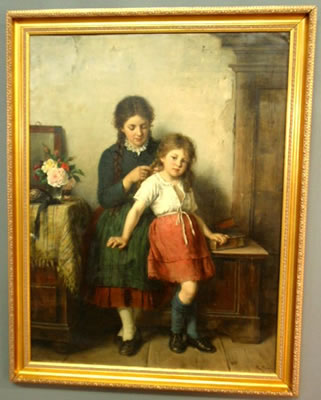
Epp's motives were true to life and described life in the late 19 Century without judging. This makes it still attractive and historically significant art and cultural products. The number of his works is in the hundreds. Many of the themes he has painted several times.
Major part of his artistic work are mostly small genre pieces . The subtle moods, and the skillful combination of finely colored landscapes and natural unsophisticated characters lend his paintings a special artistic statement.
Works by Rudolf Epp are in numerous public collections, including Kunsthalle Mannheim , Staatliche Kunsthalle Karlsruhe, Kunsthalle Bremen, Wallraf-Richartz Museum (Cologne) and Neue Pinakothek (Munich). Three pieces are also owned by the Widener University Art Collection & Gallery, Chester, Pennsylvania.
Source:
Wikipedia, Translated from http://de.wikipedia.org/wiki/Karl_Ludwig_Seeger