Page loaded successfully. Showing biography for Samuel (Sam) Middleton.
Samuel (Sam) Middleton BIOGRAPHY
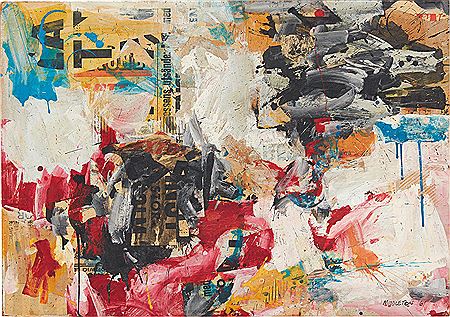
1927 New York City - 2015 Schagen, Netherlands. Known for: Abstract painting, collage, jazz music motif.
The following entry was submitted May 2004 by Johanna Kalff-Middleton, wife of the artist. SAM MIDDLETON: MISCHIEF AND MELANCHOLY. By John A. Williams. One part of the mischief is that he has pulled... Read full biography
The following entry was submitted May 2004 by Johanna Kalff-Middleton, wife of the artist. SAM MIDDLETON: MISCHIEF AND MELANCHOLY. By John A. Williams. One part of the mischief is that he has pulled it off after all -- the business of being one's own person without being considered a ranting rebel,... Read full biography
The following entry was submitted May 2004 by Johanna Kalff-Middleton, wife of the artist. SAM MIDDLETON: MISCHIEF AND MELANCHOLY. By John A. Williams. One part of the mischief is that he has pulled it off after all -- the business of being one's own person without being considered a ranting rebel, a choleric contrarian, or an obnoxious outsider. The other part of the mischief is what he calls the "small stealing" of things, materials for his collages. They can come from anywhere, anyplace, and... Read full biography
The following entry was submitted May 2004 by Johanna Kalff-Middleton, wife of the artist. SAM MIDDLETON: MISCHIEF AND MELANCHOLY. By John A. Williams. One part of the mischief is that he has pulled it off after all -- the business of being one's own person without being considered a ranting rebel, a choleric contrarian, or an obnoxious outsider. The other part of the mischief is what he calls the "small stealing" of things, materials for his collages. They can come from anywhere, anyplace, and he collects them all the time. Musicians might call this "sampling.'. The root of the melancholy, which is not unmixed with nostalgia, may lie in the cost of becoming the master collagist, draftsman, and the painter we know today as Sam Middleton.... Read full biography
The following entry was submitted May 2004 by Johanna Kalff-Middleton, wife of the artist. SAM MIDDLETON: MISCHIEF AND MELANCHOLY. By John A. Williams. One part of the mischief is that he has pulled it off after all -- the business of being one's own person without being considered a ranting rebel, a choleric contrarian, or an obnoxious outsider. The other part of the mischief is what he calls the "small stealing" of things, materials for his collages. They can come from anywhere, anyplace, and he collects them all the time. Musicians might call this "sampling.'. The root of the melancholy, which is not unmixed with nostalgia, may lie in the cost of becoming the master collagist, draftsman, and the painter we know today as Sam Middleton. As well, those Harlem experiences that shaped him no longer do. The physical Harlem is gone, too; the shops,... Read full biography
Artist Biography
Biography page for Samuel (Sam) Middleton ((1927 - 2015)), known for Abstract painting, collage, jazz music motif. Showing 3 biographical entries and 0 sample artworks.
Samuel (Sam) Middleton - Artist Info
About Samuel (Sam) Middleton
Biography from the Archives of askART
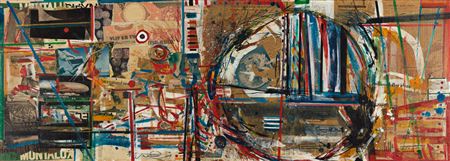 The following entry was submitted May 2004 by Johanna Kalff-Middleton, wife of the artist.
SAM MIDDLETON: MISCHIEF AND MELANCHOLY
By John A. Williams
One part of the mischief is that he has pulled it off after all -- the business of being one's own person without being considered a ranting rebel, a choleric contrarian, or an obnoxious outsider. The other part of the mischief is what he calls the "small stealing" of things, materials for his collages. They can come from anywhere, anyplace, and he collects them all the time. Musicians might call this "sampling.'
The root of the melancholy, which is not unmixed with nostalgia, may lie in the cost of becoming the master collagist, draftsman, and the painter we know today as Sam Middleton. As well, those Harlem experiences that shaped him no longer do. The physical Harlem is gone, too; the shops, dance halls, clubs, and many of the barber shops and storefront churches have also vanished. Famous avenues have been renamed Malcolm X, Frederick Douglass, and Martin Luther King, Jr.
Middleton, who has spent a good part of his life painting his impressions of the sights and the sounds he's associated with jazz music, is into his seventieth decade --and is now equally concerned with portraying other kinds of music: classical, spiritual, gospel. He is one of the Grand Old Men among American painters, having had about 200 exhibitions -- an average of over two per year -- but fewer than 50 have been held in the land of his birth. His self-exile from the United States and Harlem began over 50 years ago to avoid smashing his spirit into the restrictive, irrational and soul-numbing barriers of American racism. The tradition of escape was at least a century old, measured from the European sojourn of Robert Scott Duncanson in the mid-1840s, to the current crop of as-yet-unknown-African American artists boarding a plane this evening to Europe.
Of course, Middleton could have stayed home; he could have become a painter, perhaps even a very famous one, but there were always those conditional elements that offered nothing and promised little. Some of his white friends from his Greenwich Village days urged him to hit the road to avoid the system that allowed only one Black painter at a time to gain prominence. He had already begun to create his own options by setting out to view the world as it emerged from the destruction of World War 11 through 10 years of travel in the merchant marine. His trips carried him to Asia, Europe, South America, and to ports in the United States he otherwise would never have visited.
His first permanent move, from the States was to neighboring Mexico, which
earlier had welcomed the painter of the racial struggle, Charles White, and his wife, the sculptor Elizabeth Catlett. In 1955 in the land of David Siqueiros, José Clemente Orozco, and Diego Rivera, Middleton's work in paint, gouache and collage, was moving from social realism to expressionism. There in Mexico City, where lived more Africans than Spanish during parts of the 17th century, he created his first collages and held his first one-man exhibit in 1957.
Two years later he was in Spain. He is said to have been influenced by Juan Miró, but he denies this. "Miró he says, "never influenced me to do anything. I like him, I like the intricacies of Calder's mobiles too, but I wasn't influenced by them."
Middleton seems to have almost found his niche in Sweden, where he lived, and in Copenhagen, where he had a studio, rejoining old friends from New York and elsewhere -- Harvey Cropper, Clifford Jackson, Walter Williams, Herbert Gentry. Middleton had exhibitions in both Stockholm and Copenhagen in 1961, and the next year one in Amsterdam where he had moved by then, and in the United States and Germany. in the late, 1970s and early 1980s his work was declared to be in a Nieuwe Fase, which emphasized land, sea, and sky -- space -- and colors that were softer.
Those earlier jazz music motifs were less prominent and often altogether absent; people, things, places now assumed critical importance. The Netherlands, in its various aspects, repeatedly became his model. Then, late in the mid-1980s and early 1990s, Middleton combined techniques, themes and subjects; the music was back, this time including classical. A composers' series is dedicated to Rodgers and Hart, George Gershwin and Cole Porter. A 1990 collage displays Jessye Norman.
During his nearly 40 years in the Netherlands, Middleton has achieved artistic maturity, yet, like his model John Coltrane, he continues to probe and stretch, and that is why he is one of the most prodigious painters working today. But these labors mask an ageless melancholy that is made less deep by a sprightly, effortlessly innovative Black Mischief, (the title of a 1986 collage).Biography from Gerald Peters Gallery - NY II
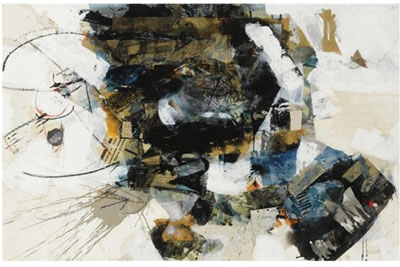 Following is The New York Times obituary of Sam Middleton, published July 29 to July 30, 2015
Born 2 April 1927 New York City; deceased 19 July 2015 Schagen, Netherlands
American artist Sam Middleton died peacefully on Sunday, July 19th in Schagen, Netherlands at the age of 88. He was born in New York City in 1927 and grew up in Harlem. In his youth he often visited the nearby Savoy Ballroom and music-jazz and classical-became important inspirations for his artistic endeavors. Middleton primarily worked with mixed media, and particularly collage. He developed a personal style in the language of abstract expressionism, often basing his color, line, and compositions on sound and harmony. The Dutch landscape and the visual environment of the Netherlands, his home since the1960s, greatly influenced his work as well.
Middleton joined the Merchant Marines in 1944. Upon his return to New York City in the 1950s, he relocated to Greenwich Village, meeting and befriending writers, artists, and jazz musicians. In the early 1950s, Middleton was part of New York's Cedar Tavern scene, which included his friends Robert Motherwell and Franz Kline. Middleton was part of the considerable contingency of expatriate African American artists in Europe. In 1955 he moved to Mexico, then Spain, Sweden and Denmark, finally settling in Holland in 1961. In the Netherlands, Middleton taught at Atelier 63 in Haarlem and the Royal Academy of Art in 's Hertogenbosch. He exhibited regularly in Holland; the exhibition Sam Middleton: Poems to Life in 2003, organized by the Cobra Museum voor Moderne Kunst, included dedications to Middleton by James Baldwin, Romare Bearden, Ted Joans and others.
In the late 1950s and early 1960s, Middleton's work was regularly shown in American museums, including New York's Whitney Museum of American Art, the Brooklyn Museum in New York and the Baltimore Museum of Art.
His work was featured in the Studio Museum in Harlem exhibition, "An Ocean Apart: American Artists Abroad" (1983). From Europe he sustained his reputation in the United States, resulting in his inclusion in several prominent books on African American art. Middleton's work is found in the collections of the Whitney Museum of American Art, Fisk University in Nashville, Tennessee, Hampton University Museum in Virginia, the Phillips Museum of Art at Franklin and Marshall College in Lancaster, Pennsylvania and Washington, D.C.'s Howard University.
Collected internationally, Middleton's work is held by museums in Australia, Israel and The Netherlands, including Amsterdam's Stedelijk Museum and Venlo's Van Bommel Van Dam Museum, which organized a Middleton retrospective in 1997.
He is survived by his wife Hansje Kalff of Schagen, three children, a stepson, eight grandchildren and one great grandchild.Biography from FauveParis
Samuel (Sam) Middleton is a renowned collage artist associated with the modernist movement. His work is deeply influenced by the vibrant cultural and musical scenes of Harlem and Greenwich Village, particularly jazz. Middleton views his collages as a form of visual improvisation, drawing inspiration from the improvisational nature of jazz music. He had friendships with key figures of the New York School such as Franz Kline, Jackson Pollock, and Robert Motherwell. In 1955, Middleton moved to Mexico City to explore collage further and transitioned from social realism to expressionism. He later settled in Europe in 1959, after leaving the United States for good, and had connections with African-American expatriates like Herbert Gentry, James Baldwin, and Ted Joans.