Page loaded successfully. Showing biography for Shan Li.
Shan Li BIOGRAPHY
Born 1942 Lanxi, Hailongjiang Province. Known for: Painting (political Pop movement, Mao).
At Li Shan's solo exhibition, "Building the Rouge Empire: Paintings from 1976-1992," held in Hong Kong in 1994, the artist showed for the first time a painting from 1988, entitled Surface No. 2. The... Read full biography
At Li Shan's solo exhibition, "Building the Rouge Empire: Paintings from 1976-1992," held in Hong Kong in 1994, the artist showed for the first time a painting from 1988, entitled Surface No. 2. The Shanghai critic Wu Liang commented on the work as follows: "In another of his grid paintings, [Li... Read full biography
At Li Shan's solo exhibition, "Building the Rouge Empire: Paintings from 1976-1992," held in Hong Kong in 1994, the artist showed for the first time a painting from 1988, entitled Surface No. 2. The Shanghai critic Wu Liang commented on the work as follows: "In another of his grid paintings, [Li Shan] has added the gaudy face of a woman, and equally gaudy lotus blossoms. Later, in another two more paintings entitled Surface No. 2, the thick rouge on the gaudy woman's face and the earlier images... Read full biography
At Li Shan's solo exhibition, "Building the Rouge Empire: Paintings from 1976-1992," held in Hong Kong in 1994, the artist showed for the first time a painting from 1988, entitled Surface No. 2. The Shanghai critic Wu Liang commented on the work as follows: "In another of his grid paintings, [Li Shan] has added the gaudy face of a woman, and equally gaudy lotus blossoms. Later, in another two more paintings entitled Surface No. 2, the thick rouge on the gaudy woman's face and the earlier images of lotus blossoms reappeared unexpectedly, as if the genes of his later Rouge Empire series were lurking therein."1 As Wu Liang suggested, from the time the gaudy female figure and lotus blossoms made their initial appearance in Li's painting,... Read full biography
At Li Shan's solo exhibition, "Building the Rouge Empire: Paintings from 1976-1992," held in Hong Kong in 1994, the artist showed for the first time a painting from 1988, entitled Surface No. 2. The Shanghai critic Wu Liang commented on the work as follows: "In another of his grid paintings, [Li Shan] has added the gaudy face of a woman, and equally gaudy lotus blossoms. Later, in another two more paintings entitled Surface No. 2, the thick rouge on the gaudy woman's face and the earlier images of lotus blossoms reappeared unexpectedly, as if the genes of his later Rouge Empire series were lurking therein."1 As Wu Liang suggested, from the time the gaudy female figure and lotus blossoms made their initial appearance in Li's painting, Surface No. 2 and up through the mid-1990s, Li Shan continued to paint these symbolic images, sometimes combin... Read full biography
Artist Biography
Biography page for Shan Li ((Born 1942)), known for Painting (political Pop movement, Mao). Showing 5 biographical entries and 0 sample artworks.
Shan Li - Artist Info
About Shan Li
Biography from Sotheby's Hong Kong
At Li Shan's solo exhibition, "Building the Rouge Empire: Paintings from 1976-1992," held in Hong Kong in 1994, the artist showed for the first time a painting from 1988, entitled Surface No. 2. The Shanghai critic Wu Liang commented on the work as follows: "In another of his grid paintings, [Li Shan] has added the gaudy face of a woman, and equally gaudy lotus blossoms. Later, in another two more paintings entitled Surface No. 2, the thick rouge on the gaudy woman's face and the earlier images of lotus blossoms reappeared unexpectedly, as if the genes of his later Rouge Empire series were lurking therein."1 As Wu Liang suggested, from the time the gaudy female figure and lotus blossoms made their initial appearance in Li's painting, Surface No. 2 and up through the mid-1990s, Li Shan continued to paint these symbolic images, sometimes combining them with portraits of Mao Zedong, the five-pointed star and other Chinese political symbols. These works comprise Li's important Rouge series." In 1993, examples of the Rouge series hung in "China's New Art, Post 1989" held at the Hong Kong Arts Centre, curated by Chang Tsong-zung and Li Xianting. In the exhibition catalogue, Li Shan wrote: "If we use 'rouge' as verb, and wish to 'rouge' something away, this is not so much a matter of will and method, but rather a question of attitude, a very noisy warning. Whenever art becomes an object of attention, it then becomes a very poor copy of itself, which everyone is capable of possessing."2 What Li Shan seems to be saying here is that the artist must discover an artistic philosophy and an artistic language appropriate to his or her own life and experience.
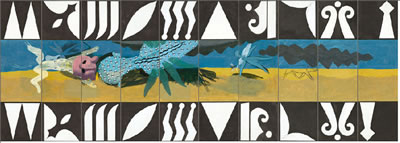
After appearing in the Hong Kong exhibition, paintings from the Rouge series traveled to the 1993 Venice Biennale, the 1994 São Paulo Biennial and other major exhibitions that signaled the arrival of Chinese contemporary art on the international stage. In addition to making their mark internationally, the Rouge series was an important milestone in Li Shan's professional career, and served as the basis for critic Li Xianting referring to Li Shan as one of the key practitioners of 1990s "Political Pop." Examining Surface No. 2 (1988), not only do we discover clues to the Rouge series, but more important, we can observe how the Rouge series works of the 1990s evolved out of their 1980s predecessors. Surface No. 2 is permeated with a macabre sense of humour. The centre of the canvas is occupied by a solid black rectangle, a portion of its borders trimmed with black fringes which reach out like tentacles. Hovering above the ends of the rectangle are two clusters of erogenous rouge-coloured blossoms, out of which multiple tendrils are growing. Almost incredibly, at the horizontal ends of the painting, Li has symmetrically positioned two female figures, their bodies partially covered by the black rectangle. The women appear to be grasping the black rectangle, but at the same time, they seem organically connected to it. The mood here is different from that in the later works in the Rouge series, which are more refined, colourful and luxuriant, and tinged with a different kind of eroticism. In Surface No. 2, while solid colours are used in a restrained manner, the depiction of the flowers and the women still presents viewers with any number of sexual innuendoes. In fact, Surface No. 2 is closer to the thinking and methods evident in Li Shan's works from the 1970s and 1980s.
Li was born in Heilongjiang province in 1942, graduated from the Shanghai Theatre Academy, and taught in the academy after his graduation. In his early career, he was influenced by the works of Henri Rousseau, Gauguin and other western artists, paying close attention to actual living experience. In the late 1970s, Li initiated a series entitled "In the Beginning." As Li recalled, "I started that series in the late 1970s and early 1980s, when I first began painting in oils. 'In the Beginning' represents my Expressionist period. At the time I was also influenced by Primitivism."3 Drawing on the techniques of abstract expressionism, Li combined icons of ancient culture, primitive people and totemic symbols in his canvasses, imbuing them with a sense of mystery.
At the time of the "85 New Wave" Li Shan was already a mid-career artist. As countless associations of young artists sprang up throughout China, his works became increasingly individualistic and self-oriented. But he was also influenced by the "reading fever" that had overtaken China at the time. But while the majority of "New Wave" artists vigorously engaged in philosophical speculation, Li Shan was more attracted to books about science and technology, specifically mathematics, physics and biology, and this interest of his gradually found expression in his works. He soon began to explore such ultimate questions as the basic nature of art with an almost scientific rationality. At the time, Li wrote: "I will redefine art, something I have to rethink from the very beginning. That's because our long held assumptions about art being something real and substantial are now starting to crumble."4
Li Shan's most recent Extension Expansion series takes off from there: Extension Expansion borrows concepts from physics. Most of the works are in black and white, applied with a flat colour technique. If there is a living, embryonic connection between the In the Beginning and Extension Expansion series, some kind of regenerative force… there is a tension, a kind of primitive cry that is constantly extending and expanding."5 In the Extension Expansion series, simplified geometric symbols appear in a fuzzy "circle" suspended in an impenetrable space, as well as black and white rectangles, like the rectangular black object in Surface No. 2. In two paintings from Extension Expansion, Continued (1987), the composition is quite similar to that of Surface No. 2, but the seductive females in the latter work appear as totemic figures reminiscent of those in "In the Beginning." If In the Beginning and Extension Expansion can be said to fully represent Li Shan's early period, then which marks his maturity as an artist, encapsulates all the works in his formative years. In this sense, Surface No. 2 with its intrinsic depth of thought and ceaseless exploration is a milestone from which to look back on the 1980s and 1990s. As critic Gao Minglu has written, Li Shan's practice "…has its own inner logic, yet it also is consistent with the logic of the development of contemporary art in China."6
1 Wu Liang, "On the Road to the Empire of Rouge." In Li Shan: Building the Rouge Empire: Paintings from 1976-1992. Hong Kong: Alisan Fine Arts, 1994. p. 11
2 China's New Art/Post 1989. Asian Art Archieve, 2001. p.18
3 Liu Chun: "The process of painting is the process of the artist seeking his own inner truth: An interview with Li Shan." In Art, Life, and the New Wave: Dialogues with 41 Chinese Contemporary Artists. Yunnan People's Publishing House, 2003. p. 23
4 "An Interview with Li Shan." In Materials of the Future: Documenting Contemporary Chinese Art from 1980-1990. March 4, 2009. Online archive, Asia Art Archive (www.aaa.org.hk)
5 Liu Chun, op. cit.
6 Gao Mingu. A History of Contemporary Chinese Art, 1985-86. Shanghai: People's Art Publishing House. p. 184Biography from Christie's Hong Kong
Having lived through the Cultural Revolution, Chinese artist Li Shan frequently appropriates images from that era in his art practices. Li was one of the key figures in the Political Pop Movement in Shanghai around the 1990s. For the artist, the word “Rouge” embodies an element of surrealism; in paintings from the artist’s Rouge Series, compositions are infused with Li Shan’s iconic pink flora motif. The continuous and linear floral patterns create a sublime yet surrealistic universe. A strong sense of irony is apparent in Li’s Rouge Series No. 7 which seeks to create a dialogue between sex, a taboo topic, and communism. The flamboyant pink lotus petals surrounding the clock are arranged in such a way that is charged with erotic energy. The fissure of the clock presses an urgency to conduct sexual-related activities in an ephemeral privacy before being returning to the public eye. Li alludes to voyeurism by inserting the image of an official’s head on wings at the top right corner of the painting not only to reinforce his critique of the government’s conservative attitude toward sex, but also to highlight how such activities were monitored in order to make sure they adhered to government policies. In light of China’s progression and optimism over the past decades, Li’s mockery and satire of the clash between communist policies of the past and human sexuality continues to arouse and entertain us.
As one of the key figures in Shanghai's Political Pop movement, Li Shan's oil paintings have undergone many stylistic changes throughout his career; his paintings express his internal sensibilities as well as external conviction. As one of the first artists to appropriate Mao's own image, Li Shan was born in 1940 and grew up under the Chairman's leadership. Li's development as an artist during this period was heavily constrained; he was permitted to only paint within the context of propaganda, folk art, and socialist realism. However, out of this restriction, Mao Zedong became the main subject for the artist. Throughout the 1990s, Chinese artists' were engaged in a relentless pursuit of new techniques and vocabularies to critically re-define the representation of their own existence.
The Political Pop group of artists included Wang Guangyi, Yu Youhan and Li Shan, illustrate a spectrum of nuanced plurality in this category with their individual reinterpretation of visual culture associated with the high Communist period of China. While some appropriated these recognized symbols and imagery to demonstrate the head-on clash between consumerism and Communism or to embrace Mao as a cultural icon. Li Shan's appropriation of the ubiquitous imagery of Mao Zedong, adding his own individualistic creative vision, transported the symbolic figure into his iconic Rogue series paintings. As such, the series stood on its own for its distinct use of irony and taboo of sexuality in relation to politics. This sense of irony and iconography continues with Lotus Woman. It is an explosion of coral, fuchsia and pink, all familiar colors of the Rouge series, contrasts with the background of black and green creating a visually striking painting. Surrounded by a flurry of lotus flower pedals, Li Shan has added a personal twist on his appropriation of Mona Lisa's face with exaggerated makeup, turning her into a clownish figure. On the adjoining side are stringy pedals bursting forth like confetti from a shadowy shape. This combination creates a rather farcical scenario filled with sexual innuendos. The context of the Lotus Woman is overtly sexual. Two organisms erupts with a plethora of pink pedals, appearing to be representing the genitals of both sexes, Mona Lisa as the feminine, while the spindly flower on the right represents the masculine. The two organisms are in full bloom, like the tails of peacocks, ready to copulate. Li Shan use of flowers as sexual motif is reminiscent of Georgia O'Keeffe imageries of highly sexual flowers. In addition, the symbolic decoration of the ornate petals represents Li's interests and nostalgia in Chinese popular culture; flower motifs are commonly found in Chinese prints and on vintage consumer goods. The portrait is not pure iconoclasm, as the adoption of gentle features, the lotus pedals resembles hand gesture, of Buddhist imagery, to instill elements of religious iconicity. The rogue-cheeks of the Mona Lisa is a direct reference to traditional Chinese opera in which men traditionally assumed female roles, explicitly underlining cultural aspects of gender and sexuality highly condemned during Mao's reign. While the subversive and transformative nature of rouge makeup underpins the subtle play between power, sex and cosmetic enhancement in both visual imagery and political ideologies. More importantly Mona Lisa is a symbol of the highest form of western artistic achievement, but in Li's hands, her face is embellished with an overdose of rouge or make up, sexualizing her in the process and ultimately subverting her symbolic authority. This act of turning an icon into an object of ridicule is reminiscent of the Avant-Guard Dadaist artist Marcel Duchamp's defacement of a Mona Lisa postcard by giving her a mustache. Toying with the idea of multi-layered ambiguities, Li's works are clever and coy reflections on the cultural circumstances of iconicity and power. Li subversively pushes his candid expressionism with his trademark red and pink flora motif, the result is a voluptuously sensual and humorous take on art history. With its energetically kitschy aesthetics, and erotic sensuality, Lotus Woman is a stunning painting by the artist.Biography from 33 Auction
Born in China, 1942, Li Shan is a painter and a prominent figure in the Political Pop movement that developed in China in the 1990s. Born in Heilongjiang Province, Li studied oil painting at the Shanghai Drama Institute before establishing his place on the Shanghai art scene. In the late 1970s, Li rejected Socialist Realism, a style popular among other artists. However he chose to distinguish his own style that is self- expressive and politically critical.
His most famous works, entitled 'Rouge' series and started in the late 1980s, depicting stylized figures, abstract flowers, and portraits of Mao Tze Dong acting as a reminiscent of Andy Warhol's silk screen prints of a singular subject in a repetitive manner. Li parodies the leader's image cultivated through his propaganda posters by presenting him as a frivolous, feminine character.
In his most recent series of 'Reading' from 2005, Li digitally compose images of insects and plants from parts of the human body, alluding to the role of ethics in today's bio- scientific experiments. Li's works has been exhibited at the 1993 Venice Biennale, the Brooklyn Museum of New York and the Museum of Contemporary Art in Shanghai and among other institutions.
He resides in Shanghai.
At the China Modern Art Exhibition that was held at Beijing- National Art Museum, Li Shan became instantly famous for his performance art "Washing Feet". Prior to that, Li also participated in the planning and exhibition of "the First Shanghai Concave - Convex Exhibition" in 1986 and "the Second Shanghai Concave - Convex Exhibition - The Last Supper" in 1988. His Rouge series was recognized as an important figure of Political Pop Art in the 1990s. The New Art from China: Post-1989, Venice Biennale in 1993, and Sao Paulo Art Biennial in Brazil in 1994 were the key exhibitions that brought Li Shan's 'Rouge' series to international fame.
Different from Li Shan's own expression about his artworks, the art critic Lu Peng believes that "Li Shan attempts to express his opposed political differences by taking a stance of keeping away from the direct ideology and political confrontation; he obscure his political view through using metaphorical rhetoric. However, in the 1990s of China, within the historical context of political pop art, Li Shan's explanation was largely considered credible. The irony, metonymy, metaphor, jeer, indication, and analogy, which originally belong in the category of artistic rhetoric, were actually a political discourse and an ideological stance. It is in this sense that Li Shan's art is an important part of the political pop art. At a stage of historical transition, Li Shan has sent out the last reminder, with his art, to those who are on the brink of forgetting history".
Li later became a founding member of the Political Pop movement in contemporary Chinese art. Recently, he has continued to push boundaries with his photography of insects and flowers with close inspections, revealing themselves to be composites containing close-up images of human body parts, including skin and genitals. Underlying Li's self-described "biological art" is a fascinating technological advancement of the field of biology that questions the concept of cloning. Li Shan has undergone many stylistic transitions throughout his career but has never lost his motivation in expressing internal sensibilities as well as external reluctances.
The latest paintings in his 'Rouge' series show mutant beings with butterflies portraying in a metaphorical manner off representing parts of the human face. This evokes two contradictory strains: humor, laughter and self-mockery on the one hand and a cynical undercurrent of criticism on the other. "Rouge" is based on the principle of ambiguity as Li attempts to find an evolving form that can address the problem of extracting the familiar from the unfamiliar. Through his uncannily realistic representation of interspecies insects, Li questions the hypocrisy and lack of equality of human values in today's politically informed bio-scientific experiments. In terms of artistic style, he has adopted decorative methods similar to those of folk art, creating intimate, and eccentric of oddly shaped organic objects. The synthesised insects are constructions of digital imagery morphed into abstracted pictures. He raises the possibilities in identifying the boundaries between organism and the world it inhabits. The Artist's intention meant nothing political. Instead, he believes that the society has placed responsibility heavily on the shoulder of art. In his opinion, art is art itself. His painting of the Leader Mao is only a comical reflection of history, to relieve the heavy burden of art and to bid farewell to the history by using a once symbolical image.Biography from Shanghai Hosane Auction Co., Ltd.
Li Shan was born in Lanxi, Heilongjiang Province in 1942. He graduated from Heilongjiang University in 1963. And in 1964, he studied at Arts Department (oil Painting) of Shanghai Theater Academy.
Solo Exhibitions:
1990 Solo Exhibition, Shanghai Academy of Drama
2001 "Li Shan: Thou are not the fish", A room with a view, Shanghai
2002 "Reading - the New Works by Li Shan", ShanghART Gallery, Shanghai
2004 "Li Shan - Small New Works", ShanghART Gallery, Shanghai
2006 "Reading - Photoworks 2003-2005", ShanghART H-Space, Shanghai
2007 "The Pumpkin Project - Li Shan & Zhang Pingjie Bio-Art Exhibition", ShanghART Gallery, Shanghai
2012 Pink smile: Reading Li Shan, Taipei Museum of Contemporary Art
Group Exhibitions:
1982 "Painting the Chinese Dream - Chinese Art 30 Years after the Revolution", Smith College, Northampton Ma; City Hall, Boston, Ma; Brooklyn Museum, New York, USA
1983 "Art and Experiment of 83" (Stage'83: Paintings Experiments), Fudan University, Shanghai
1986 "First Shanghai Concave - Convex Exhibition", Xuhui Cultural Centre, Shanghai
1987 "A State of Transition: Contemporary Painting from Shanghai", Asian Fine Arts at the Hong Kong Arts Centre, Hong Kong
1989 "China/Avant-garde Art Exhibition", National Art Museum of China, Beijing
1992 "Encountering the Others - Projektgruppe Stoffwechsel", Dokumenta Kassel, Kassel, Germany
1993 "45th International Art Exhibition Venice Biennale - Cardinal Points of the Arts", Venice, Italy
1994 "22nd International Biennial of Sao Paulo", Brazil
1995 "Chinese New Art 1989-93", Vancouver Art Museum, Vancouver, Canada 1997 Faces and Bodies of the Middle Kingdom, Chinese Art of the 1990', Galerie Rudolfinum, Prague, Czech; OTSO Gallery, Espoo, Finland
1998 New Voices: Contemporary Art Dialogue Among, Hong Kong Art Center, Hong Kong; National Taiwan Art Education Institute, Taipei; Liu Hai Su Art Museum, Shanghai
2000 Futuro Chinese Contemporary Art, Contemporary Art Centre, Macau;
2001 Shanghai Star, Casula Art Centre, Sydney, Australia
2002 Paris-Pekin-Chinese Contemporary Art Exhibition, Espace Pierre Cardin, Paris, France
2003 Subversion and Poetry-Contemporary Chinese Art, Culturgest, Lisbon, Portugal
2005 Study Practice, Shanghai Gallery of Art, Shanghai
2006 Art in Motion, Moca Shanghai, Shanghai
2007 85 New Wave - The Birth of Chinese Contemporary Art, Ullens Center for Contemporary Art, Beijing
2008 Five Years of Duolun: Chinese Contemporary Art Retrospective Exhibition, Shanghai Duolun Museum of Modern Art, Shanghai; Collision-Experimental Cases of Contemporary Chinese Art, CAFA Art Museum, Beijing, China
2010 Fairy Tales Selections from the MaGMA's collection, Opera Gallery SingaporeBiography from Heritage Auctions
Li Shan graduated from the Art Department of the Shanghai Theater Academy in 1968. He is a principal artist of the Political Pop movement, which emerged in the early 1990s.
His best-known works feature a stylized young Mao, sometimes wearing lipstick or sporting a lotus flower, set against a bright background. Moving beyond Mao portraits, Li uses decorative and folk art motifs to explore ambiguities of sex, gender, and species: works in his 2005 Reading series, for instance, depict fantastical insects collaged from human body parts.
Li's art has been exhibited internationally, including '85 New Wave - The Birth of Contemporary Chinese Art at the Ullens Center for Contemporary Art, Beijing (2007), the First Guangzhou Triennial (2002), and the 45th Venice Biennale (1993).
He lives in Shanghai.