Page loaded successfully. Showing biography for Shusaku Arakawa.
Shusaku Arakawa BIOGRAPHY
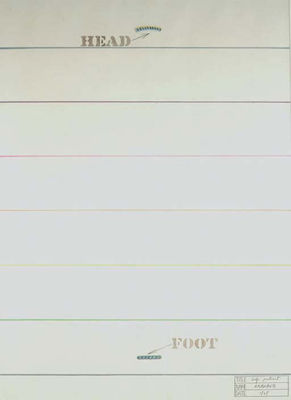
1936 Nogoya, Japan - 2010 Manhattan, New York. Known for: Modernist genre-caligraphy, graphics.
The following obituary is by Fred A. Bernstein and published in The New York Times, May 19, 2010. Arakawa, a Japanese-born conceptual artist and designer, who with his wife, Madeline Gins, explored... Read full biography
The following obituary is by Fred A. Bernstein and published in The New York Times, May 19, 2010. Arakawa, a Japanese-born conceptual artist and designer, who with his wife, Madeline Gins, explored ideas about mortality by creating buildings meant to stop aging and preclude death, died Tuesday in... Read full biography
The following obituary is by Fred A. Bernstein and published in The New York Times, May 19, 2010. Arakawa, a Japanese-born conceptual artist and designer, who with his wife, Madeline Gins, explored ideas about mortality by creating buildings meant to stop aging and preclude death, died Tuesday in Manhattan. He was 73. He had been hospitalized for a week, said Ms. Gins, who declined to give the cause of death. "This mortality thing is bad news," Ms. Gins said by phone from her studio on Houston... Read full biography
The following obituary is by Fred A. Bernstein and published in The New York Times, May 19, 2010. Arakawa, a Japanese-born conceptual artist and designer, who with his wife, Madeline Gins, explored ideas about mortality by creating buildings meant to stop aging and preclude death, died Tuesday in Manhattan. He was 73. He had been hospitalized for a week, said Ms. Gins, who declined to give the cause of death. "This mortality thing is bad news," Ms. Gins said by phone from her studio on Houston Street. She said she would redouble her efforts to prove that "aging can be outlawed." . Arakawa, who was known professionally by his surname, and Ms. Gins explored their philosophy, which they called Reversible Destiny, in poems, books, paintings... Read full biography
The following obituary is by Fred A. Bernstein and published in The New York Times, May 19, 2010. Arakawa, a Japanese-born conceptual artist and designer, who with his wife, Madeline Gins, explored ideas about mortality by creating buildings meant to stop aging and preclude death, died Tuesday in Manhattan. He was 73. He had been hospitalized for a week, said Ms. Gins, who declined to give the cause of death. "This mortality thing is bad news," Ms. Gins said by phone from her studio on Houston Street. She said she would redouble her efforts to prove that "aging can be outlawed." . Arakawa, who was known professionally by his surname, and Ms. Gins explored their philosophy, which they called Reversible Destiny, in poems, books, paintings and, when they found clients, buildings. Their most recent work, a house on Long Island, had a steeply sloped... Read full biography
Artist Biography
Biography page for Shusaku Arakawa ((1936 - 2010)), known for Modernist genre-caligraphy, graphics. Showing 2 biographical entries and 0 sample artworks.
Shusaku Arakawa - Artist Info
About Shusaku Arakawa
Biography from the Archives of askART
 The following obituary is by Fred A. Bernstein and published in The New York Times, May 19, 2010.
Arakawa, a Japanese-born conceptual artist and designer, who with his wife, Madeline Gins, explored ideas about mortality by creating buildings meant to stop aging and preclude death, died Tuesday in Manhattan. He was 73.
He had been hospitalized for a week, said Ms. Gins, who declined to give the cause of death.
"This mortality thing is bad news," Ms. Gins said by phone from her studio on Houston Street. She said she would redouble her efforts to prove that "aging can be outlawed."
Arakawa, who was known professionally by his surname, and Ms. Gins explored their philosophy, which they called Reversible Destiny, in poems, books, paintings and, when they found clients, buildings.
Their most recent work, a house on Long Island, had a steeply sloped floor that threatened to send visitors hurtling into its kitchen. Called Bioscleave House (Lifespan Extending Villa), it featured more than three dozen paint colors; level changes meant to induce the sensation of being in two places at once; windows that seemed too high or too low; oddly angled light switches and outlets; and an absence of doors that would have permitted occupants even a modicum of privacy.
All of it was meant, the couple explained, to lead its users into a perpetually "tentative" relationship with their surroundings, and thereby keep them young.
"It has to do with the idea that you're only as old as you think you are," Steven Holl, the Manhattan architect, said of the couple's work, which he said was deeply rooted in Japanese philosophy. He added, "It may take years for people to fully understand it."
Arthur Danto, the art critic and philosopher, who had known Arakawa for nearly 40 years, said, "He really felt they were doing the most important kind of work, to overcome death." But, Mr. Danto said, "How that was going to happen was never clear, to anyone outside Madeline and him."
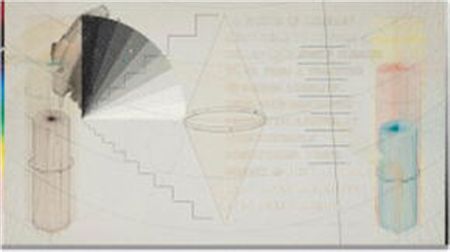
When Mr. Danto met Arakawa and Ms. Gins, they were focused on completing 83 large canvases called "The Mechanism of Meaning." "It was considered by a lot of people I knew to be very important work," he said.
In 1997, "The Mechanism of Meaning" was shown at the SoHo branch of the Guggenheim Museum as part of a retrospective of the couple's work. Calling the paintings "a bridge between Dada and Fluxus and the soon-to-be Conceptual Art," Roberta Smith, writing in The New York Times, noted that "their philosophical or linguistic puzzles can stretch the mind in briefly pleasant ways."
In recent years, the Arakawa and Ms. Gins's work was taken up by philosophers and scientists, and they were the subject of several symposiums.
Shusaku Arakawa was born on July 6, 1936, in Nagoya, Japan, and studied art in Tokyo, where he became known for his neo-Dadaist creations. He moved to New York in 1961. In his pocket, he said, were $14 and the phone number of Marcel Duchamp, who he said became his mentor.
Two years later Arakawa enrolled in art school in Brooklyn (for the visa, he said, not the education). There he met Ms. Gins, a fellow student, who had grown up on Long Island.
Within days they had become a couple. (They married, she said, in 1965.) Over the next several decades, living in a loft building on Houston Street, they produced a body of work that gradually extended from poetry and prose to architecture.
In 1996, Herbert Muschamp, the architecture critic of The Times, reviewed their room-size installation at a museum in Japan. He called it "a comic stroke with cosmic intentions."
In 1998 they won a competition, sponsored by the city of Tokyo, to build a vast housing project on 75 acres of landfill. The project, to be called City of Reversible Destiny, was never realized, but several apartments were built following their ideas.
Around the same time, they were commissioned to build the house on Long Island. When it was completed in 2008, Arakawa pranced across the sand-dune-like floor. He said he felt like the first man on the moon, adding, "If Neil Armstrong were here, he would say, 'This is even better!' "
In the 1990s, the couple invested money with Bernard Madoff. After Mr. Madoff's fraud was exposed in 2008, they were forced to lay off staff and close their office. "He pulled the rug out from under us," Ms. Gins said at the time.
But, she said this week, her husband shrugged off things as trivial as money. There was a bigger morality in play.
"It's immoral," Ms. Gins said, "that people have to die."Biography from the Archives of askART
 Dadaist Conceptualist Shusaku Arakawa was born in Nagoya, Japan, on July 6, 1936. He studied medicine and mathematics at Tokyo University from 1954 to 1958, and art at the Musashino College of Art, Tokyo, before completing his degree he left Japan. In 1958 he began submitting paintings to the Yomiuri Independent exhibitions and in 1961 held his first solo exhibition at Mudo Gallery, Tokyo.
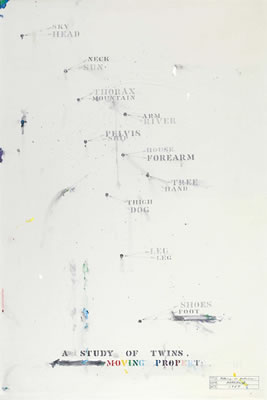
In 1960, he started a neo-Dada group, programming Happenings, and later gaining recognition with a series of boxes. In 1962, he came to New York and created a new series, "Diagram," in which silhouettes of combs, footprints, tennis rackets, arrows and refrigerators were arranged on canvas. Gradually he replaced the silhouettes with words only.
Throughout the 1960s he had a number of solo exhibitions at Dwan Gallery, New York and Los Angeles, at Galerie Schmela, Düsseldorf, and Galleria Schwartz, Milan. In 1966 he was given his first museum exhibition at the Stedelijk van Abbemuseum, Eindhoven, Netherlands, and in 1970 represented Japan at the Venice Biennale. During the 1970s museums featured his work throughout Europe and the United States and in 1981 a large retrospective was organized by the Städtische Galerie im Lenbachhaus, Munich.
With his wife, the poet Madeline H. Gins, Arakawa has also published books that "parallel the preoccupations of his paintings," in particular The Mechanism of Meaning (1979).
In 1991 a retrospective was organized by the National Museum of Modern Art, Tokyo. Arakawa and Gins increasingly concentrate on collaborative installation pieces and architectural design, such as the Utopian City of Reversible destiny seen at the Guggenheim Soho in 1997.
He has produced two experimental films.
"The cool and analytical appearance characteristic of Arakawa's mature work, which gives it the look of scientific research or a philosophical treatise, is not surprising given that he had studied medicine and mathematics before making art. It is also not surprising because he is part of the fashionable neo-Dadaist, anti-art milieu that dominated the art of the late 20th century. The cylindrical motif seen in the earlier painting "Tubes" reappears in Out of distance/Out of texture," 1978 (195.7 x 305.6 cm, synthetic polymer paint, fiber-tipped pen and canvas).
Here the tubes are more elaborate, a tube within a tube made up of rotating planes. These overlie a diagrammatic floor plan of a small two-bedroom dwelling, and, in turn, are overlaid with radiating lines of perspective emanating from the tubes and an enigmatic series of words and phrases.
In this complex juxtaposition, language - both visual and verbal - becomes more important than the technical qualities of the painting. The machine-look stenciled labels that Arakawa fixes to objects, whether tubes or more complex creations such as the electromagnets seen here, remain an inadequate description, underscoring the gap between object and word. Words become objects and objects become words as Arakawa exposes the ambiguities in the relationship.
Like all Conceptualists and Pop Art neo-Dadaists like Andy Warhol and Roy Lichtenstein, Arakawa denies the 'artist's hand' in his paintings. Expressionistic or emotive marks on the canvas are few, serving only as a foil to the deadpan, depersonalized, mechanical style. Paintings such as Out of distance/Out of texture appear to be aimed at the intellect devoid of feeling for life, poetry or spirituality."
Sources include:
Les Krantz, American Artists, Illustrated Survey of Leading Contemporary Artists
http://www.nga.gov.au/International/Detail.cfm?IRN=74725
http://www.nga.gov.au/International/Detail.cfm?ViewID=1&SiteID=&SubViewID=1&IRN=74725