Page loaded successfully. Showing biography for Soo Pieng Cheong.
Soo Pieng Cheong BIOGRAPHY
1917 Amoy, China - 1983 Singapour. Known for: Abstract marine, landscape and figure painting and ink drawing.
Iconic and innovative Singaporean artist Cheong Soo Pieng is famous for his "Nanyang" paintings and pioneering efforts in that style, however his subjects and styles actually spanned the artistic... Read full biography
Iconic and innovative Singaporean artist Cheong Soo Pieng is famous for his "Nanyang" paintings and pioneering efforts in that style, however his subjects and styles actually spanned the artistic spectrum from realist to abstract. Furthermore, other styles he practiced were difficult to place on... Read full biography
Iconic and innovative Singaporean artist Cheong Soo Pieng is famous for his "Nanyang" paintings and pioneering efforts in that style, however his subjects and styles actually spanned the artistic spectrum from realist to abstract. Furthermore, other styles he practiced were difficult to place on the spectrum because they were the result of his constant experimentation and use of new media, such as metal installations, wood, and cloth, to create his own unique styles. His methods mirrored his... Read full biography
Iconic and innovative Singaporean artist Cheong Soo Pieng is famous for his "Nanyang" paintings and pioneering efforts in that style, however his subjects and styles actually spanned the artistic spectrum from realist to abstract. Furthermore, other styles he practiced were difficult to place on the spectrum because they were the result of his constant experimentation and use of new media, such as metal installations, wood, and cloth, to create his own unique styles. His methods mirrored his dual Western and Eastern educations and the melting pot of cultures and influences he witnessed while living in China and Southeast Asia. He made a profound impact on Singaporean modern art in a short time period due to his ability to learn many... Read full biography
Iconic and innovative Singaporean artist Cheong Soo Pieng is famous for his "Nanyang" paintings and pioneering efforts in that style, however his subjects and styles actually spanned the artistic spectrum from realist to abstract. Furthermore, other styles he practiced were difficult to place on the spectrum because they were the result of his constant experimentation and use of new media, such as metal installations, wood, and cloth, to create his own unique styles. His methods mirrored his dual Western and Eastern educations and the melting pot of cultures and influences he witnessed while living in China and Southeast Asia. He made a profound impact on Singaporean modern art in a short time period due to his ability to learn many different styles throughout his career. Quickly mastering each he continuously moved on to the next art style, from Post-Impressionist to abstract to traditi... Read full biography
Artist Biography
Biography page for Soo Pieng Cheong ((1917 - 1983)), known for Abstract marine, landscape and figure painting and ink drawing. Showing 2 biographical entries and 0 sample artworks.
Soo Pieng Cheong - Artist Info
About Soo Pieng Cheong
Name variants
Cheong Soo Pieng
Biography from Tobin Reese Fine Art
Iconic and innovative Singaporean artist Cheong Soo Pieng is famous for his "Nanyang" paintings and pioneering efforts in that style, however his subjects and styles actually spanned the artistic spectrum from realist to abstract. Furthermore, other styles he practiced were difficult to place on the spectrum because they were the result of his constant experimentation and use of new media, such as metal installations, wood, and cloth, to create his own unique styles. His methods mirrored his dual Western and Eastern educations and the melting pot of cultures and influences he witnessed while living in China and Southeast Asia. He made a profound impact on Singaporean modern art in a short time period due to his ability to learn many different styles throughout his career. Quickly mastering each he continuously moved on to the next art style, from Post-Impressionist to abstract to traditional Chinese painting on cotton. He was influenced by and admired ancient art, especially that of the Egyptians.
Cheong, the youngest of seven children, was born into a farming and fishing family in 1917 in Xiamen, China. Although his father was a member of an ethnic minority group from the east coast of China with a history of artistic abilities, his parents neither encouraged nor discouraged his artistic interest. From 1933-1935 Cheong attended the Xiamen Academy of Fine Art and in 1936, he studied at the Sin Hwa Fine Art Academy in Shanghai until the events of the Second Sino-Japanese War put his safety at risk. Japanese bombs eventually destroyed the school in 1938. He then briefly returned to teach at Xiamen, his alma mater, where, in 1942, his first solo exhibition was held. During this time, Cheong mainly painted watercolors because oil paints were a rare find as a result of the war. After World War II ended, Cheong made a brief visit to Hong Kong and then moved to Singapore in 1946, where he worked as a lecturer at the Nanyang Academy of Fine Arts until 1961. He continued to improve his painting skills while teaching, but now having access to oils began depicting the beauty and nature that surrounded him in his new home of Singapore. Indians and Cows (1949, oil) and Seaside (1951, oil) are two works characteristic of the artist during this period. One of the most influential trips of his career was to Bali in 1952 with artists Chen Chong Swee, Chen Wen His, and Liu Kang, which resulted in the creation of the Nanyang ("south seas" in Chinese) style. Cheong produced over three hundred sketches while in Bali, several of which would later be reproduced into large-scale ink or oil paintings. He became a full-time artist in his mid-40s when he retired from teaching. During retirement he traveled to Europe for the first time, lived for one year in London, and visited the renowned art galleries and museums to see the works of the European Masters he studied in his youth. Pablo Picasso particularly inspired him. In 1955, he, and five other artists, were asked to show their works at an exhibition in England to be opened by the Duchess of Kent. Cheong was one of the first Singaporean artists to be featured in a solo exhibition in London.
The previously mentioned Nanyang style paintings are characterized by rural scenes, migrant culture, simple color schemes, and a mixture of Southeast Asian themes and Western compositional techniques. Most Nanyang works are Chinese ink and color or oil on canvas. Cheong's trademark Nanyang paintings often featured native Southeast Asian women with unrealistically lengthened limbs and figures and almond-shaped facial features. This style of painting women was created after a 1959 trip to the longhouses of the Dayak people native to Borneo. Nanyang paintings were intended to express the Southeast Asian identity of Singapore in the midst of the foreign influences during the colonial period. An example of his work depicting indigenous Southeast Asian rural living and the Nanyang style is Malay Life (1981). Other paintings and mixed media pieces created by Cheong focused on ordinary people, animals, and objects found and used in everyday life, such as frying pans, trash, and squirrels, which the artist was very fond of.
Cheong was awarded the Meritorious Public Service Medal by the Government of Singapore in 1962 for his major contributions to art. His 1977 oil painting titled Mother and Daughter was chosen for an UNESCO stamp in 1982. During his lifetime Cheong held eighteen high profile exhibitions in Singapore and other international cities. A major retrospective exhibition of Cheong's work took place at the National Art Gallery in Singapore in 1983. Sadly, Cheong died of heart failure, at age 66, just four months before the opening of the show. Several posthumous exhibitions of his work have taken place in Asia, including the National Museum Art Gallery in 1983, the Singapore Art Museum in 2010, and Nanyang Academy of Fine Arts in 2013.
The artist's impact is still felt in Singapore today through the reproduction of Drying Salted Fish (1978, oil) on the $50 note. In addition, Thomas Yeo, Wee Beng Chong, and Tay Chee Toh—all prominent artists in Singapore and Malaysia today—were mentored by Cheong. Cheong's original design of the logo for the Nanyang Academy of Fine Arts is still used today on some of the school's publications. It features the head, the eye, and the hand, to symbolize the critical connection between the mind, what the eye sees, and what the hand makes. Art Writer, Frank Sullivan, said, "For Soo Pieng, art is the beginning, the end, and the meaning of all life. He has no other interest."
Source: Kristin Guess for Tobin Reese Fine ArtBiography from Christie's Hong Kong
A first-generation Chinese who migrated to Singapore, and became firmly entrenched within what is now known as the 'Nanyang' style - or school - of Singapore art, Cheong Soo Pieng has been widely acclaimed as an artist whose personal career has undergone a myriad of transformations: stylistically ranging from the experimental to the traditional; with motifs drawn from the warmly local to elegantly abstract.
Born in Xiamen, China, in 1917, Cheong Soo Pieng received formal art education in traditional Chinese ink painting at the Xiamen Academy of Fine Arts, and later attended the Xin Hua Academy of Fine Arts in Shanghai where he was exposed to Western artistic styles such as Abstraction*, Cubism* and Surrealism*. He was deeply aware of a shift taking place in Chinese art: the push away from the traditional into the brave new world of Modernism* - reflecting the social and political inclinations of mid-20th century China, and the Western influences which trickled in through the coloured plates, engravings and art books sent home by émigré artists.
Cheong developed an awareness of the colour theory of the Fauvists* in tandem with the modernism of Matisse, which evolved to the shattered forms of Picasso and Braque; and the cohesions of shapes favored by Kandinsky to the abstract expressionism of Mark Rothko.
Arriving in Singapore in 1946, Cheong sought a continuation of the modern Chinese art movement within his new surroundings in tropical Southeast Asia. Along with his contemporaries, Chen Chong Swee, Liu Kang and Chen Wen Hsi, Cheong pioneered what later became hailed as the Nanyang School*: a style of art that was largely concerned with the integration of traditional Chinese art forms with modern developments in Western art, depicting the vivid context of Southeast Asia as their main subject matter.
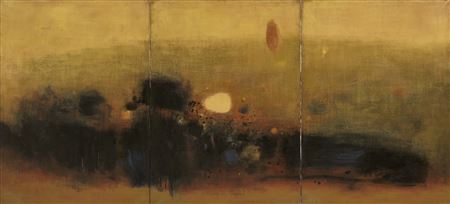
By the early 1960s, Cheong's artistic portfolio received such acclaim that he was invited to tour Europe, producing and exhibiting works in the United Kingdom and Germany. This particular phase of Cheong's career has become known as his 'European' or 'London' period because it was during the course of this trip that he cultivated a specific style of Sino-Western abstract painting which has especially resonated with his international audience until today. The works produced and displayed throughout Cheong's Europe trip reflect a similar aesthetic: masterful abstract landscapes of bold vermillion, crimson or yellow backgrounds, and dense painterly intersections of black, blue and red, rendered with calligraphic intensity.
Cheong showed a distinct preference for the intersection of earth and sky, with a rising or setting sun clearly in evidence - the insignia of cyclical birth and life. In 1963, the Redfern Gallery at Cork Street, London organized two exhibitions by two promising Chinese émigré artists. Cheong Soo Pieng's exhibition at the Redfern Gallery ran from 23 April to May 17 while Zao Wou-Ki's exhibition was from 29 October to 29 November in the same year. For Cheong Soo Pieng, the Redfern solo exhibition was the culmination of a successful European tour; which had commenced with the Bond Street Galleries of Fost & Reed in London in March 1962 and a second exhibition at Galerie Schoninger, Munich, in November 1962.
Nature's Inspiration, painted in 1963, was the headline work of the Redfern Gallery exhibition. Listed as the first work within the exhibition catalogue, we can infer that the monumental three-panel painting was considered by artist and audience as outstanding, being a clear representation of Cheong's finest endeavors. Nature's Inspiration simultaneously fulfills several different artistic achievements within a single work.
Firstly it re-invents the classical Chinese genre of shanshui (landscape painting) through its gestural calligraphic strokes and strongly Oriental aesthetic; yet at the same time it incorporates Western modernism through its dynamic colour palette, thickly layered oil paint and abbreviated visual motifs. This affinity to depict a monumental nature landscape brings Cheong into close resonance with his Chinese forebears, a lineage which can be traced to the ilk of those such as Northern Song painter Guo Xi, who penned the artistic treatise The Lofty Message of Forest and Streams' an instructive text on how to paint landscapes.
Guo banished the constraints of perspective and sought to present an angle of unified totality in approaching landscape portrayals. The awe-inspiring result of such a holistic depiction of nature's glory was, in turn, a commentary on the fleeting nature of humanity and evoked meditative contemplation within its viewer. In a sense, Guo's treatise encompasses the 12th century version of modernism - an attempt to move beyond a factually descriptive, hence limited, pictorial plane. Cheong resurrects this revered tradition of landscape painting superbly within Nature's Inspiration, which is neither fettered by bounded perspective nor concerns over mimesis. Instead he merges the principles of Chinese landscape with Western abstraction for a unified visual impact, breaking through pictorial conventions to create a stunningly emotive and powerful panorama.
* For more in-depth information about these terms and others, see AskART.com Glossary http://www.askart.com/AskART/lists/Art_Definition.aspx