Page loaded successfully. Showing biography for Stanton MacDonald-Wright.
Stanton MacDonald-Wright BIOGRAPHY
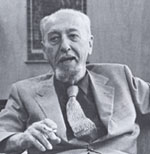
1890 Charlottesville, Virginia - 1973 Pacific Palisades, California. Known for: Synchromist and other modernist painting, landscape, still life.
Born in Charlottesville, VA on July 8, 1890. A problem child, Stanton ran away from home on a windjammer. When his father became manager of the Arcadia Hotel on the coast at Santa Monica, he moved... Read full biography
Born in Charlottesville, VA on July 8, 1890. A problem child, Stanton ran away from home on a windjammer. When his father became manager of the Arcadia Hotel on the coast at Santa Monica, he moved with his family to California in 1900. His art studies were begun locally with Warren Hedges and... Read full biography
Born in Charlottesville, VA on July 8, 1890. A problem child, Stanton ran away from home on a windjammer. When his father became manager of the Arcadia Hotel on the coast at Santa Monica, he moved with his family to California in 1900. His art studies were begun locally with Warren Hedges and Joseph Greenbaum. He soon hyphenated his last name with Macdonald to avoid being ask if he was related to the architect or the aviators. In 1909 he journeyed to Paris for further study at the Sorbonne,... Read full biography
Born in Charlottesville, VA on July 8, 1890. A problem child, Stanton ran away from home on a windjammer. When his father became manager of the Arcadia Hotel on the coast at Santa Monica, he moved with his family to California in 1900. His art studies were begun locally with Warren Hedges and Joseph Greenbaum. He soon hyphenated his last name with Macdonald to avoid being ask if he was related to the architect or the aviators. In 1909 he journeyed to Paris for further study at the Sorbonne, Académies Julian, Beaux Arts, and Colarossi. In Paris he and artist Morgan Russell developed an art style which they termed Synchromism in which color generates form. They co-exhibited in Paris and Munich in 1913 and New York in 1914. Upon returning to... Read full biography
Born in Charlottesville, VA on July 8, 1890. A problem child, Stanton ran away from home on a windjammer. When his father became manager of the Arcadia Hotel on the coast at Santa Monica, he moved with his family to California in 1900. His art studies were begun locally with Warren Hedges and Joseph Greenbaum. He soon hyphenated his last name with Macdonald to avoid being ask if he was related to the architect or the aviators. In 1909 he journeyed to Paris for further study at the Sorbonne, Académies Julian, Beaux Arts, and Colarossi. In Paris he and artist Morgan Russell developed an art style which they termed Synchromism in which color generates form. They co-exhibited in Paris and Munich in 1913 and New York in 1914. Upon returning to the U.S. in 1916, MacDonald-Wright was active on the East Coast until his return to Los Angeles in 1918. He then turned from S. Source: Edan Hughes,... Read full biography
Artist Biography
Biography page for Stanton MacDonald-Wright ((1890 - 1973)), known for Synchromist and other modernist painting, landscape, still life. Showing 5 biographical entries and 0 sample artworks.
Stanton MacDonald-Wright - Artist Info
About Stanton MacDonald-Wright
Name variants
Stanton MacDonald Wright
Biography from the Archives of askART
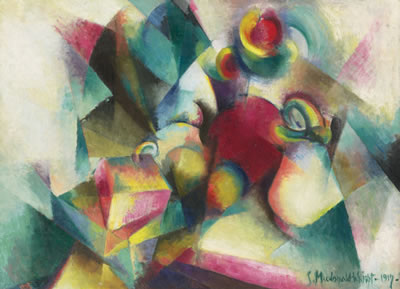 Born in Charlottesville, VA on July 8, 1890. A problem child, Stanton ran away from home on a windjammer. When his father became manager of the Arcadia Hotel on the coast at Santa Monica, he moved with his family to California in 1900.
His art studies were begun locally with Warren Hedges and Joseph Greenbaum. He soon hyphenated his last name with Macdonald to avoid being ask if he was related to the architect or the aviators. In 1909 he journeyed to Paris for further study at the Sorbonne, Académies Julian, Beaux Arts, and Colarossi. In Paris he and artist Morgan Russell developed an art style which they termed Synchromism in which color generates form.
They co-exhibited in Paris and Munich in 1913 and New York in 1914. Upon returning to the U.S. in 1916, MacDonald-Wright was active on the East Coast until his return to Los Angeles in 1918. He then turned from Synchromism to a more oriental approach to art, and produced the first full-length stop-motion film ever made in full color.
He was director of the ASL of Los Angeles from 1923-30. During the 1930s he served as regional advisor for seven states on the WPA art program. From 1942-52 he taught oriental aesthetics, art history, and iconography at UCLA. Upon retirement, he devoted full time to painting, dividing his time between Kyoto, Japan and his home in Santa Monica.
His work alternated throughout his career between pure abstractions and figural representations. Eugen Neuhaus put it succinctly in his History and Ideals of American Art, "Wright apparently attempts to correlate music with painting, as indicated in his emphasis upon strongly moving dynamic rhythms clothed in the hues of the spectrum."
A pioneer in modern art, MacDonald-Wright died in Los Angeles on Aug. 22, 1973.
Exhibition: American Modernists (LA), 1920; California Watercolor Society, 1923-25; Los Angeles County Museum of Art 1927, 1932, 1956; Art Center School (LA), 1941; North Carolina Museum, 2001 (retrospective).
Collection:
Brooklyn Museum; LACMA; MM; CGA; AIC; Carnegie Inst.; Detroit Inst. of Arts; Boston Museum; Oakland Museum; MOMA; Walker Art Center (Minneapolis); San Diego Museum; Pasadena Art Inst.; Orange Co. (CA) Museum; Santa Monica City Hall, High School and Public Library; Whitney Museum (NYC); Thomas Edison Jr. High School (LA).Biography from the Archives of askART
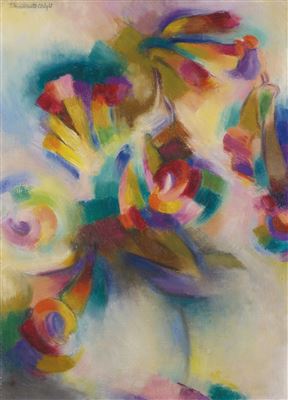 Stanton Macdonald-Wright was born in Charlottesville, Virginia in 1890 and grew up in a well-off hotel-managing family. His father treated him to painting lessons when he was five years old. Mystery writer S.S. Van Dine was his brother. At fifteen young Stanton rebelliously went to sea on a windjammer, and got so seasick that he was put off at Hawaii. Private detectives sent by his father brought him back home. His family solved his wanderlust by sending him off to Paris at sixteen to study art at the Sorbonne and the Beaux Arts, Colarossi and Julian Academies.
He and Morgan Russell developed the style they called Synchromism. The idea was that color generates form.
Returning to the United States, he lived in New York from 1914 to 1919, and then returned to Los Angeles where he turned from Synchromism to a more Oriental style. He also produced the first full-length motion picture in color.
MacDonald-Wright was a man given to confounding the experts. Art critics pronounced him through at thirty; his doctors, unable to diagnose a mysterious illness, gave up his case as hopeless at forty-seven. Both doctors and critics were wrong. He painted for many years with a rich, more serene art, with formal soaring movements and pure color that suggest visualized orchestral music.
In the 1930s, he was a seven-states regional director of the WPA art program, and one of his commissions was a very large mural of the Santa Monica Public Library. From 1942 to 1952 he taught iconography at the University of California at Los Angeles and after retiring divided his time between Los Angeles and Kyoto, Japan.
He died in 1973.
Written and submitted by Jean Ershler Schatz, artist and researcher from Laguna Woods, California.
Sources include:
Time Magazine, March 5, 1956
From the internet, AskART.comBiography from Caldwell Gallery Hudson
Stanton MacDonald-Wright was a well educated early Modernist. His first academic training was at the Art Students League in Los Angeles, 1904-05, and then he traveled to Paris to study from 1907 to 1909) at the Acadamie Julian, and then the Ecole Des Beaux Arts, 1909-1912. MacDonald-Wright is credited for inventing "Synchronism", a style in which form is generated by color.
According to this theory, the use of color was governed by natural laws that endow each color with its own character and emotional quality. He was active on the East Coast until his move to Santa Barbara in 1919, where he taught at the ASL for eight years.
He took up an interest in Eastern philosophy and approach to art, and his own work moved between pure abstraction to figuration throughout his career. MacDonald-Wright produced the first full-length, stop motion film ever made in full color for which he created 500 pastel drawings and designed synchromatic theater sets. He also served as the regional adviser in seven states for the WPA in the 19030s.Biography from Peyton Wright Gallery
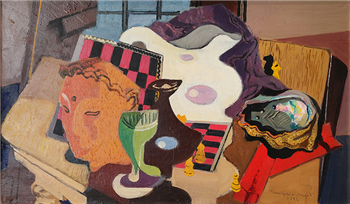 Stanton Macdonald-Wright
(American Painter, 1890-1973)
Stanton Macdonald-Wright (1890-1973) was one of America’s leading modernist painters and an early pioneer of abstract art. Born in Virginia and raised in southern California, he enrolled at the Art Students League in Los Angeles as a precocious thirteen-year-old. In 1907, while still a teenager, he married and then settled in Paris, studying at the * several art academies, including the Académie Colorossi* and the École des Beaux Arts*, and then privately with Percyval Hart-Tudor, who taught color theory in relation to music. Inspired chiefly by the works of Cézanne, Matisse, and the Cubists, Macdonald-Wright exhibited at the Salon d’Automne* in 1910 and at the Salon des Indépendents* in 1912.
Together with fellow American expatriate Morgan Russell, Macdonald-Wright co-founded the avant-garde painting movement Synchromism*, whose first exhibition was held in Munich in the summer of 1913 and the second in Paris during the fall of the same year. These were soon followed by shows in London, Milan, and Warsaw. And in early 1914 Synchromist paintings were exhibited for the first time in New York.
Similar to its rival Parisian movement Orphism, Synchromism combined color with Cubism, producing luminous and rhythmic compositions of swirling and serpentine forms infused with a rich chromatic palette. As Macdonald-Wright later described it, “Synchromism simply means ‘with color’ as symphony means ‘with sound’, and our idea was to produce an art whose genesis lay, not in objectivity, but in form produced in color”.
At the outbreak of World War I, Macdonald-Wright moved to London with his older sibling, Willard Huntington Wright, who was an editor and author. Sharing quarters there for the next two years, the brothers collaborated on three art books, including Modern Painting, Its Tendency and Meaning (1915), that were subsequently published in New York. After repatriating himself to the United States in 1915, Macdonald-Wright took up residence in New York, where he participated in the Forum Exhibition of Modern American Painters in 1916 and was given his first one-man show at Alfred Stieglitz’s “291” gallery* the following year. His Synchromist paintings had a direct and marked influence on the work of Thomas Hart Benton, Andrew Dasburg, Jan Matulka, Stuart Davis, Arnold Friedman, and Alfred Maurer.
Although successful in New York, Macdonald-Wright became increasingly dissatisfied with what he saw as the “sterile artistic formulism” of modern art and the “academicism” of his own Synchromism. Consequently, he permanently resettled in Santa Monica in 1919 and withdrew from the commercial art scene for the following three decades.
Instead, he became an active and energetic force in the southern Californian art world primarily as a teacher and administrator, all the while still continuing his artistic pursuits, which turned heavily toward Eastern representational models, especially Chinese painting. From 1922 to 1930 he served as Director of the Art Students League in Los Angeles, writing a student textbook entitled Treatise on Color (1924). During the late twenties and early thirties, he co-exhibited at several museums in California with Morgan Russell and had a one-man show at Stieglitz’s “An American Place” in New York in 1932.
He then worked for the WPA* Art Project as Director of Southern California and as Technical Advisor for seven western states from 1935 to 1942, during which time he personally completed several major civil art projects, including the murals at the Santa Monica City Hall. During World War II and up through 1952, Macdonald-Wright taught at UCLA, USC, Scripps College, and the University of Hawaii on the subjects of art history, Oriental aesthetics, and iconography. In 1952-53, he visited Japan as a Fulbright exchange professor and briefly lectured at Kyoiku Daigaku (Tokyo University of Education). Finally, in 1954, he retired from academia.
After a hiatus of more than thirty years, Macdonald-Wright returned to nonobjective* painting in the mid 1950s with renewed vigor and enthusiasm, producing some of his finest canvases. This new body of Neo-Synchromist work surpassed the artist’s earlier paintings by way of a heightened luminosity and augmented spatiality, creating as a result, in the opinion of the modern art champion, Alfred Barr, a deeper spirituality. As the artist himself described it,
“At first I saw my new painting with a certain astonishment, for I had made the “great circle,” coming back after 35 years to an art that was, superficially, not unlike the canvases of my youth. However, at bottom there was a great difference: I had achieved an interior realism, what is called yugen by the Japanese. This is a sense of reality which cannot be seen but which is evident by feeling, and I am certain that this quality of hidden reality was what I felt to be lacking in my younger days.”
From 1958 on, Macdonald-Wright spent five months each year at Kenninji, a Zen monastery in the center of Kyoto, Japan. One of the most fruitful outcomes of his exposure to Japanese poetry and art was the creation of the Haiga portfolio (1965-66), a suite of twenty Haiku illustrations in brilliant color that is a masterful synthesis of modernist art in the Synchromist style and the traditional technique of Japanese woodblock printing.
In 1967 the Smithsonian Institution’s National Collection of Fine Arts held a major retrospective exhibition on Macdonald-Wright, honoring his more than six decades of artistic achievement. During the remaining years of his life and up until his passing in 1973 at the age of 83, Macdonald-Wright continued to be productive and inventive, leaving as his legacy a large and diverse body of modernist painting, which has since taken its rightful place as being of premier importance in American twentieth-century art.
By Andrew Diversey
References:
Daviee, Jerry M. 1982. Stanton Macdonald-Wright: Watercolors and Drawings. San Francisco: The Art Museum Association.
Figoten, Sheldon. 1985. Stanton Macdonald-Wright: Paintings 1953-1964. Redding, CA: Redding Museum and Art Center.
Scott, David W. and Stanton Macdonald-Wright. 1967. The Art of Stanton Macdonald-Wright. Washington, D.C.: The Smithsonian Press.
South, Will. 2001. Color, Music, and Myth. Stanton Macdonald-Wright and Synchromism. Raleigh, NC: North Carolina Museum of Art.
Wight, Frederick. 1970. Stanton Macdonald-Wright: A Retrospective Exhibition 1911-1970. Los Angeles: The UCLA Art Galleries.
?
* For more in-depth information about these terms and others, see AskART.com. Glossary http://www.askart.com/AskART/lists/Art_Definition.aspxBiography from Tobey C. Moss Gallery
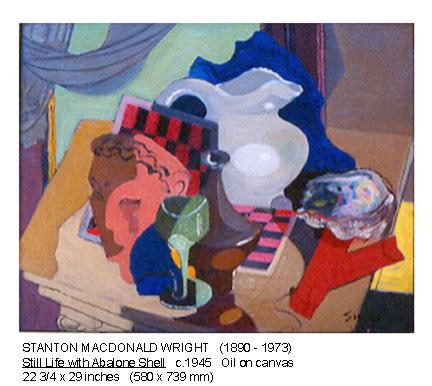 After studying at the Art Students League of Los Angeles, Stanton Macdonald-Wright, at the age of 17, moved to Paris to continue his training. With fellow artist Morgan Russell, he developed Synchromism:, an aesthetic philosophy of color perception: modernism. He described rhythmic abstracted forms in luminous layers of color that identified much of Macdonald-Wright's visual vocabulary.
With the advent of the World War I in 1916, Macdonald Wright joined his brother in New York. By 1919, he returned to Los Angeles, rejoined the Art Students League and took a position of leadership. In 1923, Macdonald Wright organized a landmark exhibition: "The Group of Independent Artists" uniting Los Angeles artists with his friends Thomas Hart Benton, Morgan Russell and others for a window on modernism.
From the mid-1920s through the 1930s, he turned to subjective composition, combining cubistic and synchromist elements. In the mid-1930s, as director of the mural division within the Southern California WPA/FAP, figuration predominated in his murals. Following World War II, he experienced an awakening interest in Cubism, Zen Buddhism and meditation. By 1950 he reaffirmed his Synchromist color theories and cited the light and landscape of southern California in his later work.
Stanton MacDonald Wright was an intellectual force, an artist, an administrator, an art historian, a teacher and a true leader within the Los Angeles modernist community.