Page loaded successfully. Showing biography for Theo Tobiasse.
Theo Tobiasse BIOGRAPHY
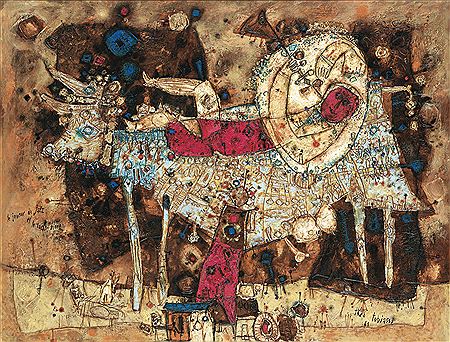
1927 Jaffa, Palestine - 2012. Known for: Childhood, fantasy and exile themed modernist, abstract painting, sculpture.
Theo Tobiasse was born in Israel of Lithuanian parents. Before he turned seven, his family moved to Paris due to financial difficulties. In Paris, he felt like a fish out of water. He didn't quite... Read full biography
Theo Tobiasse was born in Israel of Lithuanian parents. Before he turned seven, his family moved to Paris due to financial difficulties. In Paris, he felt like a fish out of water. He didn't quite fit in. Between the years of 1942 and 1944, the Germans occupied Paris. He and his family were forced... Read full biography
Theo Tobiasse was born in Israel of Lithuanian parents. Before he turned seven, his family moved to Paris due to financial difficulties. In Paris, he felt like a fish out of water. He didn't quite fit in. Between the years of 1942 and 1944, the Germans occupied Paris. He and his family were forced to live in solitary confinement with the constant fear of being discovered. The only things that kept Tobiasse sane were his books and his drawings. By the time it was safe to come out of hiding, he... Read full biography
Theo Tobiasse was born in Israel of Lithuanian parents. Before he turned seven, his family moved to Paris due to financial difficulties. In Paris, he felt like a fish out of water. He didn't quite fit in. Between the years of 1942 and 1944, the Germans occupied Paris. He and his family were forced to live in solitary confinement with the constant fear of being discovered. The only things that kept Tobiasse sane were his books and his drawings. By the time it was safe to come out of hiding, he had quite a portfolio put together. He attributes his works to his real-life experiences. He believes that because of these experiences, he has reached a place of perfect contentment and harmony. This is apparent in his works through the use of colors... Read full biography
Theo Tobiasse was born in Israel of Lithuanian parents. Before he turned seven, his family moved to Paris due to financial difficulties. In Paris, he felt like a fish out of water. He didn't quite fit in. Between the years of 1942 and 1944, the Germans occupied Paris. He and his family were forced to live in solitary confinement with the constant fear of being discovered. The only things that kept Tobiasse sane were his books and his drawings. By the time it was safe to come out of hiding, he had quite a portfolio put together. He attributes his works to his real-life experiences. He believes that because of these experiences, he has reached a place of perfect contentment and harmony. This is apparent in his works through the use of colors and textures. In 1950 he moved to Nice where he continued to paint. He had his first . exhibition at the Palais de le Mediterra... Read full biography
Artist Biography
Biography page for Theo Tobiasse ((1927 - 2012)), known for Childhood, fantasy and exile themed modernist, abstract painting, sculpture. Showing 3 biographical entries and 0 sample artworks.
Theo Tobiasse - Artist Info
About Theo Tobiasse
Biography from RoGallery
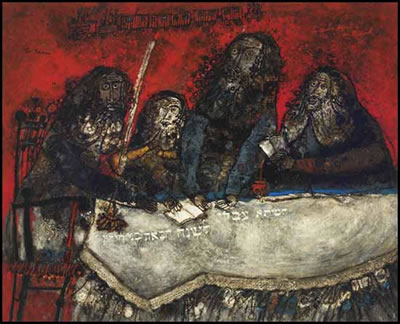 Theo Tobiasse was born in Israel of Lithuanian parents. Before he turned seven, his family moved to Paris due to financial difficulties. In Paris, he felt like a fish out of water. He didn't quite fit in.
Between the years of 1942 and 1944, the Germans occupied Paris. He and his family were forced to live in solitary confinement with the constant fear of being discovered. The only things that kept Tobiasse sane were his books and his drawings. By the time it was safe to come out of hiding, he had quite a portfolio put together.
He attributes his works to his real-life experiences. He believes that because of these experiences, he has reached a place of perfect contentment and harmony. This is apparent in his works through the use of colors and textures.
In 1950 he moved to Nice where he continued to paint. He had his first
exhibition at the Palais de le Mediterranee in 1961 where he also won the grand prize. This helped him to make the decision to quit his other career and devote his time entirely to art.
In 1960, his work was noticed at an exhibition of young artists at the Palais de la Mediterranee in Nice and he won first prize. From then on art galleries and collectors continued to show interest in his work, and by 1962 Theo Tobiasse was finally able to devote himself entirely to painting. In 1970, he moved into his studio on Quai Rauba-Capeu, overlooking the Port of Nice. In 1976 he moved again to St. Paul-de-Vence where he rediscovered both the sky of Jerusalem and that of Florence.
It was in Nice, the city he had adopted on leaving Paris, that his pictorial expression came into its own. Initially profane and close to certain bestiaries, his subjects rapidly evolved towards reminiscences about his childhood: buses that he had caught sight of on his journey to France, boats with wheels on the Nieman in Lithuania, tea kettles, the warmth of the fireside, the trains when he arrived in Paris at dawn, the smokiness of railway stations, etc.
All of these symbols were combined, quite extraordinarily, with Biblical or erotic fantasies and also with the theme of exile which had become his main interest over the previous few years. Often visible in his more recent work, the theme of exile took on a more dramatic dimension when it began to encompass not only past and present exiles, but the fear of exiles still to come. This background subject, currently his main preoccupation, is woven out of women, children, crowds, but also candelabra, which represent the glow of hope.
Since 1980, Theo Tobiasse has travelled a great deal in the United States. On a detour, via Mexico, he discovered the impressive Aztec sites of the Yucatan, whose sculptures and engraved stones left their mark on him for a certain period. Fascinated by New York, he decided to find a place where he could work for several months every year.
Thus, he now divides his time between St. Paul-de-Vence and New York. Many exhibitions and one-man shows have been held throughout the world, providing milestones for his work that is to be found in the catalogues of many International museums. Theo Tobiasse has created monumental works such as the fountain entitled L'Enfant fou for the Arenas Business Centre at Nice Airport, and stained-glass windows for various institutions in Strasbourg and Nice.
He also designed costumes and stage-set models for Bernard Shaw's "Pygmalion". He has filled many sketchbooks, some of which have been published, and created illustrated works for lovers of fine books, plus etchings and engravings. Theo Tobiasse also discovered a passion for ceramics, producing pottery and dishes, as well as a series of small bronze sculptures. Several monographs have been published on Theo Tobiasse's work.
His works have been on exhibition throughout the western world and Japan.
Tobiasse has also worked in etching, lithography and many more mediums.
Jaime Villamarin
Assistant Gallery Director,
Rogallery.com
New York CityBiography from Oise Encheres, Chantilly
Théo Tobiasse was born in Israel in 1927 to parents who had just arrived from Lithuania. Insurmountable material difficulties push the family to Kowno, then to Paris, where his father, a typographer, hopes for work. Théo Tobiasse is six years old; this exhausting, interminable journey, this "displacement", left the painter's entire work with the scent of exile. His difference, his accent, the look of "the other", will force Tobiasse to rely only on himself.
In times of war, Paris is under the Nazi boot. Tobiasse spends a very brief time at the School of Decorative Arts, before discriminatory laws force him to go into hiding; the Tobiasse family will remain cloistered for two long years in their tiny apartment. When the day is reborn, Théo Tobiasse has built up an important file of drawings that he made during his imprisonment.
He designs and creates luxury displays, produces numerous boxes of tapestries; for more than fifteen years, Théo Tobiasse will make advertising creations, in Paris first, then in Nice where he settles in 1950. As soon as he can, often at night, he paints. He was noticed in 1960 during an exhibition of young painters in Nice.
Théo Tobiasse decided to devote himself to painting in 1962. His themes, at first secular, quickly evolve into reminiscences of his childhood, certain elements of which in the artist become true symbols. These “pictorial words”, specific to the artist, will mingle with biblical themes, the recurring theme of exile, and erotic fantasies. Tobiasse's work speaks of the past, no doubt to better prevent the future.
His canvases, like his important work on paper (engravings, lithographs, drawings), are woven with crowds, women, children, sun, stars, but also candelabra which are the lights of hope. Passionate about art and life, relentless in his work, the painter Tobiasse serious, sculpts, models, writes - holding fantastic notebooks day by day -, creates ceramics, bronzes, draws, creates frescoes, stained glass windows, etc.Biography from Dobiaschofsky Auktionen
Théo Tobiasse came from a Lithuanian-Jewish immigrant family who moved to Paris in 1931 for economic reasons. Here Tobiasse completed an apprenticeship at the École des Arts Décoratifs, which was interrupted by the outbreak of World War II. The family lived hidden in the French metropolis for over two years without ever leaving the small apartment or even lighting it up. The time was spent reading, drawing and playing chess, and Tobiasse built up a huge pool of drawings from which he could later draw.
After the end of the war, he worked as a graphic designer for the Hermès company in Paris and Nice for 15 years. He also painted, mostly at night. After his first successful exhibition appearance in Nice, he decided to pursue a career as a freelance artist. His work, which was inspired by the Nouvelle École de Paris, quickly found international recognition and won awards such as the Dorothy Gould Prize in 1961.
In 1976 he moved his studio to Saint-Paul-de-Vence, and from 1980 he traveled regularly to New York, where he stayed for several months each year. He was close to his friends and supporters, the art dealers Kenneth and Sherri Nahan. The paintings and prints by Théo Tobiasse, comparable to those by Marc Chagall, often contain themes from Jewish culture, contain allusions to biblical content and deal with erotic fantasies as well as themes of loneliness and isolation. The artist contrasted the often difficult subject matter of his works with a dance-like, flowing language of forms and bright colors.