Page loaded successfully. Showing biography for Thomas Benrimo.
Thomas Benrimo BIOGRAPHY
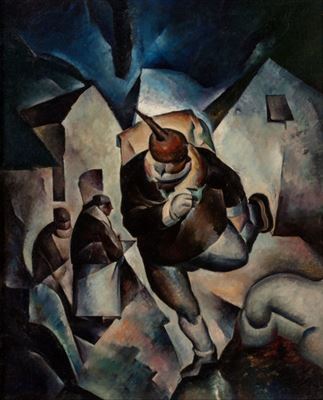
1887 San Francisco, California - 1958 Taos, New Mexico. Known for: Surreal, modernist-leaning landscape, illustration.
Born in San Francisco in 1887, Thomas Benrimo began to draw at a young age, but the San Francisco earthquake and fire of 1906 destroyed his early drawings and notebooks and forced the family to move... Read full biography
Born in San Francisco in 1887, Thomas Benrimo began to draw at a young age, but the San Francisco earthquake and fire of 1906 destroyed his early drawings and notebooks and forced the family to move to New York. Despite suffering from tuberculosis, Benrimo recovered and became a successful stage... Read full biography
Born in San Francisco in 1887, Thomas Benrimo began to draw at a young age, but the San Francisco earthquake and fire of 1906 destroyed his early drawings and notebooks and forced the family to move to New York. Despite suffering from tuberculosis, Benrimo recovered and became a successful stage designer and commercial artist in New York. He painted seriously whenever he could, but only a few of the Cubist paintings of this early period survive. Benrimo taught at Pratt Institute and was one of... Read full biography
Born in San Francisco in 1887, Thomas Benrimo began to draw at a young age, but the San Francisco earthquake and fire of 1906 destroyed his early drawings and notebooks and forced the family to move to New York. Despite suffering from tuberculosis, Benrimo recovered and became a successful stage designer and commercial artist in New York. He painted seriously whenever he could, but only a few of the Cubist paintings of this early period survive. Benrimo taught at Pratt Institute and was one of the first in this country to introduce the teaching methods developed at the German Bauhaus School of design. Benrimo moved to Taos, New Mexico, in 1939, and was able at last to paint full-time. His work evolved through periods of Cubism and... Read full biography
Born in San Francisco in 1887, Thomas Benrimo began to draw at a young age, but the San Francisco earthquake and fire of 1906 destroyed his early drawings and notebooks and forced the family to move to New York. Despite suffering from tuberculosis, Benrimo recovered and became a successful stage designer and commercial artist in New York. He painted seriously whenever he could, but only a few of the Cubist paintings of this early period survive. Benrimo taught at Pratt Institute and was one of the first in this country to introduce the teaching methods developed at the German Bauhaus School of design. Benrimo moved to Taos, New Mexico, in 1939, and was able at last to paint full-time. His work evolved through periods of Cubism and Surrealism and pure abstraction, often showing influences of antiquity, traditional painting and architecture, yet the... Read full biography
Artist Biography
Biography page for Thomas Benrimo ((1887 - 1958)), known for Surreal, modernist-leaning landscape, illustration. Showing 3 biographical entries and 0 sample artworks.
Thomas Benrimo - Artist Info
About Thomas Benrimo
Biography from the Archives of askART
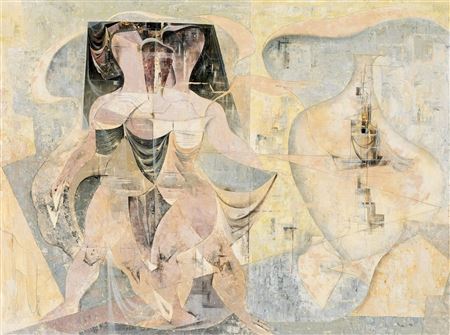 Born in San Francisco in 1887, Thomas Benrimo began to draw at a young age, but the San Francisco earthquake and fire of 1906 destroyed his early drawings and notebooks and forced the family to move to New York.
Despite suffering from tuberculosis, Benrimo recovered and became a successful stage designer and commercial artist in New York. He painted seriously whenever he could, but only a few of the Cubist paintings of this early period survive. Benrimo taught at Pratt Institute and was one of the first in this country to introduce the teaching methods developed at the German Bauhaus School of design.
Benrimo moved to Taos, New Mexico, in 1939, and was able at last to paint full-time. His work evolved through periods of Cubism and Surrealism and pure abstraction, often showing influences of antiquity, traditional painting and architecture, yet the artist believed, as he had once observed, that "abstract art departs from reality and nature only to draw far-reaching conclusions about reality. A legitimate abstract work of art can be produced only on the basis of a profound knowledge of nature." Benrimo was influenced by the landscape of New Mexico but not chained or restricted by it.
As Benrimo gradually worked from the surreal to the more abstract, he explored a series of classic images based often on Greek tragic masks. In a Canfield Gallery exhibition catalogue, the New Mexico artist Earl Stroh writes: "The greater formal discipline of classic motifs, based on themes from the literature of Greece and Rome (he read and reread the Greek and Latin poets and dramatistsVirgil, Ovid, etc.) on an acute absorption of the visual ideas of Mediterranean art, helped him to free himself from the more literal rendering of his ideas and to achieve that lyric, almost romantic, exactness that gives his finest work its contained clarity. It is mostly this particular combination of the romantic and the classic modes of feeling that gives his art its unique quality. One of the principal things that really creative art contributes to our lives is some new vision of the marriage of what are, until that moment, considered as opposites. This union of contrasts, both formal and significant, occupied him greatly."
During his life, Benrimo's work was shown at the Art Institute of Chicago, Toledo Museum of Art, Carnegie Institute of Pittsburgh, San Francisco Palace of the Legion of Honor, Whitney Museum of American Art, Musée National d'Art Moderne in Paris, Guggenheim Museum in New York, San Francisco Museum of Art, and the Museum of Modern Art in New York.
Benrimo paintings are in the permanent collections of the Cincinnati Museum of Art, Denver Art Museum, Fort Worth Museum of Modern of Art, and the Whitney Museum of Art. In New Mexico, Benrimo's work is in the Harwood Museum, Taos; Wurlitzer Foundation, Taos; University of New Mexico Museum of Art, Albuquerque; Roswell Museum and Art Center, and the Fine Arts Museum in Santa Fe.
Source:
Canfield Gallery,Biography from the Archives of askART
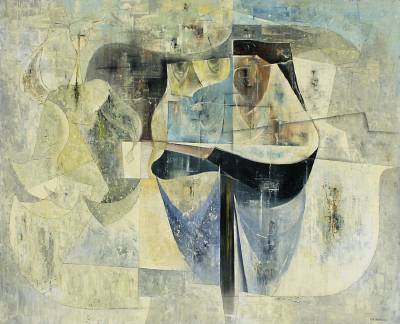 Born in San Francisco, Benrimo studied in New York at the Art Students League, then worked as a theatrical designer. He designed the stage set for Shakespeare's The Tempest, as produced by John Corbin.
Beginning in 1916, he served as a ship camouflage designer, working with William Andrew Mackay. According to Witt (2002:72-73): "Benrimo became a lecturer in camouflage methods, training others in this art while at the same time gaining experience valuable to his later teaching career. Using tape measures, chalk lines, and rules, the camoufleur marked out the design on the ship and supervised quality control in the actual paint application… [Benrimo] apparently thought this design experience important because he kept his lectures notes and drawings" (pp. 72-73). Reproduced in the same book is a page from Benrimo's camouflage notes, with drawings of dazzle camouflage schemes.
He taught at Pratt Institute from 1935 to 1939, where one of his students was graphic designer Gene Federico (who also was a camoufleur during World War II). Among his colleagues was his future wife, Dorothy, a jewelry designer who taught industrial design. They soon married and, in 1939, due to health problems, they moved to Taos NM, where they lived and worked for the rest of their lives. In Witt (2002), Benrimo is said to have been "well versed in the design principles of the German Bauhaus. His reputation as a design teacher continued even after he moved from New York. Laszlo Moholy-Nagy, founder of the New Bauhaus art school in Chicago, apparently invited him to take a position at the school some years after his move to Taos," but Benrimo declined (p. 74).
In 1952, Dallas TX art dealer Donald S. Vogel mounted a solo exhibition of twenty Benrimo paintings, accompanied by a twelve-page catalog, with a foreword by Merle Armitage (Vogel 2000).
Sources:
Roy R. Behrens (2009), "Thomas (Duncan) Benrimo" entry in Camoupedia: A Compendium of Research on Art, Architecture and Camouflage. Dysart IA: Bobolink Books.
Vogel, Donald S. (2000). Memories and Images: The World of Donald Vogel and Valley House Gallery. University of North Texas Press.
Witt, David L. (2002). Modernists in Taos: From Dasburg to Martin. Santa Fe NM: Red Crane Books.
Submitted by Roy R. BehrensBiography from the Archives of askART
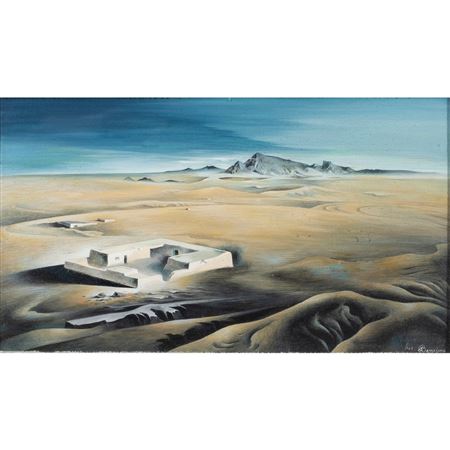 Born in San Francisco, California, Thomas Benrimo was an abstract and surrealist painter of the 20th century and a key figure among Taos modernist painters. He was largely self-taught but studied at the Art Students League in New York and was deeply influenced by the Armory Show of 1913, where modernist art from Europe was introduced in the United States.
Beginning 1916, he served as a ship camouflage designer, working with William Andrew Mackay. In this process he used a tape measure, put chalk lines on the ships and marked out the designs. He also became a lecturer in camouflage methods
His work expressed two sides of his nature, raw energy and the search for order in a chaotic world. As a child, he was exposed to the untamed life of San Francisco, and later recalled runaway horses attached to huge beer wagons, wooden sidewalks on fire, and fighting in open-door saloons on the waterfront.
He loved theatre and designed theater stage sets in New York. He also tended animals in traveling shows, rode in motorcycle races, and was a successful commercial artist. He taught at Pratt Institute in Brooklyn from 1935 to 1939 and then devoted himself to fine-art painting, moving from New York to New Mexico.
In 1954, a major painting by him was included in the landmark New York show at the Guggenheim Museum's exhibition of "Younger American Artists," of which he was the oldest included but in style and philosophy was among the most innovative.
Benrimo died in 1958 in Taos, where he had lived since 1939.
Sources include Camoupedia by Roy R. Behrens