Page loaded successfully. Showing biography for Thomas Sidney Cooper.
Thomas Sidney Cooper BIOGRAPHY
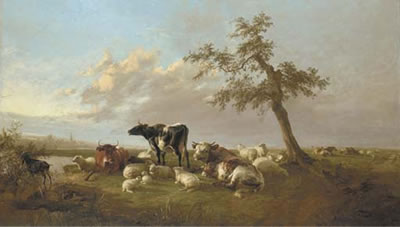
1803 Canterbury, England - 1902 Vernon Holme, England. Known for: Bucolic landscape painting with cattle.
In his hometown of Canterbury, England, Thomas Sidney Cooper became one of England's most prominent mid 19th century painters, with his signature work being bucolic landscapes with cattle and sheep.... Read full biography
In his hometown of Canterbury, England, Thomas Sidney Cooper became one of England's most prominent mid 19th century painters, with his signature work being bucolic landscapes with cattle and sheep. He began painting in Canterbury as an employee of a carriage painter and also in the theatre as a... Read full biography
In his hometown of Canterbury, England, Thomas Sidney Cooper became one of England's most prominent mid 19th century painters, with his signature work being bucolic landscapes with cattle and sheep. He began painting in Canterbury as an employee of a carriage painter and also in the theatre as a painter of backdrops. His talent was recognized, and he was invited to become a student at the Royal Academy in London, where he was especially encouraged by portrait painter Sir Thomas Lawrence... Read full biography
In his hometown of Canterbury, England, Thomas Sidney Cooper became one of England's most prominent mid 19th century painters, with his signature work being bucolic landscapes with cattle and sheep. He began painting in Canterbury as an employee of a carriage painter and also in the theatre as a painter of backdrops. His talent was recognized, and he was invited to become a student at the Royal Academy in London, where he was especially encouraged by portrait painter Sir Thomas Lawrence (1769-1830). Cooper also spent four years in Brussels. There he became very impressed with the painting of peaceful landscape and marine genre scenes of Aelbert Cuyp (1620-1691 and other Dutch Old Masters, especially the ones who did landscapes with... Read full biography
In his hometown of Canterbury, England, Thomas Sidney Cooper became one of England's most prominent mid 19th century painters, with his signature work being bucolic landscapes with cattle and sheep. He began painting in Canterbury as an employee of a carriage painter and also in the theatre as a painter of backdrops. His talent was recognized, and he was invited to become a student at the Royal Academy in London, where he was especially encouraged by portrait painter Sir Thomas Lawrence (1769-1830). Cooper also spent four years in Brussels. There he became very impressed with the painting of peaceful landscape and marine genre scenes of Aelbert Cuyp (1620-1691 and other Dutch Old Masters, especially the ones who did landscapes with billowing skies and grazing cattle. It was a motif he adopted for his own work. He was also much infl... Read full biography
Artist Biography
Biography page for Thomas Sidney Cooper ((1803 - 1902)), known for Bucolic landscape painting with cattle. Showing 1 biographical entries and 0 sample artworks.
Thomas Sidney Cooper - Artist Info
About Thomas Sidney Cooper
Biography from the Archives of askART
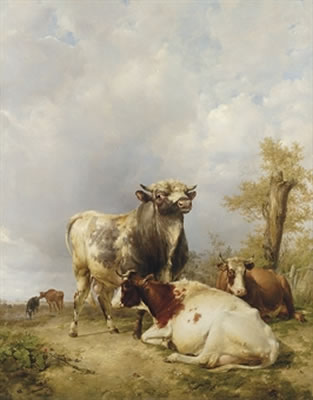 In his hometown of Canterbury, England, Thomas Sidney Cooper became one of England's most prominent mid 19th century painters, with his signature work being bucolic landscapes with cattle and sheep.
He began painting in Canterbury as an employee of a carriage painter and also in the theatre as a painter of backdrops. His talent was recognized, and he was invited to become a student at the Royal Academy in London, where he was especially encouraged by portrait painter Sir Thomas Lawrence (1769-1830).
Cooper also spent four years in Brussels. There he became very impressed with the painting of peaceful landscape and marine genre scenes of Aelbert Cuyp (1620-1691 and other Dutch Old Masters, especially the ones who did landscapes with billowing skies and grazing cattle. It was a motif he adopted for his own work. He was also much influenced by the brightness of the palette of Belgian artist, Eugene Veroeckhoven (1798-1881).
As his career progressed from the time he returned to London in 1831, Thomas Sidney Cooper became known as "Cow Cooper because of the many precisely painted bucolic landscapes he did with grazing cattle, "some what sanitized so as not to offend urban clients, but also monumental enough to delight country squires who loved their livestock." Cooper also painted sheep onto his canvases.
The best years of his career in terms of public attention were the 1840s and 1850s, which was during a period when Prince Albert and Queen Victoria commissioned him to paint their herds.
He became a regular exhibiter at the Royal Academy. "No one has broken his record of sending at least one picture to the Royal Academy of Arts summer exhibition every year from 1833 to 1902---a total of 266 entries."
In 1882, he founded an art school in Canterbury, and his work is at the Canterbury Royal Museum.
Source:
"At Either End of the Market", Fine Art Connoisseur, January, 2007, p. 26