Page loaded successfully. Showing biography for Vin Hannell.
Vin Hannell BIOGRAPHY
1896 Negaunee, Michigan - 1964. Known for: Modernist painting, wood sculpture, printmaking, pottery.
Vin (Vaino) Hannell, Finnish-American, 1896-1964. Vaino Hannell, an immigrant from Finland where he grew up and attended the Academy of Fine Arts in Åbo, is considered a pioneering Chicago Modern... Read full biography
Vin (Vaino) Hannell, Finnish-American, 1896-1964. Vaino Hannell, an immigrant from Finland where he grew up and attended the Academy of Fine Arts in Åbo, is considered a pioneering Chicago Modern Artist of the early 20th century. After being raised by his Uncle in Finland, he returned to his family... Read full biography
Vin (Vaino) Hannell, Finnish-American, 1896-1964. Vaino Hannell, an immigrant from Finland where he grew up and attended the Academy of Fine Arts in Åbo, is considered a pioneering Chicago Modern Artist of the early 20th century. After being raised by his Uncle in Finland, he returned to his family in America and enlisted in US Navy Medical corps at the outbreak of WWI. He lost his eye in a laboratory accident and was supported by a government pension for his wound. In 1923 he married fellow... Read full biography
Vin (Vaino) Hannell, Finnish-American, 1896-1964. Vaino Hannell, an immigrant from Finland where he grew up and attended the Academy of Fine Arts in Åbo, is considered a pioneering Chicago Modern Artist of the early 20th century. After being raised by his Uncle in Finland, he returned to his family in America and enlisted in US Navy Medical corps at the outbreak of WWI. He lost his eye in a laboratory accident and was supported by a government pension for his wound. In 1923 he married fellow artist Hazel Johnson, moved to Chicago and become part of the "Ten Artists" collective, a group whose modernist impulse was driven by their teacher at the Chicago Art Institute, Saul Bellows. This modernism developed in a time when the city was a... Read full biography
Vin (Vaino) Hannell, Finnish-American, 1896-1964. Vaino Hannell, an immigrant from Finland where he grew up and attended the Academy of Fine Arts in Åbo, is considered a pioneering Chicago Modern Artist of the early 20th century. After being raised by his Uncle in Finland, he returned to his family in America and enlisted in US Navy Medical corps at the outbreak of WWI. He lost his eye in a laboratory accident and was supported by a government pension for his wound. In 1923 he married fellow artist Hazel Johnson, moved to Chicago and become part of the "Ten Artists" collective, a group whose modernist impulse was driven by their teacher at the Chicago Art Institute, Saul Bellows. This modernism developed in a time when the city was a bustling scene of theater, art, music, and literature of new impulses. The interconnections therein provided inspiration for these... Read full biography
Artist Biography
Biography page for Vin Hannell ((1896 - 1964)), known for Modernist painting, wood sculpture, printmaking, pottery. Showing 1 biographical entries and 0 sample artworks.
Vin Hannell - Artist Info
About Vin Hannell
Name variants
Vaino Mathies Seth Hannell, Vinol Hannell, VMS Hannell
Biography from Brauer Museum of Art, Valparaiso University
Vin (Vaino) Hannell, Finnish-American, 1896-1964
Vaino Hannell, an immigrant from Finland where he grew up and attended the Academy of Fine Arts in Åbo, is considered a pioneering Chicago Modern Artist of the early 20th century. After being raised by his Uncle in Finland, he returned to his family in America and enlisted in US Navy Medical corps at the outbreak of WWI. He lost his eye in a laboratory accident and was supported by a government pension for his wound. In 1923 he married fellow artist Hazel Johnson, moved to Chicago and become part of the "Ten Artists" collective, a group whose modernist impulse was driven by their teacher at the Chicago Art Institute, Saul Bellows.
This modernism developed in a time when the city was a bustling scene of theater, art, music, and literature of new impulses. The interconnections therein provided inspiration for these artists to treat real life, to utilize subjects and landscapes of their world, even as a kind of anti-academic push. The Chicago Modern artists formed no "school" - they themselves were of varied backgrounds and ethnicities - and in fact created the No-Jury Society of Artists to allow any artist to exhibit his or her work. These artists were rather united in their variousness, and a distinct modern realism that sought to truthfully represent the world in a modern age. In a catalog from the Marshall Fields Galleries exhibition distinguishes the "Ten Artists" as "sane modernists" who draw from their academic training without falling "subservient to any 'master' or 'ism.'" The catalog goes on further to describe that these artists feel "a picture should express a personal experience or reaction," that rather than "shutting themselves away from 'influences,' either foreign or national, they rather welcome whatever will make their art richer." The artists thus sought universality in the natural and urban landscape, just as they admitted and shared any influences on their style and representation. The collective reveals a motif throughout Vin's life: that art is a necessarily community-built philosophy.
During this period, Vin Hannell achieved moderate success as a part of this Modern collective. He was part of the Depression-era Federal Art Project and honored with a mural commission for the Women's Athletic Club in Chicago. In 1934 he received First in Sculpture at the Northern Indiana Arts Salon as well as the Harris Prize from the Chicago & Vicinity Art Exhibition at the Art Institute. He exhibited at the Chicago Art Institute and the Brooklyn Museum of Art in 1926, the Whitney Museum of Art in 1927, and from the 20s through the 40s in the Marshall Field Galleries as a part of the "Ten Artists," including fellow artists Emil Armin, Francis Strain, and Fred Biesel.
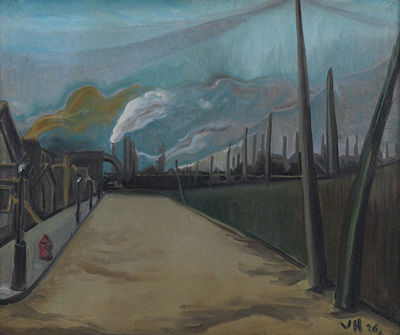
Vin's work on paper and canvas through this period includes numerous scapes - cityscapes, landscapes, or farmscapes - wherein the human is often ambiguous, faceless, or absent. This ambiguity, indeed the ashen veneer of many of his subjects, speaks to a Modernist sense of isolation. The human figure becomes as a minute creature in a landscape of towering buildings and toy-like cars as in his Old South Water Street (1929), which along with Production Line (1935) is held in the Brauer Museum of Art's permanent collection. Production Line reveals a tangled mass of arms and chains and metal; the sinuous forms merge in a hypnotic tension of muscle against steel. Even more interesting is the equality of figures, each of a different shade of skin but each fleshy, round, muscular, and literally depicted as chained to the oppressive labor of the factory. This theme points more to the conditions of lower class, often immigrant laborers whose jobs were labor-intensive. Vin's paintings steer towards a Realist perspective which is revelatory rather than didactic, in simple gouache or watercolor strokes and shapes.
There is no distinct "Vin" style because the very mark of his career is diversity of style and genre. Recurring motifs in his work and life include a realistic depiction of lower and middle class working life, the city, the Midwestern landscape, and artistic community. His work reveals a great variety of styles and influences, whether the Futurist circles and geometric figural shapes of Production Line or the organic, nature-inspired forms of his later wood sculpture. This later wood sculpture draws back perhaps to his Finnish ancestry, referencing not only Finland's artisan craft tradition but the very physical labor that immigrants often accepted in working in America. The carving down of wood is a necessarily laborious task, just as the work of collecting clay and forming the ceramics of his pottery business with his wife. Production Line itself predicts the kind of factory-like process of the Hannell pottery business which the two relied on to make a living as poor artists. Ironically, Vin sought to document the mechanical transformations of Modernism while himself relying on them to support his creation of art.
Vin's later life with his wife Hazel focused on preserving the Dunes landscape not merely through their support of Save the Dunes but through the act of cataloguing through their artwork. Starting the Chesterton Art Fair, helping found the Association of Artists and Craftsmen of Porter County and acting as active members of the No-Jury Society of Artists reveals their devotion to not only allowing more artists to exhibit their work, but to establish the significance of regional artists and artwork and the community surrounding them. The kiln and studio (which Vin designed) in Furnessville, Indiana served not merely as a working retreat as a locus of artistic community in Northwest Indiana. Vin's work embraces the modernity with which post WWI American life rapidly changed, while yet cataloguing a dying landscape of dunes, factories, and laborers as seen in his time. As Vin describes: "the work of an artist is peculiar to his city and his country . . . it is, as part and parcel of the artist himself" (Jacobsen Art of Today). The wood sculpture work that takes up the latter part of his life seems as an organic, biotic push towards craft and the natural elements of the surrounding dunescape even as modernity advanced onwards.
The Brauer Museum of Art at Valparaiso University retains a collection of twenty-two of Vin's works in print, painting, and sculpture. The museum's 1994 exhibition "Hazel and Vin Hannell: Two Lives in Art" payed homage to the enduring influence of the artist couple of Vin and Hazel on preserving and celebrating the art and landscape of Northwestern Indiana.
Submitted by Gregory Maher, Researcher
Brauer Museum of Art, 2014
Sources
A Bit About Them. Exhibition catalog, Ten Artists Exhibition. Chicago, IL: Marshall Fields & Co. Picture Galleries, 1931/32.
Adams, Robert. Chicago Modernist Artists. Exhibition catalog, Song of Chicago: An Exhibition of Urban Images Between the World Wars. Valparaiso, IN: Sloan Gallery, Moellering Library, VU Museum of Art, 1991. Print.
Hannell, V.M.S. "V.M.S. Hannell." Art of Today: Chicago, 1933. Comp. J. Z. Jacobson. Chicago: L.M. Stein, 1932. 75. Print.
Kuhr, Faye H. and Ligocki, Gordon. Exhibition catalog, Vintage Calumet : Regional Artwork, 1935-1965 : Celebrating the Artistic Tradition of Northwest Indiana. Munster, IN: Northern Indiana Arts Association, 1989. Print.
McLaughlin, Jane A. "The Angelus Bell Tower and Mary Garden in Woods Hole." Spiritsail 1992: 2-19. Woods Hole Museum Archives. Web.
Scanlan, Patricia S. "Vinol Hannell." Modernism in the New City: Chicago Artists, 1920-1950. Bernard Friedman, 2014. Web.
Weininger, Susan S. Hazel and Vin Hannell: Two Lives in Art: A Retrospective Exhibit of Paintings, Prints, Sculpture and Pottery. Exhibition Catalogue, Valparaiso, IN: Wesemann Hall Atrium, Valparaiso University School of Law, VU Museum of Art, 1994. Print.