Page loaded successfully. Showing biography for Wadsworth Jarrell.
Wadsworth Jarrell BIOGRAPHY
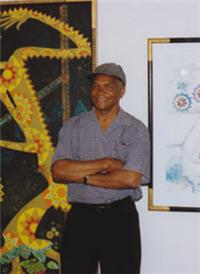
Born 1929 Albany, Georgia. Known for: Abstract painting, elongated figures, playful children, African-American themes.
Wadsworth Jarrell (1929 - ) . Born in Albany, Georgia,Wadsworth Jarrell's artworks continue to capture recurring themes of the working life of African-Americans in Chicago, as well as the sights and... Read full biography
Wadsworth Jarrell (1929 - ) . Born in Albany, Georgia,Wadsworth Jarrell's artworks continue to capture recurring themes of the working life of African-Americans in Chicago, as well as the sights and sounds of jazz musicians. After serving in Korea with the U.S. Army, Jarrell moved to Chicago and,... Read full biography
Wadsworth Jarrell (1929 - ) . Born in Albany, Georgia,Wadsworth Jarrell's artworks continue to capture recurring themes of the working life of African-Americans in Chicago, as well as the sights and sounds of jazz musicians. After serving in Korea with the U.S. Army, Jarrell moved to Chicago and, inspired by his first museum visits, enrolled in the School of the Art Institute of Chicago (1954-58). In the late 1960's, he opened WJ Studio and Gallery, where he hosted regional artists and... Read full biography
Wadsworth Jarrell (1929 - ) . Born in Albany, Georgia,Wadsworth Jarrell's artworks continue to capture recurring themes of the working life of African-Americans in Chicago, as well as the sights and sounds of jazz musicians. After serving in Korea with the U.S. Army, Jarrell moved to Chicago and, inspired by his first museum visits, enrolled in the School of the Art Institute of Chicago (1954-58). In the late 1960's, he opened WJ Studio and Gallery, where he hosted regional artists and musicians. His gallery became an important focal point for African-American art in Chicago . In the mid 1960's, following tumultuous local racial violence, Jarrell became involved in the Organization of Black American Culture. Together in 1967, they created... Read full biography
Wadsworth Jarrell (1929 - ) . Born in Albany, Georgia,Wadsworth Jarrell's artworks continue to capture recurring themes of the working life of African-Americans in Chicago, as well as the sights and sounds of jazz musicians. After serving in Korea with the U.S. Army, Jarrell moved to Chicago and, inspired by his first museum visits, enrolled in the School of the Art Institute of Chicago (1954-58). In the late 1960's, he opened WJ Studio and Gallery, where he hosted regional artists and musicians. His gallery became an important focal point for African-American art in Chicago . In the mid 1960's, following tumultuous local racial violence, Jarrell became involved in the Organization of Black American Culture. Together in 1967, they created "The Wall of Respect", a mural depicting African-American heroes. For his part, he focused on rhythm and... Read full biography
Artist Biography
Biography page for Wadsworth Jarrell ((Born 1929)), known for Abstract painting, elongated figures, playful children, African-American themes. Showing 3 biographical entries and 0 sample artworks.
Wadsworth Jarrell - Artist Info
About Wadsworth Jarrell
Biography from the Archives of askART
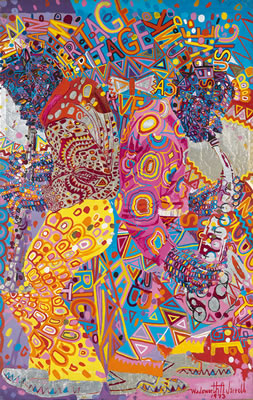 Wadsworth Jarrell (1929 - )
Born in Albany, Georgia,Wadsworth Jarrell's artworks continue to capture recurring themes of the working life of African-Americans in Chicago, as well as the sights and sounds of jazz musicians.
After serving in Korea with the U.S. Army, Jarrell moved to Chicago and, inspired by his first museum visits, enrolled in the School of the Art Institute of Chicago (1954-58). In the late 1960's, he opened WJ Studio and Gallery, where he hosted regional artists and musicians. His gallery became an important focal point for African-American art in Chicago .
In the mid 1960's, following tumultuous local racial violence, Jarrell became involved in the Organization of Black American Culture. Together in 1967, they created "The Wall of Respect", a mural depicting African-American heroes. For his part, he focused on rhythm and blues, featuring portrayals of James Brown, B.B. King, Billie Holiday, Muddy Waters, Aretha Franklin, and Dinah Washington. In 1969, he co-founded AFRICOBRA: African Commune of Bad Relevant Artists. The group showed extensively, becoming known for sociopolitical themes and use of "coolade colors."
Jarrell continues to explore the contemporary African-American experience through paintings, sculptures, and prints. His work is found at the National Museum of African-American History and Culture, the High Museum of Art, The Studio Museum in Harlem, and the University of Delaware.
Source:
Dan Ripley's Antique HelperBiography from The Johnson Collection
WADSWORTH AIKENS JARRELL (born 1929)
Wadsworth Jarrell’s career unfolded alongside the Civil Rights Movement and Black Arts Movement of the mid-1960s, culminating in his pivotal role as a co-founder of the groundbreaking African American arts collective AFRICOBRA. From the outset, Jarrell and his fellow members sought to develop, define, and disperse a distinct Black aesthetic, "an unequivocal visual vernacular rooted in a shared heritage, philosophy, political ideology, and expressive imagery."
Wadsworth Aikens Jarrell grew up as the youngest of six children living in the rural outskirts of Athens, Georgia. As a teenager, his interest in art was fueled by self-directed study of popular illustrated magazines of the day, such as the Saturday Evening Post and Collier’s. Following high school graduation, Jarrell was drafted into the US Army and stationed first in Louisiana, where he served as a company artist; he was subsequently deployed to Korea as a cannoneer. Upon his military discharge in 1953, he moved to Chicago and immersed himself in the lively cultural scene, particularly jazz and blues performances.
Jarrell enrolled at the School of the Art Institute of Chicago in 1954 and received a degree in advertising art and graphic design in 1958. By that point, however, his passion had shifted toward fine art. He spent the next year honing his painting skills during the day and working nights at a paint manufacturing plant. Throughout his professional life, Jarrell would struggle to balance his desire to be an independent artist against the need for reliable income. This concern found its match in Jarrell’s entrepreneurial spirit. Over the years, he would own or co-own an art gallery, educational toy company, and a mail-order business, in addition to his teaching roles at Howard University (1971–1977), Spelman College (1985), and the University of Georgia (1978–1988). He was employed as a commercial artist and photographer at various times and, during his tenure at Howard, earned an MFA.
When Jarrell settled in Chicago in 1953, he confronted the same pervasive prejudice he had known in the South: “It became obvious to me that regardless of which state I lived in, bigotry would follow me like a shadow.” The 1955 murder of Emmett Till, Dr. Martin Luther King’s protest marches, the Detroit riots, and the violence of the Civil Rights era ignited a “revolutionary” instinct in Jarrell—a call to liberate his art-making from white, Western paradigms in favor of a wholly Black aesthetic.
As a member of the Organization of Black American Culture (OBAC), Jarrell contributed to Chicago’s now-famous Wall of Respect (1967), a large-scale mural celebrating African American heroes. OBAC’s subsequent dissolution led to the 1968 formation of COBRA, the Coalition of Black Revolutionary Artists, which was renamed AFRICOBRA the following year. The group, co-founded by Jeff Donaldson, among other artists, was committed to using new philosophical and technical idioms to illuminate the Black experience in America. These principles specified the use of bright, harmonious “Cool Ade” colors; “literal and figurative” luminosity; the “arbitrary use of light and line;” “free symmetry;” “making use of the entire space of the picture plane;” and the inclusion of written statements as a compositional element. Figurative images would be presented with “directness and dignity,” always accentuating the positive, and the Black family would be celebrated. Jarrell created powerful portraits of African American leaders such as Angela Davis and Malcolm X, portrayed nightlife in jazz clubs, captured the excitement of horse racing, and incorporated African imagery, all in an increasingly rhythmic, abstracted style. In the 1990s, Jarrell began working in three dimensions, fashioning large painted sculpture that draws on African spirituality and symbology."
The Johnson Collection, Spartanburg, South Carolina
thejohnsoncollection.orgBiography from Knoke Fine Arts
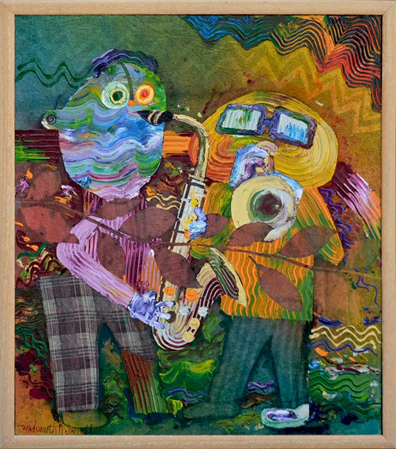 Wadsworth Jarrell is an African-American artist who was born in Albany, Georgia in 1929 and was educated at the Ray Vogue School of Art, Chicago, IL; the Art Institute of Chicago and Howard University, Washington, DC.
Before living in Atlanta, Jarrell taught at Howard University and the University of Georgia.
In the mid 1960's, following turbulent local racial violence, Jarrell became involved in the Organization of Black American Culture. Together in 1967, they created The Wall of Respect, a mural depicting African-American heroes. He focused on rhythm and blues, featuring portrayals of James Brown, B.B. King, Billie Holiday, Muddy Waters, Aretha Franklin, and Dinah Washington.
In the late 1960's, he opened WJ Studio and Gallery, where he exhibited regional artists and musicians. His gallery became an important center for African-American art in Chicago.
In 1969 he was one of the founding members of AFRICOBRA, (African Commune Of Bad Relevant Artists) a revolutionary artist school of thought that promotes the existence of an African-American aesthetic, founded in the midst of the Civil Rights Movement.
Mr. Jarrell feels his art is a reflection of the attitudes, the many colors, "coolade" colors, the style, the hip, and the rhythm of his people. Often found in his work are images of horse races, jazz musicians, and the African culture. As an artist he has dedicated himself to creating social imagery that intrudes upon the thoughts and jars the senses of his viewers.
Jarrell has exhibited at the Chicago Fine Arts Center; Fay Gold Gallery, Atlanta GA; American Theatre, Washington, DC; Atrim Gallery, McLean, VA; Carriage House Gallery, Richmond, VA; Mayor's Gallery Space, Washington, DC and Image Gallery, Athens, GA.
The work of Wadsworth Jarrell is a part of the permanent collection of the High Museum of Art, Atlanta, GA, the Atlanta Bureau of Cultural Affairs, National Museum of African-American History and Culture, the Studio Museum in Harlem, the University of Delaware, the Coca-Cola Company, Atlanta, GA, The Carriage House Gallery, Richmond, VA, John Wieland Homes Collection, Atlanta, GA, Park Forest Art Gallery, Park Forest, IL, Oak Park Art Society, Oak Park, IL, and King and Spalding Law Firm Collection, Atlanta, GA.
Some commissions are Northern Telecom Corporation, Atlanta, GA; OK Café, Atlanta, GA; Westinghouse Electric Company, Athens, GA; Harambee House Hotel, Washington, DC; Rill Harris in Paris, Washington, DC; and Fulton County Board of Commissioners, Atlanta, GA.