Page loaded successfully. Showing biography for Wesley Elbridge Webber.
Wesley Elbridge Webber BIOGRAPHY
1841 Gardiner, Maine - 1914 Wollaston, Massachusetts. Known for: Marine, landscape, historical genre painting.
Wesley Elbridge Webber. Marine, landscape and historical painter, Wesley Elbridge Webber was born in Gardiner, Maine, in 1841. Considered self-taught, Webber began his career after a move to Boston,... Read full biography
Wesley Elbridge Webber. Marine, landscape and historical painter, Wesley Elbridge Webber was born in Gardiner, Maine, in 1841. Considered self-taught, Webber began his career after a move to Boston, Massachusetts, where he apprenticed himself to J. C. Roberts, a successful sign and carriage painter... Read full biography
Wesley Elbridge Webber. Marine, landscape and historical painter, Wesley Elbridge Webber was born in Gardiner, Maine, in 1841. Considered self-taught, Webber began his career after a move to Boston, Massachusetts, where he apprenticed himself to J. C. Roberts, a successful sign and carriage painter from 1858 to 1861. He then opened and maintained his own fine art studio in Boston, with annual painting excursions to the Conway area of New Hampshire until a move to New York City in 1892. His... Read full biography
Wesley Elbridge Webber. Marine, landscape and historical painter, Wesley Elbridge Webber was born in Gardiner, Maine, in 1841. Considered self-taught, Webber began his career after a move to Boston, Massachusetts, where he apprenticed himself to J. C. Roberts, a successful sign and carriage painter from 1858 to 1861. He then opened and maintained his own fine art studio in Boston, with annual painting excursions to the Conway area of New Hampshire until a move to New York City in 1892. His Conway excursions brought him into a close circle of artists, including J. J. Enneking and Frank Shapleigh, who helped Webber shape a personal style of a sophisticated realism as the group explored the lush, mountainous hills and valleys of this scenic... Read full biography
Wesley Elbridge Webber. Marine, landscape and historical painter, Wesley Elbridge Webber was born in Gardiner, Maine, in 1841. Considered self-taught, Webber began his career after a move to Boston, Massachusetts, where he apprenticed himself to J. C. Roberts, a successful sign and carriage painter from 1858 to 1861. He then opened and maintained his own fine art studio in Boston, with annual painting excursions to the Conway area of New Hampshire until a move to New York City in 1892. His Conway excursions brought him into a close circle of artists, including J. J. Enneking and Frank Shapleigh, who helped Webber shape a personal style of a sophisticated realism as the group explored the lush, mountainous hills and valleys of this scenic part of New Hampshire. During this period Webber exhibited widely with exhibitions at the Boston Art Club, the National Academy of Design, the... Read full biography
Artist Biography
Biography page for Wesley Elbridge Webber ((1841 - 1914)), known for Marine, landscape, historical genre painting. Showing 4 biographical entries and 0 sample artworks.
Wesley Elbridge Webber - Artist Info
About Wesley Elbridge Webber
Name variants
Wesley Elbridge, Elbridge Wesley Webber
Biography from the Archives of askART
 Wesley Elbridge Webber
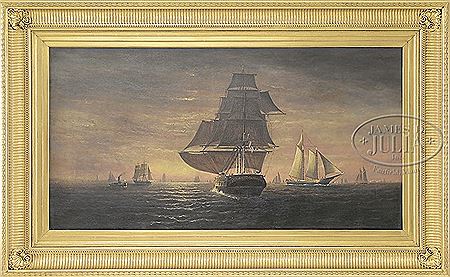
Marine, landscape and historical painter, Wesley Elbridge Webber was born in Gardiner, Maine, in 1841. Considered self-taught, Webber began his career after a move to Boston, Massachusetts, where he apprenticed himself to J. C. Roberts, a successful sign and carriage painter from 1858 to 1861. He then opened and maintained his own fine art studio in Boston, with annual painting excursions to the Conway area of New Hampshire until a move to New York City in 1892.
His Conway excursions brought him into a close circle of artists, including J. J. Enneking and Frank Shapleigh, who helped Webber shape a personal style of a sophisticated realism as the group explored the lush, mountainous hills and valleys of this scenic part of New Hampshire. During this period Webber exhibited widely with exhibitions at the Boston Art Club, the National Academy of Design, the Brooklyn Academy, the Peabody Museum in Salem, and the Portland Museum, Maine.
At the outbreak of the Civil War, Webber volunteered to serve in Company B of the Sixteenth Maine Volunteer Regiment present at General Robert E. Lee’s surrender at Appomattox Courthouse. As the only artist present on the Northern side of the conflict, Webber dashed off a number of detailed sketches which were later reproduced as lithographs and later wood engraving in Harper’s Weekly, the most popular periodical in America at the time of the Civil War. J. H. Bufford, of Boston, also printed a large and very popular lithograph of the surrender that made Webber a celebrity overnight.
A large group of his original drawings together with lithographs, wood cuts and paintings were exhibited at the Boston Art Club, confirming Webber’s unique role as the artist who captured Lee’s surrender and the end of the War between the States. On June 15, 1865, Webber was discharged from the Army. He immediately opened a new studio in Gardiner, Maine, where his mature style was appreciated with exhibitions in Boston and New York City.
Later Webber’s New York City studio, located at 11 East 14th Street, quickly became a meeting spot for a number of hard-drinking realist painters working in New York after the turn of the century. In 1914, Webber, suffering from the effects of alcoholism, left the city for Wollaston, Maine, and the home of his only daughter where he died that same year. The contents of his studio numbering over 140 finished paintings were sold at auction in 1915 in Boston by C. F. Libbie and Company.
Webber’s paintings are now included in most large regional American museums including the Boston Athenaeum, the Peabody Museum, the Brooklyn Museum, the New York Public Library, the Metropolitan Museum, and the Portland Museum, Maine. Little is known or recorded about Webber’s travels in North America or his trips abroad although paintings with place names found in Manchester-by-the-Sea, and other parts of maritime Canada, the Yosemite area of the American West, and an important group of atmospheric paintings done during winter in Venice, Italy, in the late 1890s, suggest that Webber was exploring impressionistic variations of his polished realist style with a group of silvery nocturnes of St. Mark’s Square seen from the Grand Canal and captured as light falls and the glow of the city takes over.
Webber is included in most standard reference works on American painting including the two volume Index of Artists, Mantle Fielding’s Dictionary of American Painters, Zellman’s 300 Years of American Painting, and the Exhibition Record of the National Academy of Design 1861-1900
Written and submitted by Gary R. Libby art historian and authorBiography from the Archives of askART
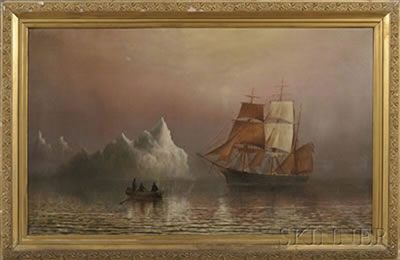 Born in Gardiner, ME in 1841. Webber was a self-taught, Eastern artist who was active in Yosemite in 1886. He died in Wollaston, MA on Nov. 4, 1914. Exh: Boston Art Club, 1874-91; Williams & Everett Gallery (Boston), 1877.
Biography from Pierce Galleries
 Webber, Wesley (American, 1839-1914)
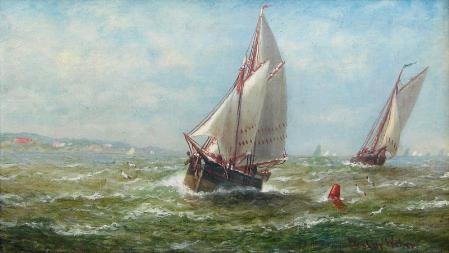
Landscape and marine painter Wesley Webber was born in Gardiner, Maine and died in Wollaston, Massachusetts in November 1914. He lived in Boston from 1870 to 1890 and in New York City from 1892 and was self-taught. He is considered one of the finer landscape painters who painted from life in the Conway area of New Hampshire and along the New England coast and he is reminiscent of the Hudson River School in style and manner.
Webber served in the Civil War (Company B of the Sixteenth Maine Volunteer Infantry Regiment) and was present at General Lee's surrender at Appomattox. His original sketches made at the surrender, along with his finished illustrations of the Civil War were shown at the Boston Art Club and brought Webber considerable fame, recognition and fortune. Many of his Civil War scenes were published as wood engravings in Harper's Weekly and as a lithograph published by J.H. Bufford of Boston. He was discharged from Civil War service in Augusta, Maine, June 15, 1865 and he opened a studio in Gardiner, where he became a carriage painter. Thereafter, Webber earned a fine reputation as a marine and landscape painter, but at the end of his life (ca. 1900-1914) he became an alcoholic and his style weakened along with his reputation.
Webber shared a Boston studio in Pemberton Square and then shared a Boston studio with marine painter William P. Stubbs (1876-) and kept other studios in New York City until his death. Every summer he went to Conway, New Hampshire to paint the hillside, where painters John J. Enneking, Frank Shapleigh and others joined him to paint. He also painted in Manchester-by-the-Sea, in Nova Scotia and in Canada. Two of his most famous paintings are "Kennebec River", "Maine Boat Shop and Unidentified Vessels Ice-bound at Gloucester" (both at the Peabody Museum, Salem, MA). He is also represented in the permanent collections of the Boston Athenaeum; New York Public Library; the Brooklyn Museum; Portland Museum of Art (Maine) and elsewhere.
From 1897 to 1914 Webber's New York City studio at 11 East 14th Street was filled with artists. In 1914, he left the city for his daughter's home in Wollaston, MA, where he died. In February 1915, his family sold the contents of his studio at the Boston auction house of C.F. Libbie and Company. The artist is buried in Gardiner, Maine.
References: American Art Analog, vol. 1; Who Was Who in American Art, vol. 3, p. 3489; Campbell, New Hampshire Scenery, p. 171.
PJ PIERCEBiography from Schwarz Gallery
Wesley Webber was born in Gardiner, Maine and became interested in art at an early age. About 1858 he went to Boston and was apprenticed for three years to J.C. Roberts of Haymarket Square, an ornamental sign and carriage painter. Webber entered the Sixteenth Maine Volunteer Infantry Regiment in July 1862 and was reportedly the only artist on hand at the surrender of Lee's forces at Appomattox. He produces sketches of the surrender that were later published as lithographs in Harper's Weekly. He continued to paint scenes from the Civil War throughout his career.
Webber exhibited frequently at the Boston Art Club, the New England Manufacturers and Mechanics Institute, Boston, and at the National Academy of Design, New York, and the Brooklyn Academy, Brooklyn, and the Peabody Museum, Salem, and the Portland Museum of Art, Portland.
Webber maintained a studio in Boston from 1870 to 1889, and by 1892 he moved his studio to New York City. He was married twice, the first marriage ended due to his problem with alcohol. Soon after his death, in 1915, C.F. Libbie and Company of Boston held an auction of Webber's work. More than one hundred and forty of Webber's paintings were represented in this auction, including, in addition to his sought after seascapes, landscapes, were animal studies, depictions of the Civil War, and still lifes.
Source: Frank S. Schwarz and Son, Philadelphia