Page loaded successfully. Showing biography for William Callow.
William Callow BIOGRAPHY
1812 Greenwich, England - 1908 Great Missenden, England. Known for: Landscapes, city views, and seascape watercolors, engraving.
William Callow, born near London in Greenwich, England, was a painter, primarily in watercolour* early in his career and later in oil. He also did engravings*. His watercolor painting was a part of... Read full biography
William Callow, born near London in Greenwich, England, was a painter, primarily in watercolour* early in his career and later in oil. He also did engravings*. His watercolor painting was a part of the very popular and respected English tradition of watercolor painting. The acceptance of this... Read full biography
William Callow, born near London in Greenwich, England, was a painter, primarily in watercolour* early in his career and later in oil. He also did engravings*. His watercolor painting was a part of the very popular and respected English tradition of watercolor painting. The acceptance of this medium for visual art is linked to 18th-Century topological drawings and map making, and to watercolor sketches used for engravings of exotic sites on the Continent that were popular keepsakes for upper... Read full biography
William Callow, born near London in Greenwich, England, was a painter, primarily in watercolour* early in his career and later in oil. He also did engravings*. His watercolor painting was a part of the very popular and respected English tradition of watercolor painting. The acceptance of this medium for visual art is linked to 18th-Century topological drawings and map making, and to watercolor sketches used for engravings of exotic sites on the Continent that were popular keepsakes for upper class English people who had taken the 'Grand Tour'. In the 19th Century, Joseph M.W. Turner (1775-1851) pioneered the use of watercolor as equal to oil in fine art depictions with his lushly colored, dramatic landscapes. In 1804, eight years before... Read full biography
William Callow, born near London in Greenwich, England, was a painter, primarily in watercolour* early in his career and later in oil. He also did engravings*. His watercolor painting was a part of the very popular and respected English tradition of watercolor painting. The acceptance of this medium for visual art is linked to 18th-Century topological drawings and map making, and to watercolor sketches used for engravings of exotic sites on the Continent that were popular keepsakes for upper class English people who had taken the 'Grand Tour'. In the 19th Century, Joseph M.W. Turner (1775-1851) pioneered the use of watercolor as equal to oil in fine art depictions with his lushly colored, dramatic landscapes. In 1804, eight years before the birth of Callow, watercolor painters including Turner formed... Read full biography
Artist Biography
Biography page for William Callow ((1812 - 1908)), known for Landscapes, city views, and seascape watercolors, engraving. Showing 1 biographical entries and 0 sample artworks.
William Callow - Artist Info
About William Callow
Biography from the Archives of askART
 William Callow, born near London in Greenwich, England, was a painter, primarily in watercolour* early in his career and later in oil. He also did engravings*. His watercolor painting was a part of the very popular and respected English tradition of watercolor painting.
The acceptance of this medium for visual art is linked to 18th-Century topological drawings and map making, and to watercolor sketches used for engravings of exotic sites on the Continent that were popular keepsakes for upper class English people who had taken the 'Grand Tour'.
In the 19th Century, Joseph M.W. Turner (1775-1851) pioneered the use of watercolor as equal to oil in fine art depictions with his lushly colored, dramatic landscapes. In 1804, eight years before the birth of Callow, watercolor painters including Turner formed the Society of Painters in Water Colours*, whose descendant was the Royal Watercolour Society*.
In 1832, the New Water Colour Society*, a separate group, formed. During the early decades of Callow's career, Turner was alive and a leading presence in the English art world. However, Callow had his own, distinct, style which was gentle in tone and color, making his work much less aggressive than Turner's.
Typically Callow's subjects were landscapes with near and far structures, marine scenes with fishing boats, and harbors with mountains as backdrops. Although he traveled extensively outside his native country, many of his painting subjects were of England with titles including Goodrich Castle on the Wye (1873), Landscape in Stafford (1842), Wimbleton Common (1851), and Caesar's Tower, Warwick Castle (1852).
His travels outside of England included numerous walking and sketching tours in France, Germany, Holland, Switzerland, and Italy. From France, he depicted scenes along the Seine River and fishermen at Calais. From sketches in Germany he painted View of Heidelberg, (1868); On the Rhone (n.d.); and The Market Frankfurt (1849); Views of Geneva Harbor and Lake Lugano came from Switzerland, and from Holland, The Belfry Bruges in Holland, (1898).
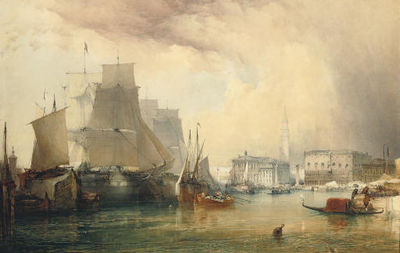
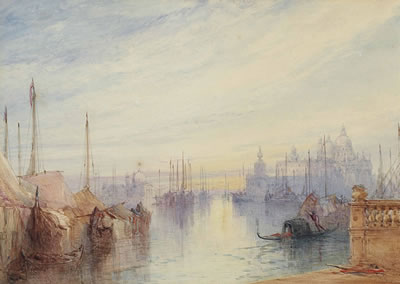
Italy, which he first visited in the summer of 1840, made a special impression. Among his favorite locations were Padua and Venice, and he exhibited watercolors of these cities at the Royal Watercolor Society and the Royal Academy of London. These paintings with "great richness of color and Italian scenes, particularly those in Venice, were to prove some of his most popular subjects." (Christie's). Among his Venetian subjects were the Grand Canal, San Marco Square, Rialto Bridge, and the Doge's Palace.
Callow was the son of a carpenter and builder, and at age eleven apprenticed in drawing, painting, and aquatint engraving for several years to Theodore Fielding (1781-1851), noted watercolorist. In 1829 at the encouragement of Thales Fielding (1793-1837), also a watercolor painter, Callow left for Paris to work for the publisher J.F. d'Ostervald. There he established himself as a teacher and exhibited in the Paris Salon* including the painting, View of Richmond.
Lodging and working with watercolorist Newton Fielding (1799-1856), Callow stayed until 1830 when the July Revolution upheaval forced them both back to Britain. Also known as the French Revolution of 1830, this event, which lasted three days, led to the overthrow of King Charles X and the ascent of his cousin, Louis Philippe, the Duc d'Orleans (1773-1850).
The next year, 1831, Callow was back in Paris, and found favor with King Louis Philippe, who hired Callow as the royal family Drawing Master. Callow remained in France for a decade, and then settled permanently in England, living first in London before purchasing and moving to a cottage at Great Missenden, a large village in Buckinghamshire on a major route between the Midlands and London.
In 1848, while still living in France but remaining in close contact with English artists, Callow was elected to the Royal Watercolour Society of London, which he served as secretary from 1866-1870. With this organization he exhibited about 1,400 paintings. In 1848, however, he turned away somewhat from watercolor and focused much effort on oil painting. Judging by his auction record history and comments of art historians, he was much more successful in the public view with watercolor.
About two years before his death in 1908, William Callow turned out portfolios of his early works, and these sold so well that he held an exhibition of them at the Leicester Galleries in 1907. Posthumously, his studio sale was held at Christie's London auction house on the 21st March 1910.
William Callow died in 1908 at Great Missenden.
Sources:
Answers.com
Richard Gardner Antiques
Christie's.com
AskART auction records: William Callow
Wikipedia: Water Color Painting, English School
* For more in-depth information about these terms and others, see AskART.com Glossary http://www.askart.com/AskART/lists/Art_Definition.aspx