Page loaded successfully. Showing biography for William Edouard Scott.
William Edouard Scott BIOGRAPHY
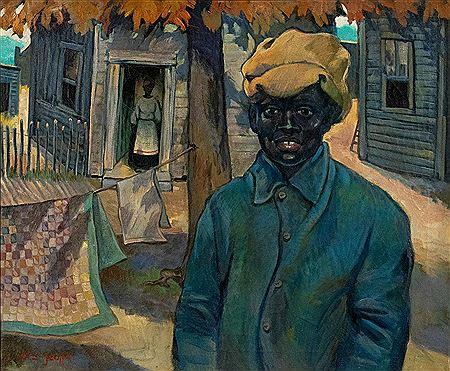
1884 Indianapolis, Indiana - 1964 Chicago, Illinois. Known for: Portrait, mural, genre-Haiti and landscape painting.
William Edouard Scott was born on March 11, 1884 in Indianapolis, Indiana. The son of Caroline Russell and Edward Miles Scott, William enjoyed a comfortable lifestyle thanks to his father's... Read full biography
William Edouard Scott was born on March 11, 1884 in Indianapolis, Indiana. The son of Caroline Russell and Edward Miles Scott, William enjoyed a comfortable lifestyle thanks to his father's employment in the wholesale grocery business and the relatively small size of his family (Hardman 100). Scott... Read full biography
William Edouard Scott was born on March 11, 1884 in Indianapolis, Indiana. The son of Caroline Russell and Edward Miles Scott, William enjoyed a comfortable lifestyle thanks to his father's employment in the wholesale grocery business and the relatively small size of his family (Hardman 100). Scott was one of only two children. The environment in which the young Scott grew up lent him "a kind of strength, stability, and continuity" that was often lacking in African American communities of the... Read full biography
William Edouard Scott was born on March 11, 1884 in Indianapolis, Indiana. The son of Caroline Russell and Edward Miles Scott, William enjoyed a comfortable lifestyle thanks to his father's employment in the wholesale grocery business and the relatively small size of his family (Hardman 100). Scott was one of only two children. The environment in which the young Scott grew up lent him "a kind of strength, stability, and continuity" that was often lacking in African American communities of the same period (Hardman 109). Scott's first formal study of art was with Otto Stark, a Hoosier Group artist and director of Indianapolis's Manual High School art department (Perry). Scott later returned to aid Stark in the school's drawing department... Read full biography
William Edouard Scott was born on March 11, 1884 in Indianapolis, Indiana. The son of Caroline Russell and Edward Miles Scott, William enjoyed a comfortable lifestyle thanks to his father's employment in the wholesale grocery business and the relatively small size of his family (Hardman 100). Scott was one of only two children. The environment in which the young Scott grew up lent him "a kind of strength, stability, and continuity" that was often lacking in African American communities of the same period (Hardman 109). Scott's first formal study of art was with Otto Stark, a Hoosier Group artist and director of Indianapolis's Manual High School art department (Perry). Scott later returned to aid Stark in the school's drawing department after his graduation in 1903—crediting Scott as the first African American to teach in the Indiana... Read full biography
Artist Biography
Biography page for William Edouard Scott ((1884 - 1964)), known for Portrait, mural, genre-Haiti and landscape painting. Showing 3 biographical entries and 0 sample artworks.
William Edouard Scott - Artist Info
About William Edouard Scott
Biography from the Archives of askART
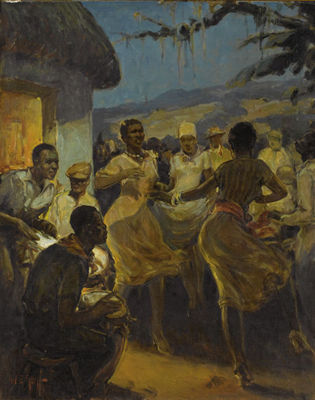 William Edouard Scott was born on March 11, 1884 in Indianapolis, Indiana. The son of Caroline Russell and Edward Miles Scott, William enjoyed a comfortable lifestyle thanks to his father's employment in the wholesale grocery business and the relatively small size of his family (Hardman 100). Scott was one of only two children. The environment in which the young Scott grew up lent him "a kind of strength, stability, and continuity" that was often lacking in African American communities of the same period (Hardman 109).
Scott's first formal study of art was with Otto Stark, a Hoosier Group artist and director of Indianapolis's Manual High School art department (Perry). Scott later returned to aid Stark in the school's drawing department after his graduation in 1903—crediting Scott as the first African American to teach in the Indianapolis public school system (Perry; Hardman 111). Encouraged by Stark, Scott migrated to Chicago to study at the Art Institute, where he graduated in 1907, but continued his classes for two additional years (Perry). During his time at the Art Institute, Scott was hired to paint his first of many commissioned murals in local schools, which were some of the "earliest public works depicting African American subjects"—many of which do indeed still exist (Michael Rosenfeld Art). Also while at the Art Institute, Scott earned several cash prizes, scholarships, and awards, including the Magnus Brand Memorial Prize for three consecutive years, which allowed Scott to fund his first trip abroad in 1910 (Hardman 115).
Scott's time in Paris, France, profoundly impacted his life as an artist. The highlight of Scott's experience, however, occurred when he met and studied under the famous American expatriate, Henry Ossawa Tanner, at the artist colony in Trepied-par-Etaples (Perry). Tanner invited Scott to join him when he heard of the young artists diminishing funds and rudimentary French communication skills (Taylor 161). Tanner's influence manifested itself in many of Scott's works and have a lasting impression on Scott's overall style as painter. Scott's formal training lead to a cultivated twist on academic realist impressionism, and his palette was molded by Tanner's use of greens and blues. He returned to Chicago in 1911 to exhibit his works and fund further study in France.
During two subsequent trips, Scott continued his training at the Academie Julien and Colarossi Academy, where his rigorous studies paid off and he was admitted to the Salon de la Societe des Artistes Francais in Paris both 1912 and 1913 (Hardman 125-6). Scott's Paris paintings depict the wretched poverty of French peasants contrasted with the glamor of the bourgeois. Works such as La Pauvre Voisine, Breton Smithy, Rainy Night, and his most famous piece produced while in France, La Misere, all portray class struggle in the style of Tanner's dark and gloomy tones. With La Misere, Scott won the Tanqueray prize of 125 francs, and was able to return to America comfortably (Perry).
In 1914 Scott established his studio in Chicago, where he became known as the "dean of Negro artists" (Perry). He painted a multitude of murals in both Illinois and Indiana and was awarded the gold medal for Distinguished Achievement among resident American Blacks from the Hannon Foundation in 1927. Four of his sketches were presented to New York's International House—the first entirely African American artist exhibition in America (Perry). Scott was also invited to attend the Tuskegee Institute as the personal guest of founder Booker T. Washington. While in Alabama, Scott produced many works portraying the dual nature of the grace and struggles of blacks in the American south.
His portraits of Booker T. Washington, George Washington Carver, and Frederick Douglass lauded some of the African American community's greatest champions in steady, earthy, understated tones. Paintings such as It's Going to Come and The Maker of Goblins showed a sense of hope and strength found in the masses of nameless poor blacks. Scott was also hired to produce several covers for W. E. B. DuBois' Crisis, the NAACP magazine (Taylor 22). Scott's most famous cover (featured in the 1918 Easter edition) was based on his own grandparent's laborious travels from North Carolina to Indianapolis (Taylor 22). Traveling (Lead Kindly Light), now housed in the Huntington Museum of Art in West Virginia, still retains the vestiges of Tanner's restrained palette as it relays the "desperation and apprehension" evident on the faces of the voyagers as they journey through the night with the halo of the lantern guiding the way (Taylor 27).
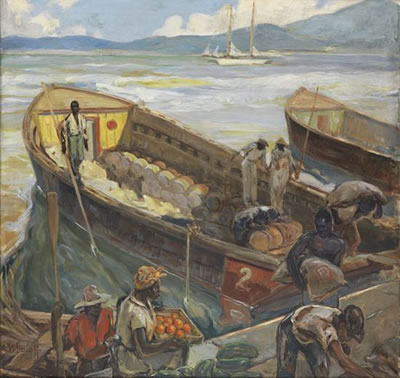
Upon receiving the Julius Rosenwald Fellowship to study Negros in the West Indies, Scott traveled to Haiti. The notion that Haitians, as the first black republic in the Americas, still maintained their unspoiled African heritage along with American occupation of the island and his own knowledge of the French language shaped Scott's decision as he sailed for Port-au-Prince the same year he received the fellowship (Taylor 27). Scott experienced his most prolific period as a painter while in Haiti, producing over 144 works (Taylor 27). While in Haiti, Scott also abandoned the demure palette he adopted from Tanner in favor of brighter, more vibrant hues, as can be seen in works such as Cockfight, The Citadel, Turkey Vendor, Haitian Market, Mother and Child, and Night Turtle Fishing in Haiti—works that burst with the life and color of the island. One of Scott's most emotional Haitian works depicts the island's liberator, Toussaint L'Ouverture, in the style of Delacroix's Liberty Leading the People with bright yellows, golds, and pulsating greens. Haitian President Stenio Vincent awarded Scott the degree of Nationale Honeure et Merite and purchased twelve of his paintings, which were exhibited in Port-au-Prince (Perry).
Scott again returned to America, where he continued to paint murals such as Pilgrim Dwelling and Simeon and the Babe Jesus in Arizona, Indiana, Illinois, Missouri, New York City, and West Virginia—including a mural for the 1933 World's Fair in Chicago. He was one of seven artists selected to paint the mural for the Recorder of Deeds Building in Washington, D.C. with his depiction of Frederick Douglass vehemently appealing to President Lincoln to let black soldiers fight in the Civil War (Perry). Scott's last trip abroad to Mexico in 1955 was conducted in hopes of repeating his Haitian experience, this time with the inhabitants of rural Mexico (Perry). However, disease cut the trip short when Scott was diagnosed with diabetes. He spent the remainder of his life continuing to paint in spite of his failing health, which eventually claimed one of his legs and his eyesight (Perry). He was a champion of the experiences of the downtrodden, and through his work he was able to help blacks from Chicago, the American south, and Haiti recognize the beauty of their surroundings and the dignity of their lives.
William Edouard Scott died in a Chicago nursing home on May 15, 1964.
Works Cited:
Delacroix, Eugène . Liberty Leading the People. 1830. Musée du Louvre, Paris.
Hardman, Della Brown. William Edouard Scott Remembered: Lessons from a Remarkable Life.
Ann Arbor, MI: Kent State University Graduate School of Education, 1994. Print.
"MichaelRosenfeldArt.com William Edouard Scott." MichaelRosenfeldArt.com. N.p., n.d. Web. 26 Feb. 2011. <http://www.michaelrosenfeldart.com/artist /artists_represented.php?i=149&m=biography>.
Perry, Rachel Berenson. "The Paintings of William Edouard Scott; text by Rachel Berenson
Perry ." Traditional Fine Arts Organization. N.p., n.d. Web. 26 Feb. 2011. <http://www.tfaoi.com/aa/8aa/8aa88.htm>.
Scott, William Edouard. Breton Smithy.
Scott, William Edouard. The Citadel.
Scott, William Edouard. Cockfight.
Scott, William Edouard. Haitian Market. 1931. California African American Museum , Los Angeles.
Scott, William Edouard. It's Going to Come.
Scott, William Edouard. La Misere. 1912.
Scott, William Edouard. La Pauvre Voisine.
Scott, William Edouard. The Maker of Goblins. 1928. Personal Collection.
Scott, William Edouard. Mother and Child. 1930. Personal Collection.
Scott, William Edouard. Night Turtle Fishing in Haiti. 1931. Clark Atlanta University Collection of African American Art, Atlanta.
Scott, William Edouard. Pilgrim Dwelling.
Scott, William Edouard. Rainy Night. 1912. Indianapolis Museum of Art, Indianapolis.
Scott, William Edouard. Traveling (Lead Kindly Light). 1918. Huntington Museum of Art, Huntington, WV.
Scott, William Edouard. Simeon and the Babe Jesus.
Scott, William Edouard. Turkey Vendor.
Taylor, William E., Harriet G. Warkel, and Margaret Taylor Burroughs. A shared heritage: art by four African Americans. Indianapolis, IN: Indianapolis Museum of Art, with Indiana University Press, 1996. Print.
Researched and written by Shaina D. W. Taylor for an honors art history seminarBiography from the Archives of askART
 Born in Indianapolis, William Edouard Scott attended Emmerich Manual High School where he was under the artistic tutelage of Otto Stark, one of Indiana's most prominent artists of the day. After graduation he would help Stark teach drawing to freshmen, thus becoming the first black person to teach in a public high school in Indianapolis.
Enrollment at the Art Institute of Chicago led to mural commissions for several Chicago and Washington DC public schools.
Like the majority of artists of the day, an art education was not considered complete until instruction had been taken in Europe. In 1909 and 1911 Scott traveled to France where he would be mentored by Henry Ossawa Tanner, one of the leading black American artists of the day.
France was successful artistically for Scott and he returned to Indianapolis and commissions to paint murals in the city's public schools in 1912. The next two decades would be fruitful for Scott, having numerous exhibitions, and winning many awards and commissions.
In 1931 Scott was awarded a fellowship to study in Haiti. Spending more than a year there, he painted over 144 works and was an inspiration to many local artists. Scott's short visit to this black republic was to have a long-lasting and profound effect on him and he would continue to draw on Haitian subject matter for many years to come. In Haiti, his preferred subjects were the common people and their everyday activities, dress, customs and lifestyles. One custom, popular with men, was the Sunday afternoon cockfight, and Scott would render this subject in both painting and mural form.
By 1934 the U.S. troops that had been occupying the island since 1915 withdrew, therefore this undated mural was likely executed during Scott's stay from 1931-32.
Submitted by Bob Constant who received this information from David Kwasigroh, Curator of Collections, Greater Lafayette Art
Museum. The communication references Haitian Mural, Oil on canvas, 1930s, that is on permanent loan at the Museum from Robert L. and Ellen E. Haan.Biography from The Johnson Collection
WILLIAM EDOUARD SCOTT (1884-1964)
In the groundbreaking anthology, The New Negro: An Interpretation (1925), educator and philosopher Alain Locke wrote of the need for African American visual artists to raise “the Negro subject from the level of trivial or sentimental genre to that of serious type study . . . and furnish the fullest and most revealing portrayal of Negro life.” Citing the work of Henry O. Tanner, Hale Woodruff, and William Eduoard Scott, Locke hailed the “advent of a representatively racial school of expression, and an important new contribution, therefore, to the whole body of American art.”
Fifteen years earlier—following six years of training at the Art Institute of Chicago—William Scott had left his native Indiana to study in France. There, he sought out fellow African American artist Henry Ossawa Tanner at the artists’ colony, Trépied-par-Etaples. Tanner was a generation older than Scott and racial prejudice had forced him to flee the United States in 1891. Tanner encouraged Scott’s interest in extolling the achievements of African Americans in his canvases. During a residency in Paris, Scott enrolled in classes at the Académie Julian and the Académie Colarossi. This rigorous training was rewarded when his work was displayed at the Paris Salon in 1912 and 1913, and at the Royal Academy in London.
While encouraged by his success abroad, Scott returned to the United States as the European theater of war expanded in 1914. He established a studio in Chicago and, despite the growing popularity of abstract art, remained true to his representational style. Scott’s determination to depict African Americans not as subservient menial laborers or stereotypes, but as fully realized and wholly unique persons of dignity. In 1915, Scott made his first of many trips to the South when he was invited to Tuskegee Institute by its founder of Booker T. Washington. During his brief residency there, he painted “day-in-the-life pictures of the locals,” honest portrayals of African Americans living in poverty and prejudice. He would later execute a double portrait featuring Mr. Washington and faculty member George Washington Carver.
In 1927, Scott was honored with a special gold medal for fine arts through the Harmon Foundation's Distinguished Achievement Among Negroes awards initiative. Four years later, he received the Julius Rosenwald Fine Arts Fellowship, which he applied toward a year-long sojourn in Haiti. Scott later painted a mural for the 1933 Chicago World’s Fair and worked for the Federal Art Project Mural and Easel division during the Depression. The summer of 1949 found Scott at the college now known as Florida Agricultural and Mechanical University, where he led classes and made several objects for the school. In 1955, the artist set off for another painting expedition, this time to Mexico. However, his trip was cut short by the onset of diabetes and its multiple complications. Scott returned to Chicago and continued to paint until he passed away in a nursing home in 1964. Now considered one of the most important artists of his generation, Scott’s work is included in such prestigious collections as the National Gallery of Art in Washington, DC, the Guggenheim Museum in New York, and the Tate Gallery in London.
The Johnson Collection, Spartanburg, South Carolina
thejohnsoncollection.org