Page loaded successfully. Showing biography for William McGregor Paxton.
William McGregor Paxton BIOGRAPHY
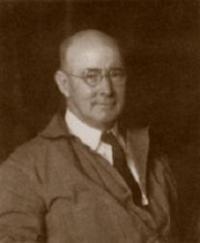
1869 Baltimore, Maryland - 1941 Newton Centre, Massachusetts. Known for: Figure, genre, portrait and landscape painting.
Born in Baltimore and raised in Newton, Massachusetts, William Paxton became a prominent late 19th, early 20th-century figure painter, especially noted for female subjects, and a key artist in the... Read full biography
Born in Baltimore and raised in Newton, Massachusetts, William Paxton became a prominent late 19th, early 20th-century figure painter, especially noted for female subjects, and a key artist in the establishment of American Impressionism. Paxton also painted outdoor views of upper class life such as... Read full biography
Born in Baltimore and raised in Newton, Massachusetts, William Paxton became a prominent late 19th, early 20th-century figure painter, especially noted for female subjects, and a key artist in the establishment of American Impressionism. Paxton also painted outdoor views of upper class life such as croquet games and hotel verandah scenes. In Philadelphia where he lived briefly, he received so many commissions for portrait paintings that he was referred to as the "court painter of Philadelphia."... Read full biography
Born in Baltimore and raised in Newton, Massachusetts, William Paxton became a prominent late 19th, early 20th-century figure painter, especially noted for female subjects, and a key artist in the establishment of American Impressionism. Paxton also painted outdoor views of upper class life such as croquet games and hotel verandah scenes. In Philadelphia where he lived briefly, he received so many commissions for portrait paintings that he was referred to as the "court painter of Philadelphia." Portrait subjects included Presidents Calvin Coolidge and Grover Cleveland. In addition to his canvas painting, Paxton was a muralist whose work was at the Army and Navy Club of New York City and St. Botolph's Club of Boston. He was also a... Read full biography
Born in Baltimore and raised in Newton, Massachusetts, William Paxton became a prominent late 19th, early 20th-century figure painter, especially noted for female subjects, and a key artist in the establishment of American Impressionism. Paxton also painted outdoor views of upper class life such as croquet games and hotel verandah scenes. In Philadelphia where he lived briefly, he received so many commissions for portrait paintings that he was referred to as the "court painter of Philadelphia." Portrait subjects included Presidents Calvin Coolidge and Grover Cleveland. In addition to his canvas painting, Paxton was a muralist whose work was at the Army and Navy Club of New York City and St. Botolph's Club of Boston. He was also a lithographer, and etcher, and his studios were in Boston, East Gloucester, and Provincetown. In 1928, he became a... Read full biography
Artist Biography
Biography page for William McGregor Paxton ((1869 - 1941)), known for Figure, genre, portrait and landscape painting. Showing 4 biographical entries and 0 sample artworks.
William McGregor Paxton - Artist Info
About William McGregor Paxton
Biography from the Archives of askART
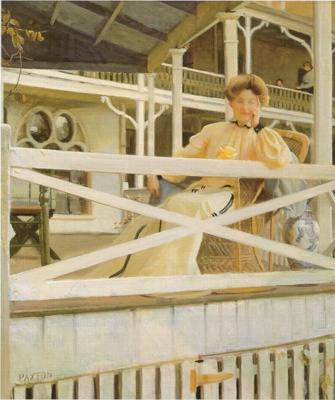 Born in Baltimore and raised in Newton, Massachusetts, William Paxton became a prominent late 19th, early 20th-century figure painter, especially noted for female subjects, and a key artist in the establishment of American Impressionism. Paxton also painted outdoor views of upper class life such as croquet games and hotel verandah scenes.
In Philadelphia where he lived briefly, he received so many commissions for portrait paintings that he was referred to as the "court painter of Philadelphia." Portrait subjects included Presidents Calvin Coolidge and Grover Cleveland.
In addition to his canvas painting, Paxton was a muralist whose work was at the Army and Navy Club of New York City and St. Botolph's Club of Boston. He was also a lithographer, and etcher, and his studios were in Boston, East Gloucester, and Provincetown. In 1928, he became a full member of the National Academy of Design.
Paxton studied in Boston with Dennis Miller Bunker at the Cowles School, and then in Paris at the Ecole des Beaux-Arts with Jean Leon Gerome, the teacher of Bunker, and a life-long influence on Paxton's skill with figures. In 1893, Paxton returned to Boston from Paris and studied at the Cowles School with Joseph De Camp, a new faculty member who had much influence on Paxton in the execution of what became his signature interiors: Vermeer-like scenes of well-to-do persons in elegant, quiet settings.
In 1904, a fire in the Harcourt Building in Boston that housed Paxton's studio destroyed about 100 of his paintings as well as many canvases of Joseph De Camp.
William Paxton died in Boston in 1941.
Sources include:
William Gerdts, American Impressionism
Michael David Zellman, 300 Years of American ArtBiography from Altermann Galleries and Auctioneers, V
William McGregor Paxton (June 22, 1869 - 1941) was an American Impressionist painter.
Born in Baltimore, the Paxton family came to Newton Corner in the mid-1870s, where William's father James established himself as a caterer. At 18, William won a scholarship to attend the Cowles Art School, where he began his art studies with Dennis Miller Bunker. Later he studied with Jean-Léon Gérôme in Paris and, on his return to Boston, with Joseph DeCamp at Cowles. There he met his future wife Elizabeth Okie, who also was studying with DeCamp. After their marriage, William and Elizabeth lived with his parents at 43 Elmwood Street, and later bought a house at 19 Montvale Road in Newton Centre.
Paxton, who is best known as a portrait painter, taught at the Museum School from 1906 to 1913. Along with other well known artists of the era, including Edmund Charles Tarbell and Frank Benson, he is identified with the Boston School. He was well known for his extraordinary attention to the effects of light and detail in flesh and fabric. Paxton's compositions were most often idealized young women in beautiful interiors. Paxton gained fame for his portraiture and painted both Grover Cleveland and Calvin Coolidge. He taught at the Boston Museum of Fine Arts School from 1906 to 1913. Paxton was made a full member of the National Academy of Design in 1928.[1]
Like many of his Boston colleagues, Paxton found inspiration in the work of the seventeenth-century Dutch painter Johannes Vermeer. Paxton was fascinated not only with Vermeer's imagery, but also with the system of optics he employed. He studied Vermeer's works closely, and discovered that only one area in his compositions was entirely in focus, while the rest were somewhat blurred. Paxton ascribed this peculiarity to "binocular vision," crediting Vermeer with recording the slightly different point of view of each individual eye that combine in human sight. He began to employ this system in his own work, including The New Necklace, where only the gold beads are sharply defined while the rest of the objects in the composition have softer, blurrier edges. Paxton crafted his elaborate compositions with models in his studio, and the props he used, appear in several different paintings.[2]
Paxton was working on his last painting, a view of his living room at 19 Montvale Road, with his wife posing for him, when he was stricken with a heart attack and died at the age of 72.
Source: www.wikipedia.comBiography from Pierce Galleries
William M. Paxton was one of Boston's most famous figure-portrait painters. Known as a "Tarbellite" or member of the Boston school of painting, Paxton studied at the Boston Museum School with Tarbell, the Cowles Art School (Boston) with Dennis Miller Bunker, Benson and DeCamp; the Academie Julian, Paris and the Ecole des Beaux-Arts with Gerome.
He was a National Academician (1928) who exhibited extensively and taught at the Museum School from 1906-1913.
Known as "the court painter of Philadelphia" after he moved there, Paxton remains a noted portrait painters in America. He died in Baltimore, MD in 1941.Biography from Taylor Graham
One of Boston's better known figure and portrait painters, William Paxton and his colleagues Edmund Tarbell and Frank Benson were prominent members of the Boston School of painting, which flourished during the first quarter of the 20th century. Known for his lovely paintings of the leisure class, Paxton placed his graceful figures in settings rich in texture and color and approached them with the gifts of a true draftsman and instinctive colorist. His canvases were a unique combination of his acute sense of design and an impressionist's sensitivity to light. This dual gift set Paxton apart from all other painters.
At a time when drawing was emphasized in art training, Paxton was extremely well taught. A native of the Boston area, he studied initially at the Cowles Art School with Dennis Bunker, and then traveled to Paris in 1889, where he spent four years studying at the Academie Julian, the École de Beaux Arts and in the atelier of Jean Leon Gérome. This formal training, combined with his remarkable gift for drawing, enabled Paxton to retain a sure grasp of form while pursuing the most subtle effects of color.
Paxton became devoted to the ideals of the impressionist painters. Seeing was a tremendously exciting experience for Paxton, and he believed that the primary function of the painter was to interpret this sort of experience for others to share. He strove to render his impression of reality, not to create a facsimile of it. He insisted on truth of form, value, definition and color coupled with superb composition.
His taste in color was singular, very much his own, and developed by much thought and observation. In his own words, Paxton described, "I let the surfaces flow into one another in a supple envelope of light and paint." He delighted in blues and lavenders, orchid pinks and citron yellows. His deliberate use of color produced the most tactile and supple depictions of flesh both in his portraits and especially in his nudes.
William Paxton's unique artistic talents combined with his sound academic training, and an incredible sensitivity to light and color, enabled him to carry the principles evolved by the 19th century impressionists further than any other painter, and secured him a prominent place in the history of art.
Collections:
Metropolitan Museum of Art
Smithsonian American Art Museum
Corcoran Gallery of Art
Yale University Art Gallery
Brooklyn Museum of Art
Museum of Fine Arts, Boston
Butler Institute of American Art
Detroit Institute of Art
National Arts Club
Pennsylvania Academy of Fine Arts
Whistler House Museum of Art
Indianapolis Museum of Art
Delaware Art Museum
Springfield Museum of Fine Art
Sheldon Memorial Art Gallery
Reading Public Museum
El Paso Museum of Art
Exhibitions:
World's Columbian Exposition, Chicago, 1892
Boston Arts Club 1895-1903
Art Institute of Chicago 1897-1926
Pennsylvania Academy of Fine Arts 1898-1941, Gold medal 1928, Prizes 1915, 1921
Pan-American Exhibition 1901
St. Louis Exposition, Medal 1904
Corcoran Gallery Bienniels 1907-1941 (17 times)
Pan-Pacific Exposition, San Francisco 1915
Indianapolis Museum of Art, Retrospective, 1979
Memberships:
National Academy of Design
Salmagundi Club
National Arts Club
Boston Guild of Artists
St. Botolph Club
Copley Society
Art Club of Philadelphia
Allied Artists of America
American Federation of Arts