Page loaded successfully. Showing biography for Yasutomi Hiroki.
Yasutomi Hiroki BIOGRAPHY
Born 1978. Known for: Painting.
Steeped in Nipponese and Chinese culture, and deeply imbued with 8th-century Chinese philosophy and poetry, Yasukawa creates untitled works as meditation aids, in a never-ending quest for the utmost... Read full biography
Steeped in Nipponese and Chinese culture, and deeply imbued with 8th-century Chinese philosophy and poetry, Yasukawa creates untitled works as meditation aids, in a never-ending quest for the utmost simplicity. Yasukawa's works are supports for meditation, the product of a long process of... Read full biography
Steeped in Nipponese and Chinese culture, and deeply imbued with 8th-century Chinese philosophy and poetry, Yasukawa creates untitled works as meditation aids, in a never-ending quest for the utmost simplicity. Yasukawa's works are supports for meditation, the product of a long process of composition and color, and they demand to be looked at for a long time, because every detail counts. His geometric abstraction is the result of a long process of composition, in which the artist seeks to... Read full biography
Steeped in Nipponese and Chinese culture, and deeply imbued with 8th-century Chinese philosophy and poetry, Yasukawa creates untitled works as meditation aids, in a never-ending quest for the utmost simplicity. Yasukawa's works are supports for meditation, the product of a long process of composition and color, and they demand to be looked at for a long time, because every detail counts. His geometric abstraction is the result of a long process of composition, in which the artist seeks to create a meditative support for the viewer. Her compositions are flat and strictly geometric, but the many layers of color she applies facilitate immersion in her work. He seeks only to express the essential and ruthlessly eliminate the superfluous.... Read full biography
Steeped in Nipponese and Chinese culture, and deeply imbued with 8th-century Chinese philosophy and poetry, Yasukawa creates untitled works as meditation aids, in a never-ending quest for the utmost simplicity. Yasukawa's works are supports for meditation, the product of a long process of composition and color, and they demand to be looked at for a long time, because every detail counts. His geometric abstraction is the result of a long process of composition, in which the artist seeks to create a meditative support for the viewer. Her compositions are flat and strictly geometric, but the many layers of color she applies facilitate immersion in her work. He seeks only to express the essential and ruthlessly eliminate the superfluous. Hiroshi YASUKAWA's works represent the manifestation in the artistic gesture of man's ability to reach the essence of nature, beyond its visib... Read full biography
Artist Biography
Biography page for Yasutomi Hiroki ((Born 1978)), known for Painting. Showing 2 biographical entries and 0 sample artworks.
Yasutomi Hiroki - Artist Info
About Yasutomi Hiroki
Name variants
Hiroki Yasutomi
Biography from Martin & Asso. & Hôtel des Ventes de Metz
Steeped in Nipponese and Chinese culture, and deeply imbued with 8th-century Chinese philosophy and poetry, Yasukawa creates untitled works as meditation aids, in a never-ending quest for the utmost simplicity. Yasukawa's works are supports for meditation, the product of a long process of composition and color, and they demand to be looked at for a long time, because every detail counts. His geometric abstraction is the result of a long process of composition, in which the artist seeks to create a meditative support for the viewer. Her compositions are flat and strictly geometric, but the many layers of color she applies facilitate immersion in her work. He seeks only to express the essential and ruthlessly eliminate the superfluous. Hiroshi YASUKAWA's works represent the manifestation in the artistic gesture of man's ability to reach the essence of nature, beyond its visible appearance, inspired by the lessons of Piet Mondrian or Theo Van Doesburg, restored by YASUKAWA with, perhaps, through the simplicity of the lines and the purity of the strokes, a greater achievement in the process of abstraction. No doubt they also have an initial symbolic function, not unfamiliar to the artists of the De Stijl movement, as each geometric figure can take on a universal significance, the sphere representing the perfect medium, the circle, the enclosed space, the square or right angle symbolizing man's work on matter or the rule of behavior. Beyond serenity, the gaze on Hiroshi YASUKAWA's work is always rewarded with a sense of aesthetic accomplishment, in keeping with the Taoist principles of art, according to which the artist's creative force "is the manifestation of the creative force of the universe", the artist's task being "to create forms of a more perfect and purer world, which are to be the models of a higher humanity or existence" (1). His work has received numerous awards and is represented in numerous American, European and Asian museums and private collections.Biography from Christie's Hong Kong
"By repeating pencil touches as if I were weaving, I can thread my emotions into my work." - Hiroki Yasutomi
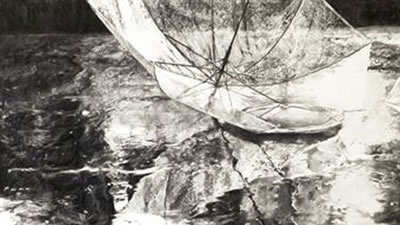
Hiroki Yasutomi's intriguing works in pencil consist of motifs of extremely fine lines drawn as though he were possessed by an overpowering force. In After Image of the Day, he draws scene inside a well-lit room, overlooking the city at night. Sofas are used not only for welcoming guests or for brief relaxation, but also as places where one can lie down and sleep, to pamper a body tired from work or other daily tasks. Yasutomi says that he feels a sense of security by drawing a snuggly sofa.
Circulating Dew meticulously depicts the hyper realistic flowers covered in drops of dew. He explains, "Water makes us realize that it is a source of life." The inevitable darkness of the night creates sense of isolation and heighten our otherwise diverted consciousness. It allows us the time to face our internal self. "I attempt to draw 'night' as a unitary concept, in order to create a world that can be one's ground."
Another characteristic of Yasutomi's art is the low eyeline in the layout of his works. He often depicts floors and lower sections of a given space, paying attention to the eyeline of those who look at his creations. Yasutomi creates his layouts to stimulate the imaginations of his audience, to draw them into his artistic world, and to make them the protagonist of a picture's story.