Page loaded successfully. Showing biography for Yifei Chen.
Yifei Chen BIOGRAPHY
1946 Ningbo, Zhejiang, China - 2005 Shanghai, China. Known for: Figure, genre, history and landscape painting, decoration.
A well-known, commercially successful painter, decorator, film maker and designer, Chen Yifei spent most of his life in China but lived in New York City from 1980 to 1990. He did many oil paintings... Read full biography
A well-known, commercially successful painter, decorator, film maker and designer, Chen Yifei spent most of his life in China but lived in New York City from 1980 to 1990. He did many oil paintings that blended styles of realism and romanticism and was one of the first artists to bridge the gap... Read full biography
A well-known, commercially successful painter, decorator, film maker and designer, Chen Yifei spent most of his life in China but lived in New York City from 1980 to 1990. He did many oil paintings that blended styles of realism and romanticism and was one of the first artists to bridge the gap between art of the Cultural Revolution and contemporary art of the West. He was born in Ningbo in Zhejiang Province. As a child, he moved with his family to Shanghai and there studied Russian art and... Read full biography
A well-known, commercially successful painter, decorator, film maker and designer, Chen Yifei spent most of his life in China but lived in New York City from 1980 to 1990. He did many oil paintings that blended styles of realism and romanticism and was one of the first artists to bridge the gap between art of the Cultural Revolution and contemporary art of the West. He was born in Ningbo in Zhejiang Province. As a child, he moved with his family to Shanghai and there studied Russian art and Socialist Realism, which was the official art of China. He graduated from the Shanghai College of Art in 1965, the beginning of the Cultural Revolution. Early in his career, he followed the party line of Mao-Tse-Tung and did large-scale, "glorified"... Read full biography
A well-known, commercially successful painter, decorator, film maker and designer, Chen Yifei spent most of his life in China but lived in New York City from 1980 to 1990. He did many oil paintings that blended styles of realism and romanticism and was one of the first artists to bridge the gap between art of the Cultural Revolution and contemporary art of the West. He was born in Ningbo in Zhejiang Province. As a child, he moved with his family to Shanghai and there studied Russian art and Socialist Realism, which was the official art of China. He graduated from the Shanghai College of Art in 1965, the beginning of the Cultural Revolution. Early in his career, he followed the party line of Mao-Tse-Tung and did large-scale, "glorified" portraits of the leader. He became popular with communist party leaders in the 1970s and was recognized as one of th... Read full biography
Artist Biography
Biography page for Yifei Chen ((1946 - 2005)), known for Figure, genre, history and landscape painting, decoration. Showing 4 biographical entries and 0 sample artworks.
Yifei Chen - Artist Info
About Yifei Chen
Name variants
Chen Yifei
Biography from the Archives of askART
 A well-known, commercially successful painter, decorator, film maker and designer, Chen Yifei spent most of his life in China but lived in New York City from 1980 to 1990. He did many oil paintings that blended styles of realism and romanticism and was one of the first artists to bridge the gap between art of the Cultural Revolution and contemporary art of the West.
He was born in Ningbo in Zhejiang Province. As a child, he moved with his family to Shanghai and there studied Russian art and Socialist Realism, which was the official art of China. He graduated from the Shanghai College of Art in 1965, the beginning of the Cultural Revolution.
Early in his career, he followed the party line of Mao-Tse-Tung and did large-scale, "glorified" portraits of the leader. He became popular with communist party leaders in the 1970s and was recognized as one of the leading artists at the state sponsored Shanghai Institute of Painting. Bringing him special fame was his work titled Looking at History From My Space, which was a self portrait looking back on 20th-Century historical events in China.
In 1980, he was one of the first Chinese artists given government permission to study art in the United States. He attended Hunter College and earned money as an art restorer. By 1983, he had his first solo exhibition, which was at the Hammer Galleries, and his work was so well received that commissions flowed from that event. Armand Hammer, oil magnate, gave a painting by Yifei as a gift to Chinese leader Deng Xiaoping.
In 1990, when he returned to his own country, he vowed to bring aesthetic beauty into the lives of the many persons who had grown up in Communist China. Of that period, he said: "there were one billion people living without any sense of lifestyle." Some of his detractors say that Yifei's work became increasingly commercial because he focused on fashion design and interior decoration. However, he did many Impressionist landscapes of his native province as well. He also made film documentaries, and died on April 10, 2005 from a stomach hemorrhage while making the film Barber.
Source:
David Barboza, 'Chen Yifei, 59, Painter and Entrepreneur', The New York Times Obituary, April 14, 2005Biography from Tobin Reese Fine Art
Chen Yifei's sudden death at age 59 on April 10, 2005 sent tremors through Chinese art and intellectual circles because he was considered a renowned modern Chinese oil painter and a pioneering painter of the Cultural Revolution. Although art critics found it difficult to find fault in his artistic techniques, he was often rebuked in the press for his "capitalist behavior". His contributions to the development of oil painting in China carried over into mainstream Chinese society, as Yifei was able to promote Western influences in his home country through the "visual empire" he created in the wake of the Cultural Revolution. Yifei was also a socialite, film director, fashion designer, businessman, and Chinese celebrity.
Yifei was born in 1946 in Ningbo, a part of the coastal Zhejiang Province. His family moved to Shanghai when Yifei was a boy. While in school, Yifei studied Russian artists and China's official art style, Socialist Realism. He graduated from the Shanghai College of Art in 1965 and became the leading artist at the Shanghai Institute of Painting in 1970. Yifei lived in New York from 1980-1990 and gained enormous wealth by creating and selling works with Chinese subject matter, but painted in the Romantic Realist style.
He was one of the first artists from China allowed to work and paint in the United States. He chose to enroll in Hunter's College and obtain work in art restoration. One year before he earned a Master's Degree in Art, he had already held a solo exhibition at the Hammer Galleries, which was so wildly popular, tickets to the show sold out during week one of sales. Hammer Galleries later hired him on contract.
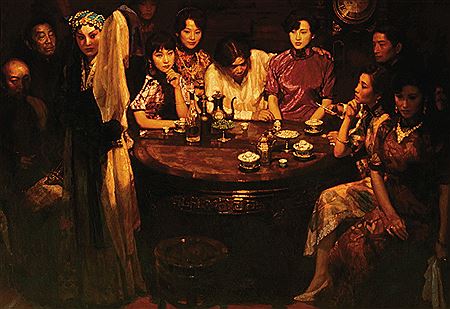
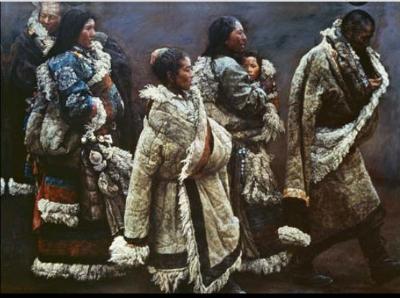
During this decade in the United States he used a darker color scheme and painted women wearing traditional dress with wistful expressions, sometimes playing instruments, Tibetan villagers, and Chinese landscapes. After living in New York for ten years, Yifei returned to Shanghai where his style transitioned to Post-Impressionism and he began to take on pop culture projects, working in collaboration with hotels, modeling agencies, high-end clothing lines, and home furnishing companies. One of his goals during this period was to expose the billions of people living in Communist China to a new lifestyle of beauty and art like they had never seen before.
Yifei made frequent trips to Tibet and the place of his birth to paint landscapes, however he spent the majority of his time in Shanghai, where he lived and worked until his early death due to stomach hemorrhage. Yifei's wife and his two sons survive him.
Yifei's most well-known works are his photographic-like paintings of Chinese women wearing traditional dress, beautifully made-up and accessorized, as well as his landscapes of China's rural areas. The most rare of Yifei's paintings are those he painted during the Cultural Revolution that depict political and revolutionary subject matter. Auctions rarely feature these propaganda style works, as many have been lost or destroyed. Red Flag (1971-1972) is one of the few exceptions, as it was featured in Sotheby's Hong Kong 40th Anniversary Sale in 2013.
Yifei was celebrated for his larger than life-size canvas portraits of Chairman Mao Tse-Tung and his scenes depicting modern Chinese historical events and brave soldiers. These types of paintings were characteristic of Yifei's earliest years as an artist. Yifei's paintings after the Cultural Revolution speak to a rebirth of Chinese identity—one that includes a modern lifestyle and new trends in fashion, movies, and design. This thematic change may have been spurred by the artist's feelings of confinement while working as a propaganda artist for the Communist Party.
In 1979 Yifei painted a self-portrait titled Looking at History from My Space, which shows the artist studying a mural of China's history from the 1910s to 1920s, which was one dominated by European nations hungry for resources and geographic treasures, such as the port at Shanghai. This work is considered to be one of his most unique. Yifei's works have been displayed at the Venice Biennale, the Shanghai Museum, the Marlborough in New Work, and the China National Museum of Fine Arts.
Chen Yiming, Yifei's younger brother, described Yifei's artistic methods to an interviewer after his death. He said, "Yifei took every one of his creations very seriously and each concept took him a long time to develop…because the concepts behind Yifei's works were well developed, both the treatment of the imagery and use of colors, were contrary to certain literary and artistic standards of its time. The response of the general public, after the creation of Red Flag in 1971, had a huge impact on Chen Yifei's overall artistic life. This is also part of the painting's legacy."
The following is a list of selected solo exhibitions:
1980 New England Centre for Contemporary Art, United States (also from 1981-83)
1983 Hammer Gallery, New York (also in 1986, '88 and '90)
1990 'Recent Paintings', Seibu Museum, Tokyo
1996 - 1997
The Homecoming of Chen Yifei, Retrospective Exhibition, Shanghai Museum, Shanghai; The China National Museum of Fine Arts, Beijing
First London Exhibition, Marlborough Fine Art, London
Paintings of Tibet, Pavilion of the People's Republic of China, XLVII Venice Biennale, 1997
Chen Yifei, Première Exposition en France, Musée Granet, Aix-en-Provence
1999 New Works, Marlborough Gallery, New York
2003 Oeuvres Recentes, Marlborough Monte Carlo, Monaco
Source:
Kristin Guess for Tobin Reese Fine ArtBiography from Bonhams Hong Kong
'Shanghai, Shanghai, I come from Shanghai;
Shanghai, Shanghai, I'm fulfilling my dreams of Shanghai.
Dreams of your loving touch, dreams of your intoxication.
Shanghai, Shanghai, how repeatedly I linger in your dreams.'
-- Shanghai, Shanghai, song from the movie Old Dreams of Shanghai
In Chen Yifei's first movie production, 1993's Old Dreams of Shanghai, the above song performed by the lead singer Mao Amin and the Shanghai Symphony Orchestra is a rather accurate footnote for Chen's own surge of feelings for Shanghai.
Chen Yifei was born in 1946 to a culturally refined family in Zhenhai County, Zhejiang Province. His father was a chemical engineer, and his mother, once a nun, often took her children to church for service. From liturgies, as well as the stained glass, sculptures and pipe organ in the church, Chen Yifei received his earliest aesthetic influences. His whole family relocated to Shanghai in the year he was born, where his lifelong attachment to the city began. According to an analysis by the renowned writer Yu Qiuyu about how Shanghai contributed to Chen's cultivation as an artist, 'Shanghai endows Chen Yifei with an academic augustness, and yet there is also allowance in this very quality for keenness and vividness.' (See Yu Qiuyu, 'Impressions of Chen Yifei', in The Homecoming of Chen Yifei: Retrospective Exhibition, Marlborough Fine Art (London) Ltd., Hong Kong, 1996, p.20.)
It was in the Affiliated Middle School of the Shanghai College of Art that Chen Yifei laid a foundation in painting under his formative instructor Meng Guang. In the college itself he studied under Yu Yunjie, who graduated from 'Maksimov's Oil Painting Training Class'. The mentorship not only established his grounding in oil painting, but also nourished him with the techniques of Russian realist oils.
Chen Yifei left in 1980 for America, where he eventually attained his Master's degree at New York's Hunter College four years later. He then travelled frequently between New York and Shanghai. Whether depicting female Western musicians, Chinese ladies dressed in traditional robes, the water towns of Jiangnan or the sights of Tibet, Chen's realist paintings were infused with a sense of beauty rooted in Chinese tradition. His style came to be described by the New York Times as 'Romantic Realism'.
After returning to China in the 1990s, Chen Yifei focused on exploring the theme of Chinese ladies in traditional attire, specifically those of old Shanghai's streets, alleys and boudoirs. These figures came to populate his Old Dreams of Shanghai series of oil paintings. Two Reclining Beauties, painted in 1996, is one of his representative works.Biography from Bonhams Bond Street
Chen Yifei was born in 1946 in Ningbo of the coastal Zhejiang Province. When he was a child, he moved with his family to Shanghai where he studied Russian art and Socialist Realism. He graduated from the Shanghai College of Art in 1965. During the Cultural Revolution, he was initially denounced for 'capitalist behaviour', but later gained recognition from the authorities for his mastery of oil painting.
He was famous for portraying grand images of Chairman Mao and the People Liberation Army. After the Cultural Revolution, he fused realistic techniques with romanticism to depict Chinese subject matters. He later became one of the first artists from the PRC permitted to study in the United States and gained his master's degree at Hunter in 1983.
After achieving great success for his solo exhibition, Chen became a contract artist for the Hammer Galleries. In 1990, Chen returned to China and settled in Shanghai. Chen Yifei's artistic creation successfully pushed Chinese realist oil painting in the West, bridging East and West with its powerful emotional content and refined technique.