Styles ART RESEARCH
Explore art styles, movements, and genres throughout art history
Trompe l'Oeil Painting
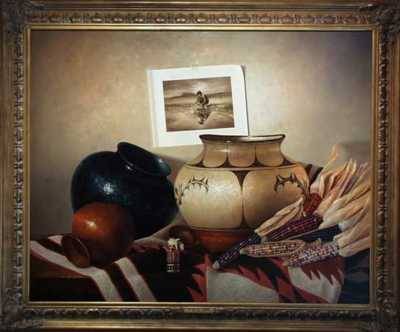
Exemplary ArtistsTrompe l'oeil, a French term meaning to fool, or deceive, the eye, describes a painting that deceives the spectator into thinking that the objects in it are real, not merely represented. To successfully fool the eye of the viewer, trompe l'oeil artists choose objects, situations and compositional devices using as little depth as possible. In this style of painting, also sometimes referred to as illusionism, i.e. creating the illusion of reality, the flat surface stops the eye at the picture plane, while objects placed upon this surface seem to protrude into the viewer's space. Most trompe l'oeil paintings are still-lifes, dealing with objects small enough to be represented in their natural size.
 Within the general
realm of still-life, a distinction may be made between the paintings that
emphasize the products of nature and those that emphasize man-made objects. Not
only may the latter be related to wealth and the acquisition of rare and costly
objects, but there is also a difference for the artists who create them. When
the subject is a few pieces of fruit, for example, an artist tests his ability
not only to imitate nature, but also makes his own choices to rearrange,
emphasize, or investigate the objects. The still-life artist who seeks to
depict objects of metal, ceramic, or glass, for example, is directing himself
more specifically to the spectator – a possible patron or perhaps even an entire
class. It was then perhaps logical that painters of man-made objects pushed one
step farther, into the realm of trompe l'oeil, where desirable, costly
objects were projected, almost literally, into the spectator's world.
Within the general
realm of still-life, a distinction may be made between the paintings that
emphasize the products of nature and those that emphasize man-made objects. Not
only may the latter be related to wealth and the acquisition of rare and costly
objects, but there is also a difference for the artists who create them. When
the subject is a few pieces of fruit, for example, an artist tests his ability
not only to imitate nature, but also makes his own choices to rearrange,
emphasize, or investigate the objects. The still-life artist who seeks to
depict objects of metal, ceramic, or glass, for example, is directing himself
more specifically to the spectator – a possible patron or perhaps even an entire
class. It was then perhaps logical that painters of man-made objects pushed one
step farther, into the realm of trompe l'oeil, where desirable, costly
objects were projected, almost literally, into the spectator's world.
As a painting style, trompe l'oeil has a history extending back as far as 400 B.C. and was part of the rich culture of the Greek and Roman Empires, where horses are said to have neighed at a mural of horses they recognized. The only ancient trompe l'oeil murals that survive today are those unearthed at Pompeii in Italy.
The famous art historian Vasari reports a story of a famous contest of antiquity held between two renowned painters to see who was the finest. The first painter produced a still life so convincing that birds flew down from the sky to peck at the painted grapes. The master then turned to his opponent in triumph and said, "Draw back the curtains and reveal your painting." The second painter knew then that he had won, because the 'curtains' were part of his painting. It is also reported that Rembrandt's students painted coins on the floor of his studio for the pleasure of watching him bend down to pick them up.
Trompe l'oeil , in the form of mural painting, resurfaced during the Renaissance and Baroque eras in Europe, and was used to extend churches and palaces by 'opening' the ceiling or a wall. The muralists of those times - Andrea Mantegna, Paolo Uccello and Paolo Veronese, among the most notable - experimented with perspective and found trompe l'oeil architecture to be their ally as they strove to paint what architect Leone Alberti called 'windows into space'.
In this country, the famous Peale family of Philadelphia helped establish
still-life painting as an acceptable pursuit for the serious artist. One man
however, to an extraordinary degree, molded a change in subject matter in
American still-life painting during the last quarter of the nineteenth century. 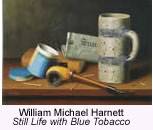 In the mid to late 1800s,
William Harnett
(1848-1892) revived trompe l'oeil still life easel painting, and today his
paintings are highly valued by collectors and museums. Harnett, who was born in
Ireland, moved with his family to Philadelphia where he began to practice the
trade of engraver, which undoubtedly furthered his abilities at precise art. He
later took up painting as his full-time career, but coming from an impoverished
family, was unable to hire models, and so relied on objects around him for
subject matter. His works often suggest the solitary person writing, reading,
or perhaps playing a solo instrument. The tonalities are dark, not the light,
joyous palette of the earlier mid-century. There seems to be a psychological
significance to the paintings by Harnett, and to many of his followers.
In the mid to late 1800s,
William Harnett
(1848-1892) revived trompe l'oeil still life easel painting, and today his
paintings are highly valued by collectors and museums. Harnett, who was born in
Ireland, moved with his family to Philadelphia where he began to practice the
trade of engraver, which undoubtedly furthered his abilities at precise art. He
later took up painting as his full-time career, but coming from an impoverished
family, was unable to hire models, and so relied on objects around him for
subject matter. His works often suggest the solitary person writing, reading,
or perhaps playing a solo instrument. The tonalities are dark, not the light,
joyous palette of the earlier mid-century. There seems to be a psychological
significance to the paintings by Harnett, and to many of his followers.
The trompe l'oeil school represents perhaps, the post- Civil War
pessimism and antisocial tendencies of that time. Although Harnett's paintings
are dark, they are richly colored, and he didn't rely on neutral tones as much
as did his followers Jefferson
David Chalfant (1856-1931),
Richard La Barre Goodwin (1840-1910), or
John Frederick Peto (1854-1907). His arrangements often
suggest wealth, appealing most likely to the moneyed class that had arisen
following the Civil War. Harnett is especially known for having invented, for
American art, the picture of paper money, shown flat. The earliest of these is
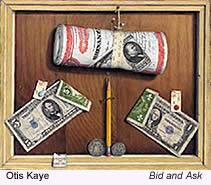
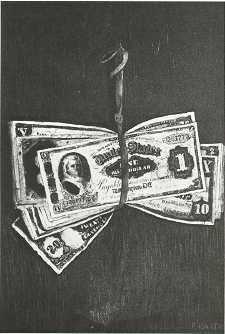
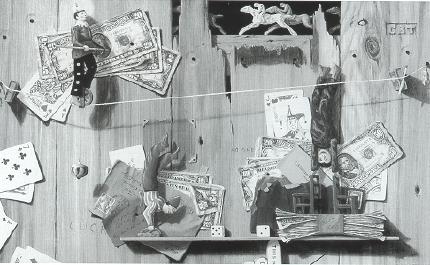
'Five Dollar Note' (1877). 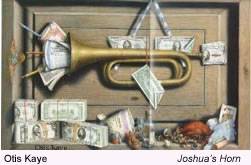 Trompe l'oeil painting of paper currency, fostered by the nineteenth-century
American fascination with wealth, was, and remains, a characteristically
American art form. Artists such as
Nicholas Brooks (1840-1904) and later,
Otis Kaye
(1885-1974) were extremely capable practitioners of the fake money painting
genre, a practice that baffled the Secret Service in the 1800s and resulted in
passage of a bill by Congress in 1909 prohibiting all nonofficial copies of
monetary tokens. These pictures, totally deceptive to the eye, inspired many
other artists of the period, and also ultimately lead to Harnett's arrest on
charges of counterfeiting.
Trompe l'oeil painting of paper currency, fostered by the nineteenth-century
American fascination with wealth, was, and remains, a characteristically
American art form. Artists such as
Nicholas Brooks (1840-1904) and later,
Otis Kaye
(1885-1974) were extremely capable practitioners of the fake money painting
genre, a practice that baffled the Secret Service in the 1800s and resulted in
passage of a bill by Congress in 1909 prohibiting all nonofficial copies of
monetary tokens. These pictures, totally deceptive to the eye, inspired many
other artists of the period, and also ultimately lead to Harnett's arrest on
charges of counterfeiting.
Other artists noted for having created 'deceptive' paintings are Raphaelle Peale (1774-1825) and Frederic Edwin Church (1826-1900), who represented an envelope tacked to a wall. The motivation of these pictures was to fool the eye, as it was for Harnett's famous 'rack' pictures, in which all the elements are flat, from the papers and tapes to the panels themselves. Their aesthetic rationale is not unlike that of many Cubist paintings of the early twentieth century, however different the form they may have taken.
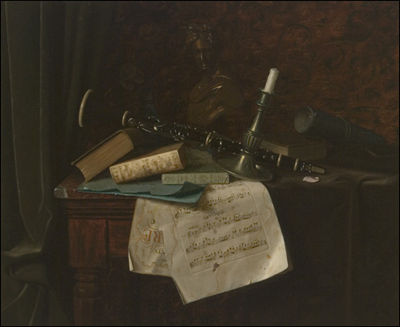
Perhaps the finest of all the followers of Harnett was
Jefferson David Chalfant (1856-1931), whose work is
most often associated with Wilmington Delaware. 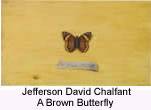 Few of his works are located today, but three of the known ones are violin
pictures. They are less dramatic and simpler than Harnett's, but were obviously
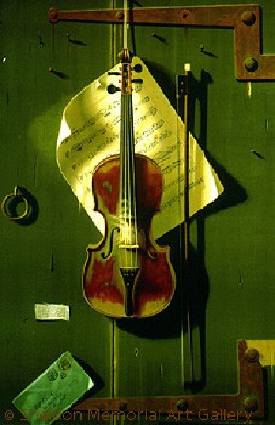
influenced by his 'The Old Violin'. Chalfant's deceptive realism is perhaps
even greater than Harnett's though; in Chalfant's newspapers and music sheets,
all the print can actually be read.
Few of his works are located today, but three of the known ones are violin
pictures. They are less dramatic and simpler than Harnett's, but were obviously
influenced by his 'The Old Violin'. Chalfant's deceptive realism is perhaps
even greater than Harnett's though; in Chalfant's newspapers and music sheets,
all the print can actually be read.
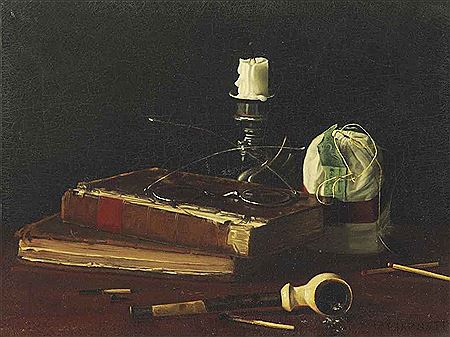
John Frederick Peto (1854-1907) is generally considered the second only to Harnett as the most important artist of the American trompe l'oeil school. Born in Philadelphia, Peto studied at the Pennsylvania Academy, but his greatest influence was Harnett, with whom he was friendly prior to Harnett's departure to travel in Europe. Considerable confusion exists about Peto's work, due to much forgery of his art as the work of Harnett. Although a follower of Harnett, Peto was at times a somewhat crude technician, and occasionally his foreshortening of, for example, pipe stems, does not work, or his matchsticks fail to jut out towards the viewer. Peto chose as his subjects objects that are usually worn and old, never sumptuous or elegant, and his still lifes have been said to be among the most pessimistic in American art. With titles emphasizing the qualities of decrepit old age, they are powerful reflections of post- Civil War pessimism. Later in his career, he became more concerned with light, which kept him from being totally trompe l'oeil . In these later works he did not pursue the precision of Harnett and Chalfant, and luminescent atmosphere blurs the edges of his forms and eliminates such details as script and print. Peto's objects may not seem as 'real' as those of Harnett, but it may be argued that the ambience in which he saturates them seems to breathe and is itself more 'alive'.
Among the painters of the Harnett school, Nicholas Alden Brooks (1840-1904) may be said to have combined competence with a lack of spontaneity. Most interesting of his works are his playbill, poster, and above-mentioned money pictures. In his works, Brooks restrained his color sense and spatial interest to produce overlapping flat surfaces that startlingly precede the analytical Cubist canvases of the following generation.
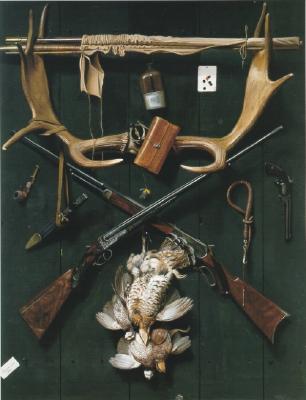
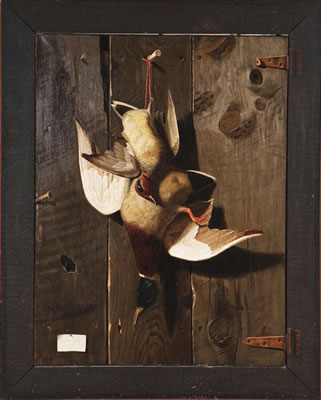
Richard La Barre Goodwin (1840-1910), of New York, is remembered mainly as a painter of hanging game and cabin-door still-lifes, and these pictures show the influence of Harnett's work, 'After the Hunt', Elements used by Harnett figure repeatedly in Goodwin's work, such as the use of a floating feather and a signature carved into a wooden door. By far Goodwin's most famous painting is 'Theodore Roosevelt's Cabin Door' (1905).
George Cope (1855-1929) is also known primarily as a specialist in hanging still-lifes, with subject matter including swords and uniforms, fishing equipment, and the day's hunt. Cope turned from landscape painting to trompe l'oeil around 1890, and in his work he had a tendency to emphasize wood paneling and its grain, and a central bunching of objects. His tabletop still lifes are intriguing for their unbelievably hard drawing, but they are also extremely photographic and show less of the dramatic skill with light that marks his hanging trompe l'oeil pictures.
Also known for door pictures is Alexander Pope (1849-1924), a Boston representative of the illusionistic school. Unlike many of Harnett's followers, he was very successful, and the Tsar of Russia even owned two of his works. Pope also created a considerable body of sculpted works. He was an ardent animal conservationist, and from his ability as an animal painter created another kind of trompe l'oeil picture: animals, -like dogs or chickens-, in simulated wooden crates, with simulated chicken wire netting over them.
Unlike the seriousness of Harnett or the melancholy of Peto, several artists have had an artistic approach to still life that was a humorous one. John Haberle (1853-1933) was perhaps the most talented of these, and he was part of the New Haven trompe l'oeil school. One of his earliest trompe l'oeil pictures is 'Fresh Roasted' (1887), depicting peanuts behind cracked glass. Others of his paintings contain small labels, which can be read, and amusingly are always in praise of the artist. Later in his life Haberle's eyes began to trouble him, and trompe l'oeil became an impractical approach for him.
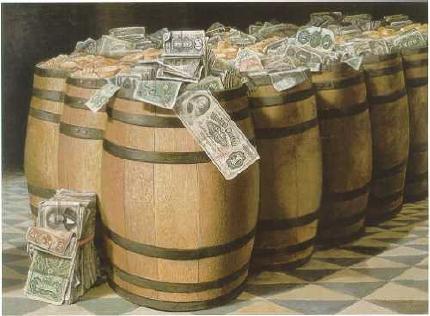
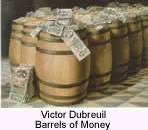 Victor Dubreuil,
(fl 1886-1900) was another humorist, but he lacked Haberle's refinement of
technique. He made up for any lack of subtlety with his enthusiasm for money.
Money was the subject matter of his pictures, whether stacks of coins, barrels
or safes full of bills, picots of single bills, and even pictures of bank
robbers taking money. Crudeness of technique diminishes the success of trompe
l'oeil trickery, and his somewhat coarse handling may be said to mar
the effectiveness of his pictures, as it does some of the works of
F. Danton, Jr.
(1877-1939).
Victor Dubreuil,
(fl 1886-1900) was another humorist, but he lacked Haberle's refinement of
technique. He made up for any lack of subtlety with his enthusiasm for money.
Money was the subject matter of his pictures, whether stacks of coins, barrels
or safes full of bills, picots of single bills, and even pictures of bank
robbers taking money. Crudeness of technique diminishes the success of trompe
l'oeil trickery, and his somewhat coarse handling may be said to mar
the effectiveness of his pictures, as it does some of the works of
F. Danton, Jr.
(1877-1939).
Charles Meurer (1865-1955), who lived and worked outside of Cincinnati, Ohio, can be said to mark the end of the Harnett tradition among well-known American artists in the early part of the 20th century.
The Trompe l'oeil Society of Artists is a recently formed organization
dedicated to keeping alive the tradition of trompe l'oeil in American art.
Founded by two Arizona artists, this member-only group held its first
exhibition in 2002.
Photo-realism, not reflected in this category listing, is a descendent of the trompe
l'oeil tradition and emerged strongly in the late 1960s into the 1970s.
In painting, the results are nearly photographic and in fact the artists relied
on the camera to gather visual information before painting a facsimile of
reality. Among the most highly regarded American photo-realist painters are
Richard Estes (b. 1932), 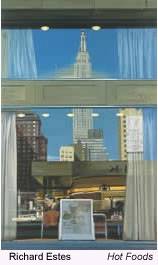 Chuck Close (b. 1940),
Audrey Flack (b. 1931),
Charles Bell
(1935-1995), and Ralph Goings
(b. 1928).
Chuck Close (b. 1940),
Audrey Flack (b. 1931),
Charles Bell
(1935-1995), and Ralph Goings
(b. 1928).
Ceramists Richard Shaw (b. 1941) and Richard Newman (b. 1948) draw on historical precedents as they successfully duplicate, in clay, the optical appearance of familiar objects. Indeed, some observers may be unaware that they are looking at replications and not the actual objects. Sculptures by Americans Duane Hanson (1925-1996) and John DeAndrea (b. 1941) are painted casts made from models to which real body hair are attached, Hanson even adding real clothing and props to his works. In exalting mundane objects---tin cans, bricks, a castoff cardboard box, a baseball glove or objects seemingly rescued from trash heaps, -these 20th century artists maintain ties to traditional trompe l'oeil expressions and invite ongoing interpretations of American culture.
Credit for much of the above information is given to William H. Gerdts and Russell Burke, authors of American Still-Life Painting .
If you have information to contribute on this subject, contact us via email: registrar@askART.com
Artists Connected to Trompe l'Oeil Painting
John Zang
Born 1859 • New York, California / Georgia
Landscape, trompe l'oeil still life
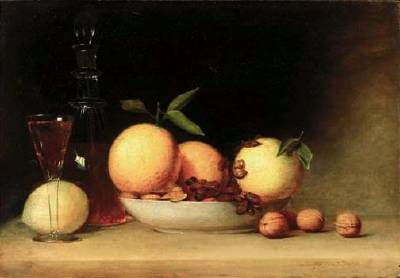
Raphaelle Peale
1774 - 1825 • Pennsylvania, Maryland
Still-life, portraits, and figure painting
Alexander Pope Jr
1849 - 1924 • Massachusetts
Dogs, still life, wildlife and trompe l'oeil doors-painting
Ferdinand Danton Jr
1877 - 1939 • New York
Artwork used for forgery, trompe still life-currency, portrait painting
George Forster
1817 - 1896 • New York / Germany
Trompe still life, landscape and genre painting
George Platt
1839 - 1899 • Illinois, Colorado
Trompe l'oeil, survey artist, portrait
William Michael Harnett
1848 - 1892 • Pennsylvania, New York
Trompe l'oeil still life painting, hanging game
Claude Claudine Raguet Hirst
1855 - 1942 • New York, Ohio
Still life-often trompe, sculptor
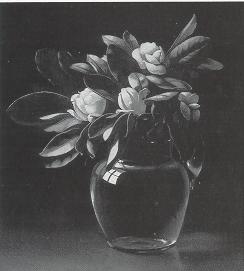
Victor Dubreuil
1846 - 1946 • New York / France
Trompe still life, genre, landscape
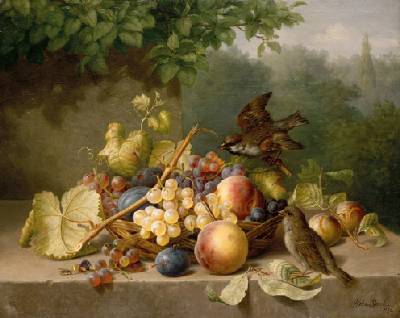
Helen Searle
1830 - 1884 • Vermont, New York, Illinois
Still life-fruit-trompe l'oeil
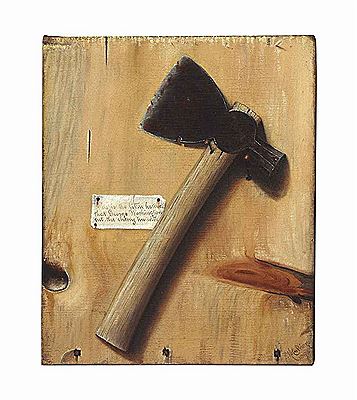
Peter McCallion
fl.1890 - 1900 • New Jersey
Trompe still life-money, figure, genre
Showing 20 artists