RaeHyun Park PRICE CHARTS
1920 - 1976. Known for: Painting.
Uhyang Park Rae-hyun, the wife of Unbo Kim Ki-chang, was an artist who began her career with polychrome painting and continuously shifted her mediums and modes of expression, eventually expanding her... Read full biography
Uhyang Park Rae-hyun, the wife of Unbo Kim Ki-chang, was an artist who began her career with polychrome painting and continuously shifted her mediums and modes of expression, eventually expanding her scope to include printmaking and tapestry. While her early works—influenced by the polychrome... Read full biography
Uhyang Park Rae-hyun, the wife of Unbo Kim Ki-chang, was an artist who began her career with polychrome painting and continuously shifted her mediums and modes of expression, eventually expanding her scope to include printmaking and tapestry. While her early works—influenced by the polychrome painting techniques she learned in Japan—depicted figures and scenes of daily life in a realistic manner, her style evolved after the 1950s toward a method of simplifying subjects and meticulously... Read full biography
Uhyang Park Rae-hyun, the wife of Unbo Kim Ki-chang, was an artist who began her career with polychrome painting and continuously shifted her mediums and modes of expression, eventually expanding her scope to include printmaking and tapestry. While her early works—influenced by the polychrome painting techniques she learned in Japan—depicted figures and scenes of daily life in a realistic manner, her style evolved after the 1950s toward a method of simplifying subjects and meticulously organizing the pictorial space through linear outlines and the geometric division of planes. Her compositions typically established a structure centered on the main subject before arranging surrounding elements, maintaining a balance between equilibrium and... Read full biography
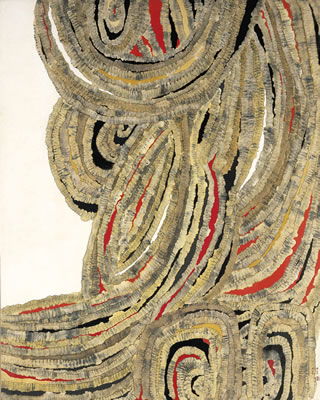
Uhyang Park Rae-hyun, the wife of Unbo Kim Ki-chang, was an artist who began her career with polychrome painting and continuously shifted her mediums and modes of expression, eventually expanding her scope to include printmaking and tapestry. While her early works—influenced by the polychrome painting techniques she learned in Japan—depicted figures and scenes of daily life in a realistic manner, her style evolved after the 1950s toward a method of simplifying subjects and meticulously organizing the pictorial space through linear outlines and the geometric division of planes. Her compositions typically established a structure centered on the main subject before arranging surrounding elements, maintaining a balance between equilibrium and tension through the interplay of intersecting lines and planes. In the early 1960s, coinciding with the *Informel* movement, her work moved away fro... Read full biography