Birger Kaipiainen began his career at the Arabia Art Department in 1937 and quickly found his own way to make art. The soon-to-begin Winter War and several losses in his personal life cast a dark... Read full biography
Birger Kaipiainen began his career at the Arabia Art Department in 1937 and quickly found his own way to make art. The soon-to-begin Winter War and several losses in his personal life cast a dark shadow over the beginning of his artistic career, and this manifested as sadness and longing in his... Read full biography
Birger Kaipiainen began his career at the Arabia Art Department in 1937 and quickly found his own way to make art. The soon-to-begin Winter War and several losses in his personal life cast a dark shadow over the beginning of his artistic career, and this manifested as sadness and longing in his early works. They are dominated by ethereal, fairy-tale-like characters depicted in pastel tones, with references to early Italian Renaissance and longing for a more beautiful world.In the 1950s,... Read full biography
Birger Kaipiainen began his career at the Arabia Art Department in 1937 and quickly found his own way to make art. The soon-to-begin Winter War and several losses in his personal life cast a dark shadow over the beginning of his artistic career, and this manifested as sadness and longing in his early works. They are dominated by ethereal, fairy-tale-like characters depicted in pastel tones, with references to early Italian Renaissance and longing for a more beautiful world.In the 1950s, Kaipiainen introduced three-dimensionality and graphic stylization in his work. The colour scheme also gradually became darker and more intense. Kaipiainen spent the years 1954–1958 in Sweden working as a studio artist at the Rörstrand porcelain factory.... Read full biography
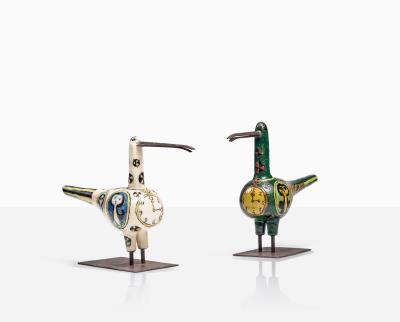
Birger Kaipiainen began his career at the Arabia Art Department in 1937 and quickly found his own way to make art. The soon-to-begin Winter War and several losses in his personal life cast a dark shadow over the beginning of his artistic career, and this manifested as sadness and longing in his early works. They are dominated by ethereal, fairy-tale-like characters depicted in pastel tones, with references to early Italian Renaissance and longing for a more beautiful world.In the 1950s, Kaipiainen introduced three-dimensionality and graphic stylization in his work. The colour scheme also gradually became darker and more intense. Kaipiainen spent the years 1954–1958 in Sweden working as a studio artist at the Rörstrand porcelain factory. During that time, the artist could fulfil oneself and his production became progressively inspired by surrealism. A re... Read full biography
Birger Kaipiainen - Art Prices in Auction LotsAuction Lots