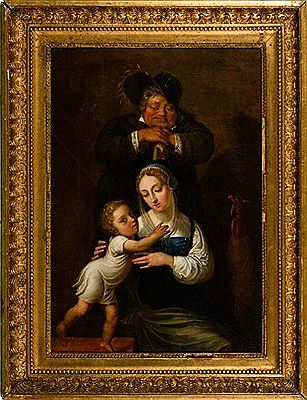
1797 - 1855. Known for: Painting.
Carl Wilhelm Tischbein was first taught to paint by his father Friedrich Tischbein (1750-1812), the so-called "Leipziger Tischbein", and following his father's death by Ferdinand Hartmann in Dresden,...
Read full biography Carl Wilhelm Tischbein was first taught to paint by his father Friedrich Tischbein (1750-1812), the so-called "Leipziger Tischbein", and following his father's death by Ferdinand Hartmann in Dresden, where he made acquaintance with Anton Graff. Following stays in Rome (1816-1818), Bonn, Leipzig,...
Read full biography Carl Wilhelm Tischbein was first taught to paint by his father Friedrich Tischbein (1750-1812), the so-called "Leipziger Tischbein", and following his father's death by Ferdinand Hartmann in Dresden, where he made acquaintance with Anton Graff. Following stays in Rome (1816-1818), Bonn, Leipzig, Frankfurt and Brussels, he became court painter in Bückeburg under Duke Georg Wilhelm von Schaumburg-Lippe in 1829 as the successor of Wilhelm Strack.
Carl Wilhelm Tischbein was first taught to paint by his father Friedrich Tischbein (1750-1812), the so-called "Leipziger Tischbein", and following his father's death by Ferdinand Hartmann in Dresden, where he made acquaintance with Anton Graff. Following stays in Rome (1816-1818), Bonn, Leipzig, Frankfurt and Brussels, he became court painter in Bückeburg under Duke Georg Wilhelm von Schaumburg-Lippe in 1829 as the successor of Wilhelm Strack.
Carl Wilhelm Tischbein was first taught to paint by his father Friedrich Tischbein (1750-1812), the so-called "Leipziger Tischbein", and following his father's death by Ferdinand Hartmann in Dresden, where he made acquaintance with Anton Graff. Following stays in Rome (1816-1818), Bonn, Leipzig, Frankfurt and Brussels, he became court painter in Bückeburg under Duke Georg Wilhelm von Schaumburg-Lippe in 1829 as the successor of Wilhelm Strack.