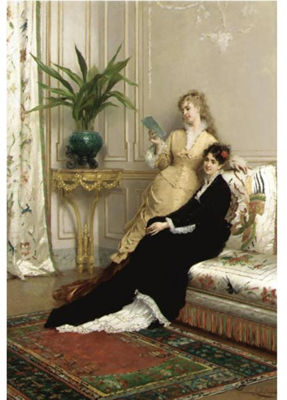
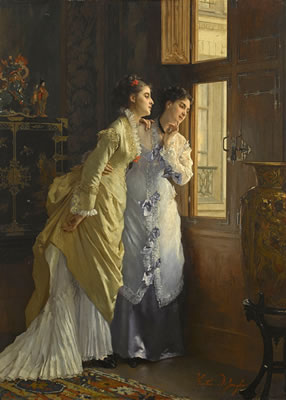
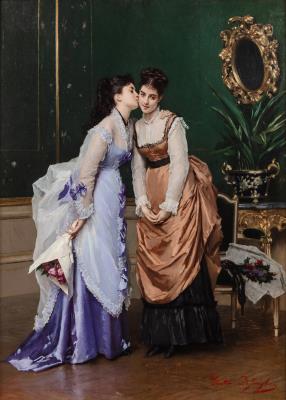
Gustave de Jonghe was born in Kortrijk, Belgium in 1829. As a young man he studied with his father, painter Jean Baptiste de Jonghe, and later with Louis Gallait and François Joseph Navez, Belgium's... Read full biography
Gustave de Jonghe was born in Kortrijk, Belgium in 1829. As a young man he studied with his father, painter Jean Baptiste de Jonghe, and later with Louis Gallait and François Joseph Navez, Belgium's most important pupil of Jacques-Louis David, in Brussels. Following the style of his teachers,... Read full biography
Gustave de Jonghe was born in Kortrijk, Belgium in 1829. As a young man he studied with his father, painter Jean Baptiste de Jonghe, and later with Louis Gallait and François Joseph Navez, Belgium's most important pupil of Jacques-Louis David, in Brussels. Following the style of his teachers, Jonghe's early works tended toward historical and religious subjects, portraits, and later, genre scenes. In 1855 he moved to Paris where fellow Belgian, Alfred Stevens, was gaining notoriety for his... Read full biography
Gustave de Jonghe was born in Kortrijk, Belgium in 1829. As a young man he studied with his father, painter Jean Baptiste de Jonghe, and later with Louis Gallait and François Joseph Navez, Belgium's most important pupil of Jacques-Louis David, in Brussels. Following the style of his teachers, Jonghe's early works tended toward historical and religious subjects, portraits, and later, genre scenes. In 1855 he moved to Paris where fellow Belgian, Alfred Stevens, was gaining notoriety for his paintings of elegant high-society women in their finery set in grand interiors. De Jonghe easily adapted his style to emulate the popular Stevens and established himself as an important painter of the Second Empire's upper crust. Several Paris engravers... Read full biography
Gustave de Jonghe was born in Kortrijk, Belgium in 1829. As a young man he studied with his father, painter Jean Baptiste de Jonghe, and later with Louis Gallait and François Joseph Navez, Belgium's most important pupil of Jacques-Louis David, in Brussels. Following the style of his teachers, Jonghe's early works tended toward historical and religious subjects, portraits, and later, genre scenes. In 1855 he moved to Paris where fellow Belgian, Alfred Stevens, was gaining notoriety for his paintings of elegant high-society women in their finery set in grand interiors. De Jonghe easily adapted his style to emulate the popular Stevens and established himself as an important painter of the Second Empire's upper crust. Several Paris engravers including Lasalle, Deblois, and Cooper popularized his best works through engravings. His paintings earned... Read full biography
Gustave Jonghe - Art Prices in Auction LotsAuction Lots